TB-500 vs TB4 (thymosin beta-4): are they the same thing?
Reviewed 28 sourcesPublished by PepVault
TB-500 vs TB4: TB-500 is 7 of thymosin beta-4's 43 amino acids with an acetyl cap. How labels differ, and what the full protein's human trials found.

- Last reviewed
- Sources
- 28
- Questions
- 7
- Compounds
- 3
The short answer
No. Thymosin beta-4, often shortened to TB4, is a natural protein of 43 amino acids. TB-500 is a synthetic copy of seven of them, LKKTETQ at positions 17 to 23, with an acetyl group capping one end, so it carries about 18% of the protein's mass. Every human trial so far used the whole protein. TB-500 itself has never been tested in people.
- TB-500 is Ac-LKKTETQ: 7 of thymosin beta-4's 43 amino acids plus an acetyl cap, 889 g/mol against about 4,963.
- Every human trial used the whole protein; the FDA found no human data on TB-500 itself.
- The best-known fragment result used the uncapped peptide. In a dish, TB-500 itself did not speed wound closing; one of its breakdown pieces did.
- To tell which molecule a label means, read its sequence and molecular weight, not its name.
Evidence: Thymosin beta-4: small human trials as eye drops, a skin gel and an IV, with the two largest eye trials posting results close to placebo. TB-500 itself: chemistry, cell and animal studies only; no human study.
What exactly is TB-500, chemically?
Start with the parent. Thymosin beta-4 is a chain of 43 amino acids, the building blocks of proteins, whose first link carries an acetyl group, a small two-carbon cap1. Its main job is to hold single units of actin, the protein cells build their internal scaffolding from, and keep them from joining into filaments until the cell needs them. In resting human platelets it holds most of the actin not yet assembled2.
TB-500 is seven links from the middle of that chain. Anti-doping chemists in Belgium identified the key ingredient of a product sold as TB-500 as Ac-LKKTETQ: positions 17 to 23 of thymosin beta-4, with an acetyl cap on the first amino acid3. A racing laboratory in Hong Kong described TB-500 as a veterinary preparation built on the same peptide4. The FDA's briefing for its July 2026 committee meeting gives the same definition and a molecular weight of 889.01 g/mol5; the whole protein weighs about 4,9631.
| Feature | Thymosin beta-4 (TB4) | TB-500 |
|---|---|---|
| What it is | A natural protein made in the body's cells12 | A synthetic peptide copying one stretch of it35 |
| Length | 43 amino acids | 7 amino acids (positions 17 to 23) |
| Sequence | Ac-SDKPDMAEIEKFDKSKLKKTETQEKNPLPSKETIEQEKQAGES1 | Ac-LKKTETQ3 |
| Molecular weight | About 4,963 g/mol1 | 889.01 g/mol; 949.1 as the acetate salt5 |
| Trials in people | Eye drops, skin gel and IV (below) | None found by the FDA5 |
| Half-life measured in people | 0.5 to 2.08 hours after an IV dose of the recombinant protein19 | Never measured5 |
| WADA 2026 | Banned at all times, S2.326 | Banned at all times, named as a derivative26 |
The Peptide Sky draws both, one bead per amino acid, side by side.
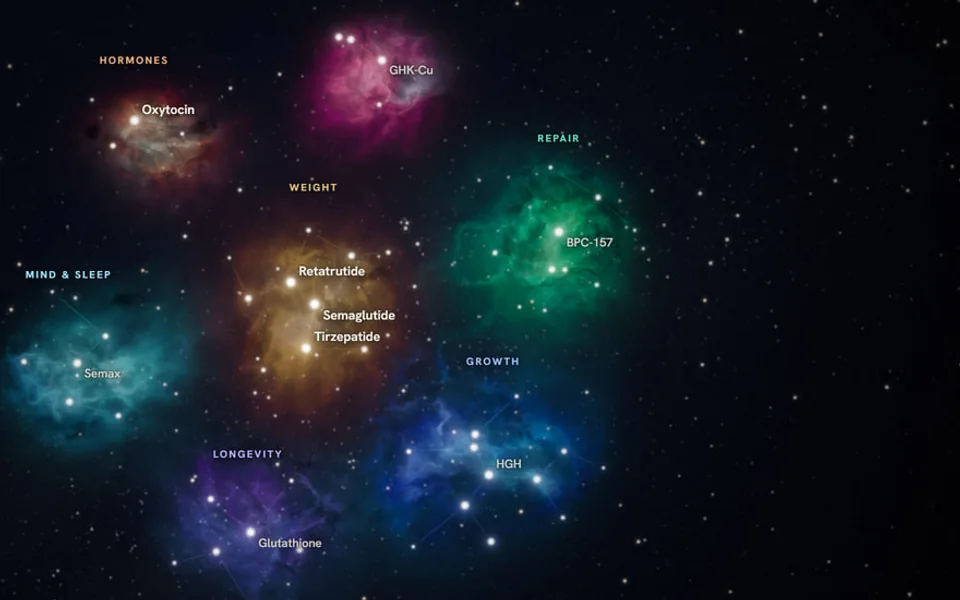 Peptide SkySee Thymosin Beta-4 as a molecule53 peptides as a night sky in 3D. Each star opens into its molecule, one bead per amino acid, with the measured shape where one exists.Open the Peptide Sky

PepVault for iPhone
Keep your protocol in PepVault
PepVault's vial record keeps the strength printed on the label and a batch note, so what the label said stays with that vial and the doses you take from it.

7 days free on the yearly plan for new subscribers.
Why do sellers and papers mix the two names up?
Partly the shorthand: TB4 is the usual abbreviation for the whole protein, and TB-500 is a common name, not an official drug name. The FDA's briefing says the agency "has encountered multiple salts, and derivatives, including different active moieties, sold commercially under the same common name"5. An active moiety is the part of a molecule that does the work, so a different one is a different drug.
The paperwork the FDA reviewed shows the problem in miniature. The one nomination asked for TB-500 free base, but its certificate of analysis described the acetate salt, and neither its molecular formula nor its second CAS number, the registry number for a substance, matched either form. The three studies it cited were all studies of thymosin beta-45.
Research papers blur it too. The 2026 rat study that found TB-500 strengthened repaired Achilles tendons calls its peptide "synthetic thymosin beta-4 (TB-500)" and names a commercial product without giving a sequence9. From the paper alone, you cannot tell which molecule the rats got.
A third molecule adds to the tangle: Ac-SDKP, the first four amino acids of thymosin beta-41, from the other end of the chain. In rats, an enzyme called prolyl oligopeptidase cuts it from the whole protein10, and in healthy volunteers given it by IV it cleared with a half-life of 4.5 minutes11. TB-500 does not contain it; our short page on TB-500 vs Ac-SDKP compares the two.
How can you tell which molecule a label means?
The name on a vial settles nothing; the chemistry printed beside it does.
- Find the sequence. Ac-LKKTETQ, seven letters, is TB-5003. A 43-letter chain that starts Ac-SDKPDMAE is thymosin beta-41. Ac-SDKP alone, four letters, is the starting piece, whatever the label calls it.
- Check the molecular weight. About 889 g/mol is TB-500 free base and 949.1 its acetate salt5. About 4,963 is the whole protein, and about 488 is Ac-SDKP1.
- Read the CAS number with care. The FDA lists 885340-08-9 for TB-500 free base and notes that several suppliers' websites use the same number for the acetate salt5.
- Treat a label with no sequence, weight or certificate as silent: it does not say which molecule is inside.
PepVault's vial record keeps the strength printed on the label and a batch note, so what the label said stays with that vial and the doses you take from it. Track your vials in PepVault
Our guide to reading a peptide certificate of analysis covers the rest of that document.
Does the seven-amino-acid piece work like the whole protein?
Only in part, and the evidence for that part comes with a catch. In thymosin beta-4, the stretch LKKTET is known as the actin-binding region5. But a crystal structure of thymosin beta-4 bound to actin shows it capping the actin unit at both ends6. TB-500 copies only the middle stretch.
The animal result most often quoted for TB-500 used a different molecule. In 26-month-old mice with skin wounds, a synthetic LKKTETQ promoted repair about as well as the whole protein7, but that peptide had no acetyl cap. The FDA's reviewers point out that acetylation changes a peptide's charge, size and binding, so the uncapped result "cannot be directly extrapolated" to TB-5005.
When TB-500 itself was tested, the picture shifted. In a 2024 study from Korea's doping control centre, TB-500 did not speed the closing of scratch wounds in fibroblasts, the cells that build connective tissue, in a dish. One of its breakdown pieces, Ac-LKKTE, did8. In rats, TB-500 broke down mainly to Ac-LK within six hours, and the piece Ac-LKK was still detectable at 72 hours8. In horses given 10 mg under the skin, TB-500 in the blood peaked at 60 to 120 minutes and fell below measurable levels by 6 to 10 hours5.
Species note: the wound results are in mice and in cells in a dish, and the breakdown data in rats and horses. No study has measured what TB-500 does, or how long it lasts, in people5.
The whole protein also carries what the fragment lacks, including Ac-SDKP at its starting end10, and all 43 amino acids went into the human trials below.
What did the human trials of thymosin beta-4 find?
Thymosin beta-4 has reached people as eye drops (RGN-259), a skin gel and an IV, lately as a recombinant version made in China. The record, as of November 2026:
| Trial | Form and people | What it found |
|---|---|---|
| Severe dry eye, phase 2 (2015) | Eye drops, 9 patients | At day 56, discomfort 35.1% and corneal staining 59.1% lower than with a plain solution12 |
| Dry eye, phase 2 (2015) | Eye drops, 72 people | Missed both main goals; discomfort 27% lower in a dry-air chamber on day 28, a secondary goal13 |
| ARISE-2, dry eye (completed 2018) | Eye drops, 601 people | Posted: discomfort changed 0.07 vs −0.04 on placebo, staining 0.07 vs −0.0114 |
| ARISE-3, dry eye (completed 2021) | Eye drops, 700 people | Posted: staining changed −0.41 vs −0.46 on placebo, discomfort −0.4 vs −0.415 |
| SEER-1, non-healing corneal defect, phase 3 (2022) | Eye drops, 18 people | Fully healed at 4 weeks: 6 of 10 vs 1 of 8 on placebo (p = 0.0656)16 |
| Venous leg ulcers, phase 2 (2010) | Skin gel, 73 patients | Safety comparable to placebo; about 25% healed fully within 3 months17 |
| Healthy volunteers, phase 1 (2010) | IV daily for 14 days, 40 people | No serious adverse events at 42 to 1,260 mg18 |
| Healthy volunteers, phase 1 (2021) | Recombinant IV, 84 people | No serious adverse events19 |
| STEMI heart attack, randomized (2025) | Recombinant IV, 96 patients | No overall difference in infarct size at 90 days; smaller in the 43 dosed within 8 hours of the artery reopening20 |
Read together: small trials found wins in the eye, while the two largest, with 1,301 people between them, posted results in which drops and placebo moved almost identically1415. Authors of the corneal and heart papers worked for the drug's developers1620. The IV trials found it well tolerated1819. A phase 2 trial of the recombinant injection in heart attack, for an estimated 189 patients, was not yet recruiting at its last update on May 14, 202627.
Does the thymosin beta-4 data apply to TB-500?
No study has built that bridge. The FDA searched PubMed, Embase and ClinicalTrials.gov and found no clinical studies of TB-500 in humans5, and it has not identified any human exposure data for the fragment22. An October 2026 orthopaedic review calls TB-500 a distinct fragment "frequently conflated with full-length TB-4 despite the absence of validated biologic or clinical equivalence"21. It also finds the whole protein's evidence for muscle, tendon and bone limited to cell and rodent studies21.
Commonly reported: with TB-500, stubborn soft-tissue injuries loosening up and range of motion returning over a few weeks; mild irritation where the needle went in, and sometimes a day of tiredness or a short head rush that passes on its own.
These are user reports, not trial results, and they cannot say which molecule was in the vial.
In PepVault, TB-500 and thymosin beta-4 are separate entries in the library, so your protocol and each dose you log carry the name of the one you chose. Log it in PepVault
Where do TB-500 and thymosin beta-4 stand with the FDA and WADA?
As of November 2026, neither is an FDA-approved drug: Drugs@FDA lists no application for either28. The FDA's list of compounding substances that may present significant safety risks names "Thymosin beta-4, fragment (LKKTETQ), also known as TB-500", for a possible immune reaction by some routes, peptide impurities and no human exposure data (page current as of April 22, 2026)22.
On July 23, 2026, the FDA put TB-500 for wound healing to its Pharmacy Compounding Advisory Committee and proposed that it not join the 503A bulks list, the ingredients pharmacies may compound with523. The FDA's page does not post the vote; Healio reported 8 to 6, with one abstention, in favor24. The committee only advises: as of November 16, 2026, TB-500 is not on the list25.
For tested athletes the difference does not matter: the World Anti-Doping Agency's 2026 list bans "Thymosin-β4 and its derivatives e.g. TB-500" at all times, under growth factors26. Our legal-status pages for both keep these lines dated.
Sources
- UniProt. P62328, Thymosin beta-4 (TMSB4X), Homo sapiens: sequence and processing (accessed November 20, 2026). rest.uniprot.org
- Safer D, Elzinga M, Nachmias VT. Thymosin beta 4 and Fx, an actin-sequestering peptide, are indistinguishable. J Biol Chem. 1991. PubMed 1999398
- Esposito S et al. Synthesis and characterization of the N-terminal acetylated 17-23 fragment of thymosin beta 4 identified in TB-500, a product suspected to possess doping potential. Drug Test Anal. 2012. PubMed 22962027
- Ho EN et al. Doping control analysis of TB-500, a synthetic version of an active region of thymosin β4, in equine urine and plasma by liquid chromatography-mass spectrometry. J Chromatogr A. 2012. PubMed 23084823
- U.S. Food and Drug Administration. FDA Briefing Document, Pharmacy Compounding Advisory Committee, July 23-24, 2026: TB-500-related bulk drug substances (TB-500 free base and TB-500 acetate). fda.gov
- Irobi E et al. Structural basis of actin sequestration by thymosin-beta4: implications for WH2 proteins. EMBO J. 2004. PubMed 15329672
- Philp D et al. Thymosin beta 4 and a synthetic peptide containing its actin-binding domain promote dermal wound repair in db/db diabetic mice and in aged mice. Wound Repair Regen. 2003. PubMed 12581423
- Rahaman KA et al. Simultaneous quantification of TB-500 and its metabolites in in-vitro experiments and rats by UHPLC-Q-Exactive orbitrap MS/MS and their screening by wound healing activities in-vitro. J Chromatogr B. 2024. PubMed 38382158
- Biçer O et al. Effects of BPC-157 and TB-500 on Achilles tendon healing in rats: a histopathological and biomechanical study. Jt Dis Relat Surg. 2026 (abstract and methods). PubMed 42542926
- Cavasin MA et al. Prolyl oligopeptidase is involved in release of the antifibrotic peptide Ac-SDKP. Hypertension. 2004. PubMed 15037553
- Ezan E et al. Pharmacokinetics in healthy volunteers and patients of NAc-SDKP (seraspenide), a negative regulator of hematopoiesis. Drug Metab Dispos. 1994. PubMed 7895600
- Sosne G, Dunn SP, Kim C. Thymosin β4 significantly improves signs and symptoms of severe dry eye in a phase 2 randomized trial. Cornea. 2015. PubMed 25826322
- Sosne G, Ousler GW. Thymosin beta 4 ophthalmic solution for dry eye: a randomized, placebo-controlled, phase II clinical trial conducted using the controlled adverse environment (CAE) model. Clin Ophthalmol. 2015. PubMed 26056426
- ReGenTree. RGN-259 ophthalmic solutions for dry eye syndrome: ARISE-2 (NCT02974907), posted results. ClinicalTrials.gov. clinicaltrials.gov
- ReGenTree. RGN-259 ophthalmic solutions for dry eye syndrome: ARISE-3 (NCT03937882), posted results. ClinicalTrials.gov. clinicaltrials.gov
- Sosne G et al. 0.1% RGN-259 (thymosin ß4) ophthalmic solution promotes healing and improves comfort in neurotrophic keratopathy patients in a randomized, placebo-controlled, double-masked phase III clinical trial. Int J Mol Sci. 2022. PubMed 36613994
- Guarnera G et al. The effect of thymosin treatment of venous ulcers. Ann N Y Acad Sci. 2010. PubMed 20536470
- Ruff D et al. A randomized, placebo-controlled, single and multiple dose study of intravenous thymosin beta4 in healthy volunteers. Ann N Y Acad Sci. 2010. PubMed 20536472
- Wang X et al. A first-in-human, randomized, double-blind, single- and multiple-dose, phase I study of recombinant human thymosin β4 in healthy Chinese volunteers. J Cell Mol Med. 2021. PubMed 34346165
- Zhang Y et al. Recombinant human thymosin beta 4 improves ischemic cardiac dysfunction in mice and patients with acute ST-segment elevation myocardial infarction after reperfusion. Cardiovasc Res. 2025. PubMed 41229390
- Tham A, Hodgkins CW, Kennedy JG. Investigational peptides in orthopaedic practice: evidence, safety, and patient counseling for BPC-157, thymosin beta-4, and TB-500. J Am Acad Orthop Surg. 2026. PubMed 42937313
- U.S. Food and Drug Administration. Certain bulk drug substances for use in compounding that may present significant safety risks (content current as of April 22, 2026). fda.gov
- U.S. Food and Drug Administration. July 23-24, 2026: Meeting of the Pharmacy Compounding Advisory Committee (content current as of August 6, 2026). fda.gov
- Bascom E. FDA committee recommends looser restrictions for several peptides. Healio. July 24, 2026. healio.com
- 21 CFR 216.23, Bulk drug substances that can be used to compound drug products in accordance with section 503A (eCFR, as of November 16, 2026). ecfr.gov
- World Anti-Doping Agency. The 2026 Prohibited List: S2.3 growth factors and growth factor modulators. wada-ama.org
- Beijing Northland Biotech. Recombinant human thymosin beta 4 for injection (NL005) for acute myocardial infarction (NCT07586865). ClinicalTrials.gov. clinicaltrials.gov
- U.S. Food and Drug Administration. Drugs@FDA (openFDA drugsfda endpoint), searched for thymosin and for TB-500 as an active ingredient, November 20, 2026: no matches. api.fda.gov
Newsletter · Weekly
The weekly peptide briefing.
New guides, the week’s peptide news, one tool. Free, one email a week, unsubscribe anytime.
PepVault for iPhone
Keep your protocol in PepVault
Log every dose, track every vial, and see your protocol come together.
7 days free on the yearly plan for new subscribers.