TB-500 Dosage, half-life & reference guide
Also known as Thymosin Beta-4 Fragment · TB4
A fragment of thymosin beta-4, a protein your body uses for cell repair. TB-500 copies the part of the protein that handles actin, the scaffolding cells use to move, so it helps repair cells reach injured tissue.

- Studied range
- 1–2.5 mg
- How often
- 2× weekly
- Half-life
- ~0.5–2 hours
- Evidence
- ●
●●Emerging - Routes
- SubQ, IM
Studied in research — not a recommendation.
How it works.
Synthetic fragment of Thymosin Beta-4: Ac-LKKTETQ, the 7-amino-acid stretch (residues 17–23) that binds actin. The whole protein holds actin building blocks back from forming filaments, a reserve cells draw on when they move. In lab and rodent studies the fragment drew blood-vessel cells, sped wound repair in aged mice and strengthened repaired tendons in rats; the anti-inflammatory findings are for the whole protein. Loading phase 2x/week then drop to maintenance.
Commonly reported: Stubborn soft-tissue injuries loosening up, with range of motion returning over a few weeks. Its own research is a few animal studies; the human trials tested the whole protein. Often paired with BPC-157.
Half-life & active level
The half-life of TB-500 is ~0.5–2 hours (measured for the whole protein, thymosin beta-4, given IV to healthy volunteers; TB-500 itself has never been measured in people).
Here's how a typical TB-500 schedule plays out over 48 hours (one-compartment estimate).
An estimate from the half-life above, not a measurement. See your own curve build live in the half-life calculator.
Where TB-500 works.
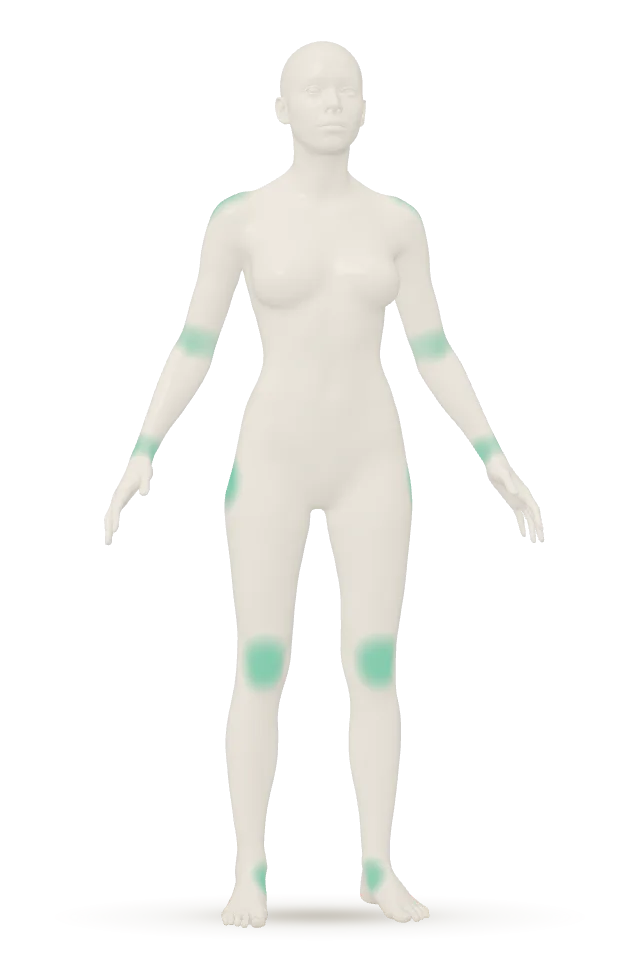
Joints & tendons
In animals. In lab and rodent studies the fragment drew blood-vessel cells, sped wound repair in aged mice and strengthened repaired tendons in rats.
An area lights for what a peptide is used for and what people report, with the evidence beside it. It isn’t a promise that it works there.
Week by week.
What to expect in the first 8 weeks
- Onset
- 1–2 weeks
- Peak effect
- 4–6 weeks
- Duration
- 4–8 weeks
Day 1–7Animal
Week one: set your baseline
Commonly reported in week one: not much yet, sometimes less stiffness or swelling around the injury. TB-500 helps repair cells move into damaged tissue, structural work that takes weeks to feel. Note how the injury moves and hurts today so you have a baseline.
The science
Thymosin beta-4 binds single actin units and keeps them from forming filaments (Safer 1991); TB-500 copies the LKKTETQ stretch where that binding happens. The migration figures are for the whole protein in a dish: thymosin beta-4 drew 2–3 times more skin cells (keratinocytes) through a porous membrane within 4–5 hours than medium alone (Malinda 1999). The LKKTETQ piece on its own matched the whole protein at drawing blood-vessel cells in lab tests (Philp 2003). No study has timed the first week in people.
Sources- Malinda et al. (1999)
- Philp et al. (2003)
- Safer et al. (1991)
Updated Sep 2026
Day 7–14Animal
Stiffness often starts to ease
Commonly reported around weeks 1 to 2: stiffness easing and range of motion starting to open up, especially in chronic injuries. Early changes vary a lot from person to person; the structural repair underneath takes longer.
The science
The day-4 and day-7 figures are for the whole protein, not TB-500: in rats with full-thickness skin wounds, thymosin beta-4 put on the wound or injected into the abdominal cavity increased new skin cover over the wound by 42% over saline at day 4 and by up to 61% at day 7 (Malinda 1999). The 7-amino-acid LKKTETQ piece matched the whole protein on wound repair in aged mice (Philp 2003). No study has measured TB-500 in people.
Sources- Malinda et al. (1999)
- Philp et al. (2003)
Updated Sep 2026
Day 14–28Community
Load tolerance often picks up
Commonly reported in weeks 2 to 4: the injury handles more load, and chronic soft-tissue problems start to feel like recovery rather than injury. Build load gradually; how the injury responds is the best read on whether it's working for you.
The science
A 2010 review by thymosin beta-4's developer lists the whole protein's lab and animal properties, including cell migration, blood vessel growth and stem cell differentiation (Crockford 2010); none has been tested for the TB-500 fragment in people. The week 2–4 pattern on this card comes from user reports, not from a study.
Sources- Crockford et al. (2010)
Updated Sep 2026
Day 28–42Animal
Gains slow, repair keeps going
Around week four, most people report the obvious gains slowing while range of motion keeps creeping up. New tissue is reorganizing underneath; in a 2026 rat study, TB-500 left repaired tendons stronger and better organized at four weeks. Compare your range of motion and pain against day 1.
The science
Biçer 2026: 32 rats had an Achilles tendon cut and repaired, then 4 weeks of daily treatment injected into the abdominal cavity, in groups of 8: none, BPC-157, TB-500, or both. TB-500 alone significantly raised the load the tendons took before failing and improved their Bonar and Movin tissue scores, with more organized type I collagen; BPC-157 alone trended the same way without reaching significance. The study ended at 4 weeks.
Sources- Biçer et al. (2026)
Updated Sep 2026
Day 42–56Community
Weeks 6 to 8: how far it's come
Community protocols commonly load for 4 to 6 weeks, then drop to once a week or stop; no study has tested either pattern, and the one tendon study of the fragment ended at week 4. How do range of motion and pain compare with day 1?
The science
In phase 2 venous-ulcer trials of the whole protein (not TB-500), healing came about a month sooner than on placebo among patients who healed (Treadwell 2012). No study has followed TB-500 past four weeks: the one tendon study of the fragment ended at week 4 (Biçer 2026).
Sources- Treadwell et al. (2012)
- Guarnera et al. (2010)
- Biçer et al. (2026)
Updated Sep 2026
Any dayClinical
What TB-500 is built on
Read this distinction carefully: every human study is of full-length Thymosin Beta-4, the parent protein — there are zero human trials of the 7-amino-acid TB-500 fragment people actually inject. The fragment is the protein's actin-binding stretch and has a few animal studies of its own, but the human evidence belongs to the parent, not the molecule in your vial.
The science
RegeneRx ran phase 2 trials of full-length Tβ4 applied to venous stasis ulcers (NCT00832091) and pressure ulcers; among patients who healed, healing came about a month sooner (Treadwell 2012). The community "TB-500" is Ac-LKKTETQ, the N-acetylated 7-amino-acid actin-binding stretch of Tβ4, residues 17–23 (Esposito 2012; Ho 2012). It was not the molecule tested in those trials, no human study of it has been published, and FDA (April 2026) says it has found no human exposure data. In a fibroblast wound-closure test in a dish, acetylated TB-500 itself showed no significant activity while its breakdown product Ac-LKKTE did (Rahaman 2024). WADA has banned Tβ4 since 2011.
Sources- Guarnera et al. (2010)
- Treadwell et al. (2012)
- Esposito et al. (2012)
- Rahaman et al. (2024)
Updated Sep 2026
With BPC-157Community
The classic healing combo
The pair is popular because each covers a different part of repair: TB-500 helps repair cells move into damaged tissue, while BPC-157 works on local tendon and gut repair. Commonly reported: faster recovery from tendon and ligament injuries. How your own injury handles load over the next few weeks is the best read on whether it's working for you.
The science
Biçer 2026: 32 rats had an Achilles tendon cut and repaired, then 4 weeks of daily treatment injected into the abdominal cavity, in groups of 8: none, BPC-157, TB-500, or both. TB-500 alone significantly raised the load the tendons took before failing and improved their tissue scores; BPC-157 alone trended the same way without reaching significance; the combination added nothing over either alone. The authors suggest the two may converge on shared downstream pathways, which is untested. Before this study, the pairing rested only on mechanisms from separate studies.
Sources- Biçer et al. (2026)
- Seiwerth et al. (2018)
- Philp et al. (2003)
Updated Sep 2026
Day 1 is the day you start it.
Parent compound (Thymosin Beta-4) has human clinical data. TB-500 fragment primarily animal data and community reports.
Preliminary research
Mixing and a typical run.
Example numbers
Reconstitution example
Reconstitute a 10 mg vial of TB-500 with 2 mL of bacteriostatic water and a 2 mg dose is 40 units on a U-100 syringe, about 5 doses per vial.
- Vial
- 10 mg
- Water
- 2 mL
- Amount
- 2 mg
Draw to40 units
0.5 mL insulin syringe · 50 units
Run notes
- Cycle
- Loading phase 2x/week for 4–6 weeks, then maintenance 1x/week or stop. Common to cycle 6–8 weeks on, time off.Community practice — opinions vary. Not a clinical recommendation.
- Timing
- Timing flexible. SubQ or IM, rotate sites.
- Routes
- SubQ injection, IM injection
- Stacks
- BPC-157, GHK-Cu
Safety.
Common side effects
- Injection site reaction
- Fatigue
- Nausea
- Headache
- Lethargy
Interactions
No published interaction data exists for TB-500 with SSRIs, anticoagulants, antidiabetics, or thyroid medication. Mechanistically it shares no obvious pathway with these classes, but the absence of study means caution is warranted rather than reassurance. When stacked with other healing peptides (e.g. BPC-157) the combined proangiogenic effect is a theoretical consideration worth raising with a clinician.
Safety notes
Published human safety data is sparse and comes almost entirely from topical/IV thymosin beta-4 (Tβ4) wound-healing trials — not injected TB-500 — where no serious drug-related adverse events were reported (tolerability generally acceptable, effects mild and transient). FDA (April 2026) says it has found no human exposure data for TB-500 and flags a possible risk of immune reactions to compounded versions. Community-reported effects include transient injection-site irritation, head-rush, mild headache, and lethargy. Because Tβ4 promotes angiogenesis and has a documented role in cell migration, a theoretical malignancy concern is noted in the literature; discuss with your clinician.
Compared with.
Questions people ask.
What is TB-500?
A fragment of thymosin beta-4, a protein your body uses for cell repair. TB-500 copies the part of the protein that handles actin, the scaffolding cells use to move, so it helps repair cells reach injured tissue.
How is TB-500 dosed in research?
The research range for TB-500 is 1–2.5 mg. 2x/week loading, 1–2mg/week maintenance. Studied in research — not a recommendation.
How long does TB-500 last?
The half-life of TB-500 is ~0.5–2 hours (measured for the whole protein, thymosin beta-4, given IV to healthy volunteers; TB-500 itself has never been measured in people).
What do people report on TB-500?
Commonly reported on TB-500: stubborn soft-tissue injuries loosening up, with range of motion returning over a few weeks. Its own research is a few animal studies; the human trials tested the whole protein. Often paired with BPC-157.
Is TB-500 safe?
The research basis for TB-500 is emerging: primarily preclinical / limited human data. Common side effects in the library: injection site reaction, fatigue, nausea, headache and lethargy.
What does TB-500 stack with?
Common stacks for TB-500: BPC-157 and GHK-Cu. Curated stacks with TB-500: GLOW, KLOW and Wolverine.
Reference.
- Cadence
2× weekly
2x/week loading, 1–2mg/week maintenance
- Half-life
~0.5–2 hours
~0.5–2 hours (measured for the whole protein, thymosin beta-4, given IV to healthy volunteers; TB-500 itself has never been measured in people)
- Research basis
●
●●EmergingPrimarily preclinical / limited human data
PepVault for iPhone
Track TB-500 in PepVault
Log every dose, keep your vial and the doses left in it and watch its estimated active level. 7 days free on the yearly plan for new subscribers.

Open the calculatorHow the vial count worksExplore the live demo
Reviewed How we check the library