Thymosin Beta-4 Dosage, half-life & reference guide
Also known as Tβ4 · Full TB4
The full-length version of the protein TB-500 is cut from. In animal studies it speeds tissue repair, supports new blood vessel growth and helps cells survive under stress, and the whole protein carries signals the fragment lacks.

- Studied range
- 2–2.5 mg
- How often
- Weekly
- Half-life
- ~0.5–2 hours
- Evidence
- ●
●●Emerging - Routes
- SubQ, IM
Studied in research — not a recommendation.
How it works.
Full-length Thymosin Beta-4 (as opposed to the TB-500 fragment). In cell and animal studies it promotes tissue repair, angiogenesis and cell survival. Regulates actin dynamics and plays a role in embryonic development and wound healing.
Commonly reported: Less nagging joint and soft-tissue pain and stiffness over a few weeks, and sometimes tiredness for a day after injecting. Its human trials are small eye-drop and skin-gel studies; injected use for injuries hasn't been tested in people.
Where Thymosin Beta-4 works.
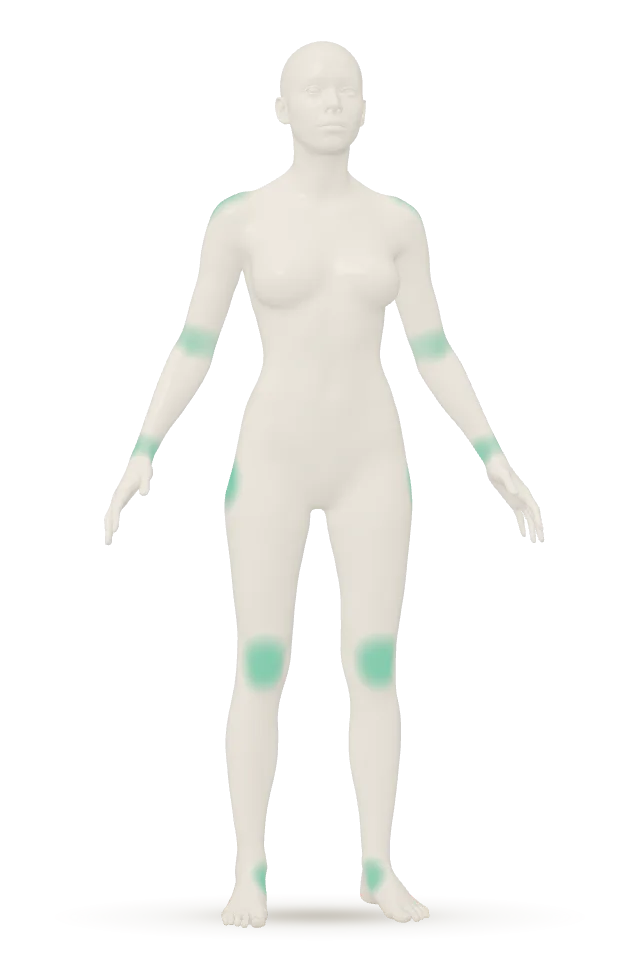
Joints & tendons
In animals. Commonly reported: less nagging joint and soft-tissue pain and stiffness over a few weeks.
An area lights for what a peptide is used for and what people report, with the evidence beside it. It isn’t a promise that it works there.
Week by week.
What to expect in the first 8 weeks
Day 1–14Clinical
The full protein, not the fragment
Unlike TB-500, you're running the whole thymosin beta-4 protein, which carries its full set of signals: actin regulation, cell migration and anti-inflammatory activity in lab studies. Commonly reported: little change in the first two weeks, sometimes a day of tiredness after a dose.
The science
Full-length Tβ4 (43 amino acids) contains the complete actin-binding domain and additional signaling sequences absent in the TB-500 fragment. It regulates actin polymerization, promotes cell migration to wound sites, and activates anti-inflammatory pathways via NF-κB modulation.
Sources- Goldstein et al. (2012)
- Crockford et al. (2010)
Updated Apr 2026
Day 14–28Community
Weeks 2 to 4: how the injury responds
Commonly reported in weeks 2 to 4: less nagging pain and stiffness, especially in older injuries, and easier recovery between sessions. It helps repair cells move in and new blood vessels form. How the injury handles load is your best read.
The science
In rats with skin wounds, thymosin beta-4 increased new blood vessels at days 4 and 7 (Malinda 1999). The one published heart-attack trial, a 2025 phase 2 of IV recombinant thymosin beta-4 in 96 patients, found no overall reduction in infarct size, though the 43 patients dosed within 8 hours of their procedure had smaller infarcts (Zhang 2025). No trial has tested injected thymosin beta-4 for injuries.
Sources- Malinda et al. (1999)
- Zhang et al. (2025)
Updated Sep 2026
With BPC-157Community
Full Tβ4 + BPC-157: local plus body-wide
BPC-157 works on local repair at the injury site, while full thymosin beta-4 helps repair cells move in from further afield. Commonly reported: faster recovery from stubborn soft-tissue injuries.
The science
BPC-157 acts through VEGFR2/nitric oxide signaling (local angiogenesis); thymosin beta-4 through actin regulation and cell migration. Both rest mostly on animal work. No study has combined full thymosin beta-4 with BPC-157; the one combination test, the TB-500 fragment with BPC-157 in 32 rats, found no added benefit over either alone (Biçer 2026).
Sources- Goldstein et al. (2012)
- Sikiric et al. (2018)
- Biçer et al. (2026)
Updated Sep 2026
Any dayClinical
What full Tβ4 is built on
Full-length thymosin beta-4 has more human research than the TB-500 fragment: small phase 2 trials of eye drops for dry eye and a gel for leg ulcers, plus IV safety studies. Injected use for injuries hasn't been tested in people; that rests on animal studies and user reports, and there's less community experience than with TB-500.
The science
Phase 2 trials: dry eye (eye drops, 9 patients, improved signs and symptoms; Sosne 2015) and venous leg ulcers (topical, 73 patients, "may have the potential to accelerate wound healing"; Guarnera 2010). IV phase 1 in healthy volunteers found it well tolerated (Ruff 2010). A 2025 phase 2 of IV recombinant thymosin beta-4 in 96 heart-attack patients found no overall reduction in infarct size, though the 43 dosed within 8 hours of their procedure had smaller infarcts (Zhang 2025). The full protein retains signaling domains that the TB-500 fragment lacks.
Sources- Sosne et al. (2015)
- Guarnera et al. (2010)
- Ruff et al. (2010)
- Zhang et al. (2025)
Updated Sep 2026
Day 1 is the day you start it.
Mixing and a typical run.
Example numbers
Reconstitution example
Reconstitute a 10 mg vial of Thymosin Beta-4 with 2 mL of bacteriostatic water and a 2 mg dose is 40 units on a U-100 syringe, about 5 doses per vial.
- Vial
- 10 mg
- Water
- 2 mL
- Amount
- 2 mg
Draw to40 units
0.5 mL insulin syringe · 50 units
Run notes
- Cycle
- Shorter cycles than TB-500 typical — 4–6 weeks. Less community data than TB-500 fragment.Community practice — opinions vary. Not a clinical recommendation.
- Timing
- SubQ or IM. Timing flexible.
- Routes
- SubQ injection, IM injection
- Stacks
- BPC-157, GHK-Cu
Safety.
Common side effects
- Injection site reaction
- Fatigue
- Headache
Compared with.
Questions people ask.
What is Thymosin Beta-4?
The full-length version of the protein TB-500 is cut from. In animal studies it speeds tissue repair, supports new blood vessel growth and helps cells survive under stress, and the whole protein carries signals the fragment lacks.
How is Thymosin Beta-4 dosed in research?
The research range for Thymosin Beta-4 is 2–2.5 mg, weekly. Studied in research — not a recommendation.
How long does Thymosin Beta-4 last?
The half-life of Thymosin Beta-4 is ~0.5–2 hours (given IV to healthy volunteers).
What do people report on Thymosin Beta-4?
Commonly reported on Thymosin Beta-4: less nagging joint and soft-tissue pain and stiffness over a few weeks, and sometimes tiredness for a day after injecting. Its human trials are small eye-drop and skin-gel studies; injected use for injuries hasn't been tested in people.
Is Thymosin Beta-4 safe?
The research basis for Thymosin Beta-4 is emerging: primarily preclinical / limited human data. Common side effects in the library: injection site reaction, fatigue and headache.
What does Thymosin Beta-4 stack with?
Common stacks for Thymosin Beta-4: BPC-157 and GHK-Cu.
Research.
Reference.
- Cadence
Weekly
- Half-life
~0.5–2 hours
~0.5–2 hours (given IV to healthy volunteers)
- Research basis
●
●●EmergingPrimarily preclinical / limited human data
PepVault for iPhone
Track Thymosin Beta-4 in PepVault
Log every dose and keep your vial and the doses left in it. 7 days free on the yearly plan for new subscribers.

Open the calculatorHow the vial count worksExplore the live demo
Reviewed How we check the library