VIP Dosage, half-life & reference guide
Also known as Vasoactive Intestinal Peptide · VIP neuropeptide
A neuropeptide your body uses to relax blood vessels and steer immune signaling; in animal studies it's a powerful anti-inflammatory. It's used mostly as a nasal spray in protocols for chronic inflammatory response syndrome (CIRS) and mold illness.

- Studied range
- 50 mcg
- How often
- 2× daily
- Half-life
- ~2 min IV
- Evidence
- ●●
●Moderate - Routes
- Intranasal, SubQ
Studied in research — not a recommendation.
How it works.
Neuropeptide with potent anti-inflammatory effects in animal and cell studies; it also relaxes blood vessels and helps regulate the autonomic nervous system. Its effect on mast cells is mixed: in human mast cells in the lab it can trigger them. Used mainly in CIRS (chronic inflammatory response syndrome) and mold-illness protocols, a use that rests on open-label case series from one clinical group.
Commonly reported: Flushing or lightheadedness soon after a dose, especially early on, and for people on those protocols a slow lift in brain fog and fatigue over weeks to months. The human evidence is small open-label case series.
Where VIP works.
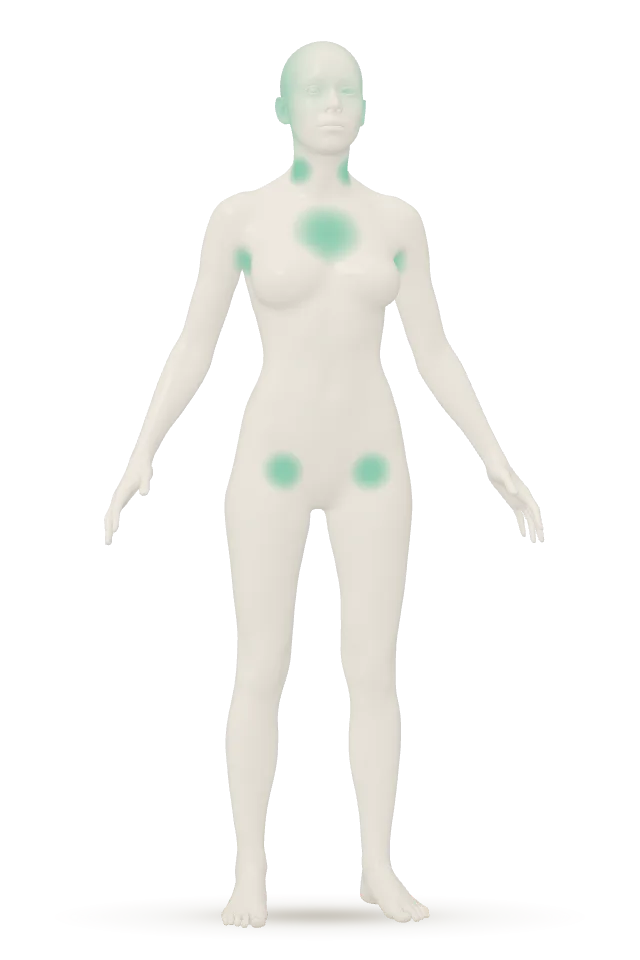
Brain, nerves & sleep
Reported by users. Commonly reported by people on CIRS protocols: a slow lift in brain fog and fatigue over weeks to months.
Immune system
In animals. Neuropeptide with potent anti-inflammatory effects in animal and cell studies; it also relaxes blood vessels and helps regulate the autonomic nervous system.
An area lights for what a peptide is used for and what people report, with the evidence beside it. It isn’t a promise that it works there.
Week by week.
What to expect in the first 8 weeks
Day 1–14Community
The first two weeks
Commonly reported in the first two weeks: flushing, warmth or lightheadedness soon after a dose, which tends to settle, and for some less reactivity to smells and chemicals. Flushing and low blood pressure are more likely at higher doses.
The science
VIP binds VPAC1/VPAC2 receptors and damps Th1/Th17 cytokine output in animal and cell studies (Delgado & Ganea 2013); in human mast cells in the lab it can trigger degranulation (Kulka 2008). Nasal dosing aims to reach the olfactory mucosa and nearby brain directly, around its short half-life in blood; that hasn't been measured in people. The protocols monitor lipase: one patient in the 2013 series had a brief rise that resolved (Shoemaker 2013).
Sources- Delgado & Ganea (2013)
- Kulka et al. (2008)
- Shoemaker et al. (2013)
Updated Sep 2026
Day 14–60Community
A slow arc, not a quick change
Commonly reported by people on CIRS protocols: a slow lift in brain fog and fatigue over weeks to months. The lab markers these protocols track (TGF-β1, MMP-9 and others) were rechecked at 12 and 18 months in the one published series, so expect a long arc rather than a quick change.
The science
In a 20-patient open-label series, C4a, TGF-β1, MMP-9 and VEGF had normalized when rechecked at 12 and 18 months of nasal VIP (Shoemaker 2013). The protocol requires mold avoidance first, and there was no control group.
Sources- Shoemaker et al. (2013)
Updated Sep 2026
Any dayClinical
What VIP is built on
Widely used in CIRS protocols, lightly studied. VIP is a well-characterized natural neuropeptide; its nasal use rests on small open-label case series from one clinical group, under practitioner guidance.
The science
Shoemaker's group published the CIRS protocol papers showing VIP's effect on innate inflammation markers (Shoemaker 2013; Shoemaker 2017), but mainstream research uptake has been limited. The largest controlled trial of synthetic VIP (aviptadil, IV) in 461 patients with COVID-19 respiratory failure found no benefit: 90-day deaths were 38% vs 36% on placebo (TESICO 2023). Endogenous VIP has wide physiological roles (vasodilation, GI motility, circadian regulation); exogenous dosing aims at the anti-inflammatory signaling specifically.
Sources- Shoemaker et al. (2013)
- Shoemaker et al. (2017)
- Delgado & Ganea (2013)
- TESICO Study Group (2023)
Updated Sep 2026
With BPC-157 and LL-37Community
An inflammation-focused trio
Three angles at once: VIP to damp inflammation, LL-37 against microbes, and BPC-157 for gut and tissue repair. Used together in some mold-illness practitioner protocols; no study has tested the combination.
The science
Each peptide targets a different node: VIP (cytokine suppression), LL-37 (antimicrobial/biofilm), BPC-157 (tissue regeneration). No combined trial exists; the stack pattern comes from functional/integrative practice where multi-mechanism attack is considered necessary for stubborn CIRS presentations.
Sources- Shoemaker et al. (2017)
Updated Apr 2026
After week 8
Day 60–120Clinical
The long arc
The published series ran 18 months, so these later months are still part of the arc. Commonly reported by those who respond: better exercise tolerance and steadier energy. Compare with how you felt before starting.
The science
The 2013 open-label series (20 patients, 18+ months) reports exercise pulmonary artery systolic pressure and estradiol/testosterone normalizing at 12–18 months (Shoemaker 2013). There was no control group, and no controlled trial of nasal VIP exists.
Sources- Shoemaker et al. (2013)
Updated Sep 2026
Day 1 is the day you start it.
Mixing and a typical run.
Example numbers
Reconstitution example
Reconstitute a 5 mg vial of VIP with 5 mL of bacteriostatic water and a 50 mcg dose is 5 units on a U-100 syringe, about 100 doses per vial.
- Vial
- 5 mg
- Water
- 5 mL
- Amount
- 50 mcg
Draw to5 units
0.3 mL insulin syringe · 30 units
Run notes
- Cycle
- Used in defined cycles in CIRS protocols, often 4+ weeks. Practitioner guidance recommended.Community practice — opinions vary. Not a clinical recommendation.
- Timing
- Intranasal: 2x daily. Separate doses by at least 6 hours.
- Routes
- Intranasal (primary), SubQ injection
- Stacks
- BPC-157, LL-37
Safety.
Common side effects
- Flushing
- Hypotension at higher doses
- Headache
- Lightheadedness
Questions people ask.
What is VIP?
A neuropeptide your body uses to relax blood vessels and steer immune signaling; in animal studies it's a powerful anti-inflammatory. It's used mostly as a nasal spray in protocols for chronic inflammatory response syndrome (CIRS) and mold illness.
How is VIP dosed in research?
The research range for VIP is 50 mcg, 2x daily, intranasal. Studied in research — not a recommendation.
How long does VIP last?
The half-life of VIP is ~2 min IV; intranasal lasts longer locally.
What do people report on VIP?
Commonly reported on VIP: flushing or lightheadedness soon after a dose, especially early on, and for people on those protocols a slow lift in brain fog and fatigue over weeks to months. The human evidence is small open-label case series.
Is VIP safe?
The research basis for VIP is moderate: animal studies + some human data. Common side effects in the library: flushing, hypotension at higher doses, headache and lightheadedness.
What does VIP stack with?
Common stacks for VIP: BPC-157 and LL-37.
Research.
Reference.
- Cadence
2× daily
2x daily, intranasal
- Half-life
~2 min IV
~2 min IV; intranasal lasts longer locally
- Research basis
●●
●ModerateAnimal studies + some human data
PepVault for iPhone
Track VIP in PepVault
Log every dose and keep your vial and the doses left in it. 7 days free on the yearly plan for new subscribers.

Open the calculatorHow the vial count worksExplore the live demo
Reviewed How we check the library