KPV Dosage, half-life & reference guide
Also known as Lys-Pro-Val · α-MSH tripeptide
One of the smallest bioactive peptides: three amino acids from the tail end of α-MSH. In cell and mouse studies it's a powerful inflammation regulator that enters cells and blocks NF-κB, the master switch for inflammatory signals; the appeal is calming inflammation without the broad immune suppression of steroids.

- Studied range
- 100–300 mcg
- How often
- Daily
- Evidence
- ●
●●Emerging - Routes
- SubQ, Oral
Studied in research — not a recommendation.
How it works.
C-terminal tripeptide of α-MSH. A potent anti-inflammatory in cell and mouse studies that works mainly inside cells rather than through melanocortin receptors: it enters through the PepT1 transporter and blocks NF-κB signaling. In mice it eased colitis and damped allergic skin reactions; as eye drops it sped corneal wound healing in rabbits; in lab dishes it slowed Staphylococcus aureus and Candida albicans.
Commonly reported: A calmer gut and calmer skin. No human study has tested it yet.
Where KPV works.
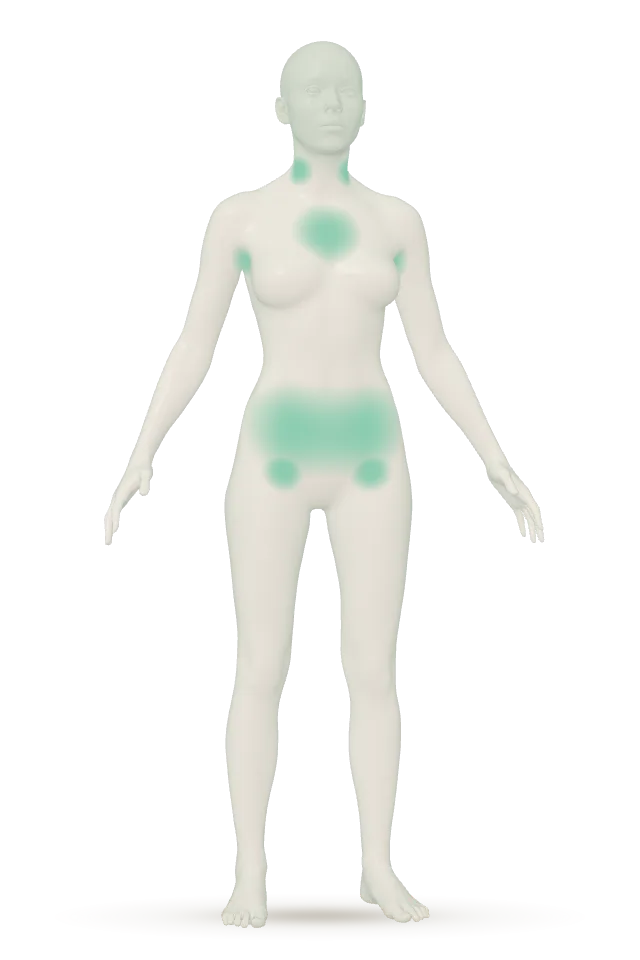
Skin & hair
In animals. In mice, KPV given systemically or on the skin damped allergic skin reactions.
Immune system
In animals. A potent anti-inflammatory in cell and mouse studies that works mainly inside cells rather than through melanocortin receptors.
Gut
In animals. In mouse colitis studies, KPV-treated mice had less colon inflammation and recovered sooner.
An area lights for what a peptide is used for and what people report, with the evidence beside it. It isn’t a promise that it works there.
Week by week.
What to expect in the first 8 weeks
- Onset
- 1–2 weeks
- Peak effect
- 4–6 weeks
- Duration
- 4–8 weeks
Day 1–7Animal
Week one: your starting point
KPV calms inflammatory signaling from inside cells: in human gut cells in a dish it blocked NF-κB at nanomolar concentrations, and in mice it eased colitis. Commonly reported: a calmer gut, with less bloating or cramping, often with oral capsules. How your gut or skin feels today is the baseline the coming weeks compare with.
The science
Dalmasso 2008: in human gut-lining cells (Caco2-BBE, HT29-Cl.19A) and T cells (Jurkat) in a dish, nanomolar KPV blocked NF-κB and MAP-kinase inflammatory signaling and cut inflammatory cytokine output; it entered the cells through PepT1, a peptide transporter. Given to mice in their drinking water, it eased colitis, checked 8 days after DSS and 48 hours after TNBS. No study has timed its effects in people.
Sources- Dalmasso et al. (2008)
Updated Sep 2026
Day 7–21Animal
Users often report a calmer gut
Commonly reported: a calmer gut, with less bloating or cramping, often with oral capsules. Damping inflammatory signaling gives the gut lining room to recover; in mouse colitis studies, KPV-treated mice had less colon inflammation and recovered sooner. No study has timed this in people.
The science
Dalmasso 2008: with KPV in their drinking water, mice given DSS lost less weight by day 8, their colon MPO activity (a marker of inflammatory cells) was about 50% lower, their colon tissue looked less inflamed and inflammatory cytokine mRNA fell; after TNBS, MPO was about 30% lower at 48 hours. Kannengiesser 2008: in DSS colitis and in T-cell transfer colitis, KPV-treated mice recovered earlier, regained more weight and had fewer inflammatory infiltrates. Carried to the colon in nanoparticles, KPV also sped healing of the gut lining in mice (Xiao 2017). No study has timed any of this in people.
Sources- Dalmasso et al. (2008)
- Kannengiesser et al. (2008)
- Xiao et al. (2017)
Updated Sep 2026
Day 21–42Animal
Some report calmer skin
Commonly reported: calmer, less reactive skin, whether KPV is used on the skin or alongside gut protocols. That traces back to α-MSH, the hormone it is cut from, which damps skin inflammation in animal studies; in mice, KPV given systemically or on the skin damped allergic skin reactions. No study has tested it on skin in people.
The science
Luger 2003, a review from the Münster group: in a mouse model of contact hypersensitivity, KPV given systemically or on the skin inhibited both the sensitization and the elicitation phase and induced tolerance to the allergen. In mice, KPV also reduced ear swelling from picryl chloride in a dose-related way (Hiltz & Lipton 1989). As eye drops, it sped the healing of scraped corneas in rabbits (Bonfiglio 2006), and in lab dishes it slowed Staphylococcus aureus and Candida albicans (Cutuli 2000). No study has tested KPV on skin in people.
Sources- Luger et al. (2003)
- Hiltz & Lipton (1989)
- Bonfiglio et al. (2006)
- Cutuli et al. (2000)
Updated Sep 2026
Day 42–56Community
Weeks 6 to 8: taking stock
Community gut protocols commonly run 4 to 8 weeks. The research hasn't followed KPV longer: its mouse studies ran from two days to 13 weeks, and no study has given it to people. How do your symptoms compare with day 1?
The science
KPV's mouse studies were built to test inflammation, not safety: mice drank it for 8 days in a DSS colitis study (Dalmasso 2008) and for 13 weeks in a gut-tumour model (Viennois 2016). No toxicity study has been published. FDA's compounding list (April 2026): FDA "has not identified any human exposure data on drug products containing KPV administered via any route of administration" and lacks information on whether it would cause harm in people.
Sources- Dalmasso et al. (2008)
- Viennois et al. (2016)
Updated Sep 2026
Any dayAnimal
What KPV is built on
KPV is the last three amino acids of α-MSH, a hormone of ancient origin that damps inflammation. Its research is cell and animal work: mouse colitis studies from several labs, skin and eye studies in animals, and lab-dish tests. No study has given KPV to people, and how it works is only partly mapped: it enters cells through the PepT1 transporter and blocks NF-κB, but its exact target isn't settled.
The science
Dalmasso 2008 (Gastroenterology) showed KPV entering human gut cells through the PepT1 transporter and blocking NF-κB and MAP-kinase signaling at nanomolar concentrations; in human airway cells it kept NF-κB's p65 subunit out of the nucleus (Land 2012). It doesn't cause the skin darkening of MT-2 and other melanocortins: it lacks the sequence melanocortin receptors bind and showed no pigmenting action (Brzoska 2010), and its anti-inflammatory effect held in mice without a working MC1R (Getting 2003; Kannengiesser 2008). No study has given KPV to people, and FDA (April 2026) has found no human exposure data. Carriers that aim it at the inflamed colon, such as nanoparticles, are being tested in mice (Xiao 2017; Zhang 2024).
Sources- Dalmasso et al. (2008)
- Land (2012)
- Brzoska et al. (2010)
- Getting et al. (2003)
- Kannengiesser et al. (2008)
- Xiao et al. (2017)
- Zhang et al. (2024)
Updated Sep 2026
With BPC-157Community
Why KPV pairs with BPC-157 for gut
Two angles on the gut: KPV damps the inflammatory signal upstream, and BPC-157 supports healing of the gut lining downstream. Together they calm the damage and repair it at the same time. Commonly reported: a calmer gut.
The science
KPV blocked NF-κB and MAP-kinase signaling in human intestinal cells and eased colitis in mice (Dalmasso 2008). BPC-157 sped gut healing in rat models (Sikiric 2018 review). The two have never been tested together; the pairing rests on those separate mechanisms and on community experience.
Sources- Dalmasso et al. (2008)
- Sikiric et al. (2018)
Updated Sep 2026
Day 1 is the day you start it.
Preclinical studies only. Community data set is smaller than other healing peptides.
Preliminary research
Mixing and a typical run.
Example numbers
Reconstitution example
Reconstitute a 5 mg vial of KPV with 2 mL of bacteriostatic water and a 200 mcg dose is 8 units on a U-100 syringe, about 25 doses per vial.
- Vial
- 5 mg
- Water
- 2 mL
- Amount
- 200 mcg
Draw to8 units
0.3 mL insulin syringe · 30 units
Run notes
- Cycle
- 4–8 weeks typical for gut protocols. Can reassess after each cycle.Community practice — opinions vary. Not a clinical recommendation.
- Timing
- Oral: with or without food. SubQ: flexible timing.
- Routes
- SubQ injection, Oral
- Stacks
- BPC-157, LL-37
Safety.
Common side effects
- Injection site irritation
- Mild nausea
Interactions
No published human interaction data exists for KPV with SSRIs, anticoagulants, insulin/antidiabetics, or thyroid medication. Its anti-inflammatory mechanism (cytokine/NF-kB modulation) has no established clinical interaction with these classes. In gut-focused stacks it is commonly combined with BPC-157; no combination-specific interaction studies exist. Discuss your medications with your clinician.
Safety notes
KPV is the C-terminal tripeptide of alpha-MSH. It lacks the sequence melanocortin receptors bind and acts on the NF-kB pathway inside cells instead, so it does not stimulate pigmentation. Its preclinical studies (mouse colitis and skin-inflammation models) weren't designed to test safety, no toxicity study of KPV has been published, and zero published human safety data exists for KPV by any route. Community use reports it as well tolerated with occasional mild injection-site reactions. Treat the safety picture as preclinical-only and discuss with your clinician.
Compared with.
Questions people ask.
What is KPV?
One of the smallest bioactive peptides: three amino acids from the tail end of α-MSH. In cell and mouse studies it's a powerful inflammation regulator that enters cells and blocks NF-κB, the master switch for inflammatory signals; the appeal is calming inflammation without the broad immune suppression of steroids.
How is KPV dosed in research?
The research range for KPV is 100–300 mcg, daily. Studied in research — not a recommendation.
How long does KPV last?
The half-life of KPV is not measured: no half-life for KPV has been published, in people or animals.
What do people report on KPV?
Commonly reported on KPV: A calmer gut and calmer skin. No human study has tested it yet.
Is KPV safe?
The research basis for KPV is emerging: primarily preclinical / limited human data. Common side effects in the library: injection site irritation and mild nausea.
What does KPV stack with?
Common stacks for KPV: BPC-157 and LL-37. Curated stacks with KPV: KLOW.
Research.
Reference.
- Cadence
Daily
- Half-life
Not measured: no half-life for KPV has been published, in people or animals
- Research basis
●
●●EmergingPrimarily preclinical / limited human data
PepVault for iPhone
Track KPV in PepVault
Log every dose and keep your vial and the doses left in it. 7 days free on the yearly plan for new subscribers.

Open the calculatorHow the vial count worksExplore the live demo
Reviewed How we check the library