AOD-9604 Dosage, half-life & reference guide
Also known as Anti-Obesity Drug 9604 · HGH Fragment 177-191
A modified fragment of human growth hormone that targets fat metabolism. In rodents it boosted the breakdown of stored fat and blocked new fat formation, without affecting blood sugar or IGF-1. In people, one 12-week trial found modest weight loss but a larger 24-week trial didn't, and it isn't approved for any use.

- Studied range
- 250–300 mcg
- How often
- Daily
- Half-life
- ~30 min
- Evidence
- ●●
●Moderate - Route
- SubQ injection
Studied in research — not a recommendation.
How it works.
Modified fragment of human growth hormone (HGH) that stimulates lipolysis and inhibits lipogenesis (shown in rat and mouse fat tissue) without affecting blood sugar or IGF-1. Cartilage repair was seen in one rabbit study.
Commonly reported: Little noticeable effect for many users, slow fat loss for others when paired with diet and training, and mild injection-site redness.
Where AOD-9604 works.
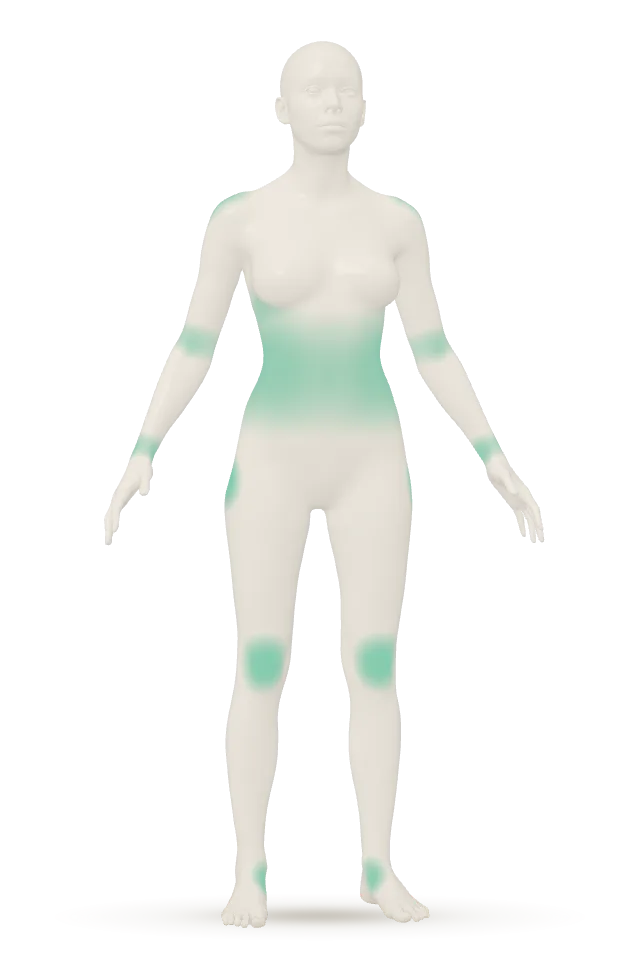
Appetite & metabolism
In people. AOD-9604 showed modest weight loss in one 12-week trial, but a larger 24-week trial failed and obesity development stopped in 2007.
Joints & tendons
In animals. Cartilage repair was seen in one rabbit study.
An area lights for what a peptide is used for and what people report, with the evidence beside it. It isn’t a promise that it works there.
Week by week.
What to expect in the first 8 weeks
Day 1–7Community
A quiet first week
AOD-9604 signals fat cells to release stored energy, as it did in rat and mouse fat tissue. Commonly reported: nothing to feel this week, and the scale doesn't move yet. Many dose fasted, since insulin dampens fat release.
The science
AOD-9604 mimics the fat-regulating tail of hGH (amino acids 177-191 plus an added tyrosine, often labelled 176-191). It doesn't act on beta-3 receptors directly; in obese mice it raised beta-3 receptor levels, and its long-term effect needed those receptors (Heffernan 2001). Unlike full hGH, it does not stimulate IGF-1 or affect glucose metabolism. Fasted dosing is community practice; no study has compared it with fed dosing.
Sources- Heffernan et al. (2001)
- Ng et al. (2000)
Updated Sep 2026
Day 7–21Community
Subtle changes, for some users
Commonly reported: some users see a first small change in this window when diet and training are dialed in, while many notice little. The effect is subtle compared to GLP-1s.
The science
A 12-week oral trial in obese adults (n=300) found modest weight loss, best at the lowest dose (1 mg: −2.8 kg vs −0.8 kg on placebo); a larger 24-week trial (n=536) found no significant effect, and obesity development stopped in 2007. Its mechanism is fat release rather than appetite suppression, a different pathway from GLP-1 agonists.
Sources- Herd et al. (2005)
- Dominikowski et al. (2026)
Updated Sep 2026
Day 21–42Community
Body composition is shifting
Commonly reported, for those who respond: the scale barely moves, but clothes fit a little differently. Users treat it as a slow recomp tool, not a crash diet.
The science
In rat and mouse fat tissue, AOD-9604 blocked new fat storage as well as boosting fat release (Ng et al. 2000), a dual action aimed at better fat-to-lean ratios even at maintenance. No human trial has published body-composition data.
Sources- Ng et al. (2000)
Updated Sep 2026
Day 42–84Community
Judge it at week 12
Community protocols run about 12 weeks, and users who respond commonly report their best results from week 6 onward. If you're stacking with BPC-157 or a GH secretagogue, this is where the effects compound.
The science
The only longer human trial (24 weeks, n=536) found no significant weight loss. Combination with GH secretagogues (CJC-1295, Ipamorelin) works through complementary pathways — AOD on fat directly, secretagogues on recovery and lean tissue — though no study has tested it.
Sources- Dominikowski et al. (2026)
Updated Sep 2026
Any dayClinical
What AOD-9604 is built on
AOD-9604 showed modest weight loss in one 12-week trial, but a larger 24-week trial failed and obesity development stopped in 2007. It was originally developed by Monash University and Metabolic Pharmaceuticals. Across six small human trials it was well tolerated, with no effect on blood sugar, insulin or IGF-1.
The science
The peptide is the C-terminal fragment of hGH (residues 177-191) with an added tyrosine, often labelled 176-191. It keeps the fat-regulating activity seen in rodents but loses the growth-promoting effects. A 12-week phase 2 trial (n=300) found modest weight loss, best at the lowest dose; the 24-week phase 2b (n=536) found no significant effect. All human trials gave it orally or intravenously, not by injection under the skin. It isn't approved for any use anywhere; cartilage claims rest on one rabbit study (Kwon & Park 2015), and FDA lists it in compounding category 2, citing a possible risk of immune reactions.
Sources- Stier et al. (2013)
- Kwon & Park (2015)
- Dominikowski et al. (2026)
Updated Sep 2026
Day 1 is the day you start it.
Mixing and a typical run.
Example numbers
Reconstitution example
Reconstitute a 5 mg vial of AOD-9604 with 2 mL of bacteriostatic water and a 275 mcg dose is 11 units on a U-100 syringe, about 18 doses per vial.
- Vial
- 5 mg
- Water
- 2 mL
- Amount
- 275 mcg
Draw to11 units
0.3 mL insulin syringe · 30 units
Run notes
- Cycle
- 12–16 weeks common. Diminishing returns reported beyond 16 weeks; cycling recommended.Community practice — opinions vary. Not a clinical recommendation.
- Timing
- Commonly taken fasted — morning or 2h before meals — since insulin dampens fat release (no study has compared fasted and fed dosing).
- Route
- SubQ injection
- Stacks
- BPC-157, CJC-1295 no DAC, Ipamorelin
Safety.
Common side effects
- Injection site reaction
- Mild headache
- Nausea
Goes with.
In the Shred Stack
Metabolic acceleration & fat loss support
With Tirzepatide and BPC-157
Compared with.
Questions people ask.
What is AOD-9604?
A modified fragment of human growth hormone that targets fat metabolism. In rodents it boosted the breakdown of stored fat and blocked new fat formation, without affecting blood sugar or IGF-1. In people, one 12-week trial found modest weight loss but a larger 24-week trial didn't, and it isn't approved for any use.
How is AOD-9604 dosed in research?
The research range for AOD-9604 is 250–300 mcg, daily, fasted. Studied in research — not a recommendation.
How long does AOD-9604 last?
The half-life of AOD-9604 is ~30 min.
What do people report on AOD-9604?
Commonly reported on AOD-9604: little noticeable effect for many users, slow fat loss for others when paired with diet and training, and mild injection-site redness.
Is AOD-9604 safe?
The research basis for AOD-9604 is moderate: animal studies + some human data. Common side effects in the library: injection site reaction, mild headache and nausea.
What does AOD-9604 stack with?
Common stacks for AOD-9604: BPC-157, CJC-1295 no DAC and Ipamorelin. Curated stacks with AOD-9604: Shred Stack.
Research.
Reference.
- Cadence
Daily
Daily, fasted
- Half-life
~30 min
- Research basis
●●
●ModerateAnimal studies + some human data
PepVault for iPhone
Track AOD-9604 in PepVault
Log every dose and keep your vial and the doses left in it. 7 days free on the yearly plan for new subscribers.

Open the calculatorHow the vial count worksExplore the live demo
Reviewed How we check the library