Thymosin Alpha-1 Dosage, half-life & reference guide
Also known as Tα1 · Thymalfasin · Zadaxin
A naturally occurring thymic peptide that fine-tunes the immune system: it helps T-cells mature and raises natural killer cell activity.

- Studied range
- 1–1.6 mg
- How often
- 2× weekly
- Half-life
- ~2 hours
- Evidence
- ●●●
Established - Route
- SubQ injection
Studied in research — not a recommendation.
How it works.
Naturally occurring thymic peptide that modulates immune function. It stimulates T-cell maturation and NK cell activity, and has antiviral and anti-tumor effects; the anti-tumor work is mostly in cells and animals, and human results are mixed.
Commonly reported: Fewer or shorter colds over a season, with little to feel day to day. It's a prescription drug (thymalfasin) in about 35 countries, mainly for hepatitis B, though not in the US, and trial results are mixed.
Half-life & active level
The half-life of Thymosin Alpha-1 is ~2 hours (Zadaxin label, after a SubQ dose).
Here's how a typical Thymosin Alpha-1 schedule plays out over 48 hours (one-compartment estimate).
An estimate from the half-life above, not a measurement. See your own curve build live in the half-life calculator.
Where Thymosin Alpha-1 works.
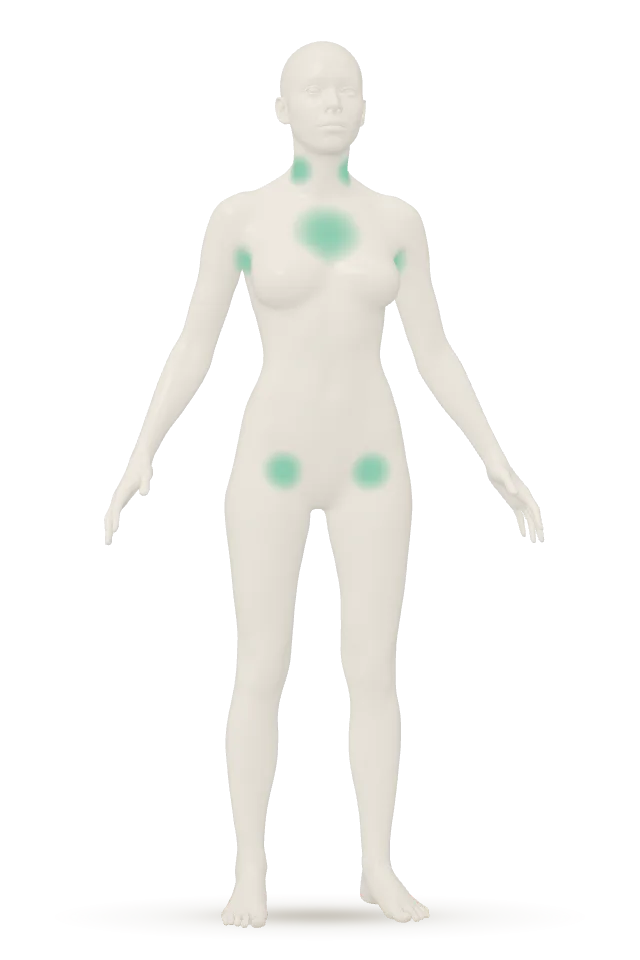
Immune system
In people. Naturally occurring thymic peptide that modulates immune function. It stimulates T-cell maturation and NK cell activity.
An area lights for what a peptide is used for and what people report, with the evidence beside it. It isn’t a promise that it works there.
Week by week.
What to expect in the first 8 weeks
Day 1–7Clinical
Your immune system is getting instructions
Commonly reported: nothing to feel in the first week. Thymosin alpha-1 helps T-cells mature and sharpens immune signaling, quiet work that users notice later, if at all, as fewer or milder colds.
The science
TA1 enhances T-cell maturation by promoting differentiation of T-cell precursors in the thymus. It upregulates MHC class I expression, improving antigen presentation and immune surveillance. Approved as Zadaxin for hepatitis B/C in over 35 countries.
Sources- Garaci et al. (2012)
- Tuthill et al. (2010)
Updated Apr 2026
Day 7–14Clinical
The immune side is ramping up
Thymosin alpha-1 raises natural killer cell activity, your front-line immune defense. Many run it through cold and flu season or around travel, and judge it by how often they get sick over the months ahead rather than by any feeling this week.
The science
TA1 increases NK cell cytotoxicity and enhances dendritic cell function in lab studies (Garaci 2012). In hepatitis and cancer patients, T-cell responses were measured over months; no trial pins down a two-week timeline.
Sources- Garaci et al. (2012)
Updated Sep 2026
Day 14–28Clinical
Where a common cycle ends
Two to four weeks is where many cycles end. Commonly reported: the effect is subtle, and users judge it over a season by fewer or shorter colds. If you started it for a specific reason, note how that has gone since day 1.
The science
In hepatitis B, adding TA1 to interferon improved viral suppression and HBeAg seroconversion over interferon alone in a meta-analysis of 7 small trials (Mao 2011); a 2026 Cochrane review of 10 hepatitis B trials rated the overall evidence very low certainty (Naing 2026). The trials ran far longer than a community cycle: in one, 1.6 mg twice a week for 26 weeks cleared viral DNA and HBeAg in 40.6% by 18 months, against 9.4% untreated (Chien 1998). No study gives a 2–4 week steady state for its immune effects.
Sources- Mao & Shi (2011)
- Naing et al. (2026)
- Chien et al. (1998)
Updated Oct 2026
Any dayClinical
What Thymosin Alpha-1 is built on
One of the few peptides that is an approved prescription drug: Zadaxin (thymalfasin) is approved in about 35 countries, mainly for hepatitis B, and has decades of clinical use with a good safety record. It isn't approved in the US, and how much it helps is less settled than its safety.
The science
Originally isolated from thymic tissue by Allan Goldstein in the 1970s. Clinical trials span hepatitis B/C, HIV, cancer immunotherapy and vaccine response. A 2026 Cochrane review of 10 hepatitis B trials found very low certainty evidence of benefit, with serious adverse events not increased (Naing 2026). In the 1,106-patient TESTS sepsis trial, 28-day mortality was 23.4% on thymosin alpha-1 and 24.1% on placebo (Wu 2025). Mechanism: T-cell maturation, NK cell activation, dendritic cell stimulation, MHC-I upregulation.
Sources- Garaci et al. (2012)
- Naing et al. (2026)
- Wu et al. (2025)
Updated Sep 2026
Day 1 is the day you start it.
Mixing and a typical run.
Example numbers
Reconstitution example
Reconstitute a 10 mg vial of Thymosin Alpha-1 with 2 mL of bacteriostatic water and a 1 mg dose is 20 units on a U-100 syringe, about 10 doses per vial.
- Vial
- 10 mg
- Water
- 2 mL
- Amount
- 1 mg
Draw to20 units
0.3 mL insulin syringe · 30 units
Run notes
- Cycle
- Community cycles typically run 4–6 weeks, 2x/week, or as needed for immune support. The hepatitis B trials ran far longer: 1.6 mg twice a week for 26 or 52 weeks (Chien 1998).Community practice — opinions vary. Not a clinical recommendation.
- Timing
- Timing flexible. Often dosed morning or evening.
- Route
- SubQ injection
- Stacks
- LL-37, KPV
Safety.
Common side effects
- Injection site reaction
- Fatigue
- Mild flu-like symptoms
Questions people ask.
What is Thymosin Alpha-1?
A naturally occurring thymic peptide that fine-tunes the immune system: it helps T-cells mature and raises natural killer cell activity.
How is Thymosin Alpha-1 dosed in research?
The research range for Thymosin Alpha-1 is 1–1.6 mg, 2x/week. Studied in research — not a recommendation.
How long does Thymosin Alpha-1 last?
The half-life of Thymosin Alpha-1 is ~2 hours (Zadaxin label, after a SubQ dose).
What do people report on Thymosin Alpha-1?
Commonly reported on Thymosin Alpha-1: fewer or shorter colds over a season, with little to feel day to day. It's a prescription drug (thymalfasin) in about 35 countries, mainly for hepatitis B, though not in the US, and trial results are mixed.
Is Thymosin Alpha-1 safe?
The research basis for Thymosin Alpha-1 is established: clinical trials or FDA-approved use exists. Common side effects in the library: injection site reaction, fatigue and mild flu-like symptoms.
What does Thymosin Alpha-1 stack with?
Common stacks for Thymosin Alpha-1: LL-37 and KPV.
Research.
Reference.
- Cadence
2× weekly
2x/week
- Half-life
~2 hours
~2 hours (Zadaxin label, after a SubQ dose)
- Research basis
●●●
EstablishedClinical trials or FDA-approved use exists
PepVault for iPhone
Track Thymosin Alpha-1 in PepVault
Log every dose, keep your vial and the doses left in it and watch its estimated active level. 7 days free on the yearly plan for new subscribers.

Open the calculatorHow the vial count worksExplore the live demo
Reviewed How we check the library