Oxytocin nasal spray: what it is used for
Reviewed 23 sourcesPublished by PepVault
Oxytocin nasal spray's one approved use is milk let-down. Its status as of November 2026, and what the big autism, anxiety and weight trials found.

- Last reviewed
- Sources
- 23
- Questions
- 7
- Compounds
- 1
The short answer
Oxytocin nasal spray is the body's own labor and milk hormone, sprayed into the nose. Its one approved use is helping milk let down for breastfeeding or pumping: Brazil's Syntocinon spray label approves it for that, while the US version is discontinued, so in the US oxytocin is approved only as the Pitocin injection used in labor. For autism, anxiety and weight, the largest trials found no clear benefit.
- Approved use: milk let-down, one 4 IU spray 2 to 5 minutes before feeding or pumping (Brazil's label). The US nasal product is discontinued.
- In the US, oxytocin is approved only as an injection used in labor and after birth (Pitocin and generics).
- The largest trials in autism (290 children), autism in adults (106 men) and obesity (61 adults) found no benefit on their main measure.
- Some of the spray reaches the brain: the fluid around the brain rose in people, and labeled oxytocin reached brain tissue in monkeys.
Evidence: Approved for milk let-down on a label (Brazil); for brain and behavior uses, many randomized trials with mostly null results in the largest ones.
What is oxytocin nasal spray?
Oxytocin is a hormone made by nerve cells in the hypothalamus, a small region at the base of the brain23. It is a chain of nine amino acids, a nonapeptide, with a molecular weight of about 1,0072. In the body it does two well-known jobs: it makes the uterus contract in labor, and it squeezes the small muscle cells around the milk glands so milk flows, the let-down reflex23.
The nasal spray is synthetic oxytocin, identical to the body's own, dissolved in water with a preservative. Brazil's product holds 40 international units (IU) per mL, and one spray delivers 4 IU3. The lining of the nose absorbs it quickly, so it reaches the blood without a needle3. A nasal spray is also how the brain and behavior studies give it: in the 38 trials one review gathered, single research doses ran from 18 to 40 IU22.
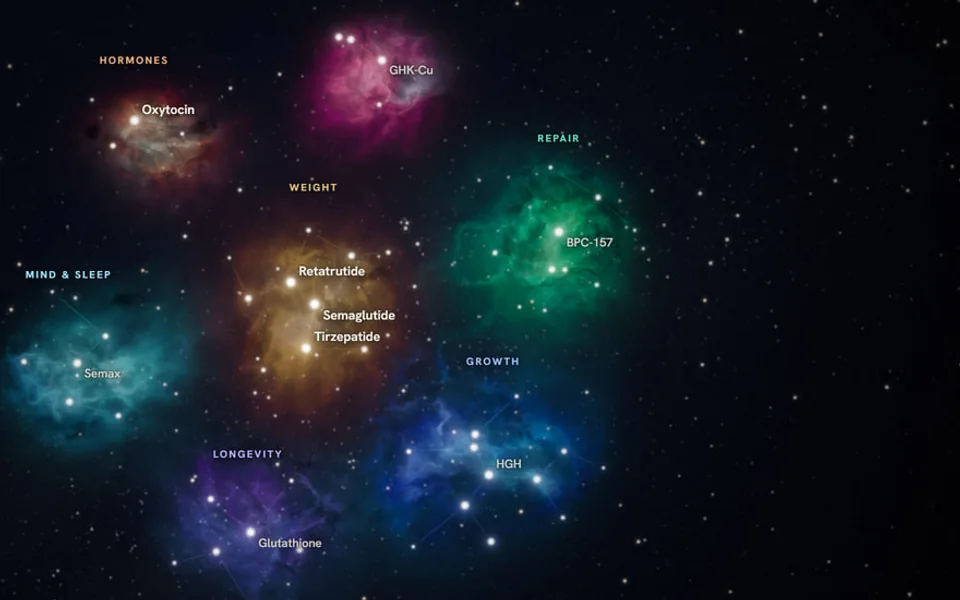 Peptide SkySee Oxytocin as a molecule53 peptides as a night sky in 3D. Each star opens into its molecule, one bead per amino acid, with the measured shape where one exists.Open the Peptide Sky
Oxytocin and vasopressin, the body's water-holding hormone, differ at only two of their amino acids. That is why large doses can make the body hold water2.

PepVault for iPhone
Keep your protocol in PepVault
PepVault logs a nasal dose in one tap, with no injection site to pick, and an as-needed schedule never counts a missed day. The side-effect log keeps what you noticed after each spray.

7 days free on the yearly plan for new subscribers.
What is oxytocin nasal spray approved for?
One thing: milk. Brazil's label, last approved by its regulator ANVISA on March 11, 2021, lists Syntocinon nasal spray for starting milk flow in women who have trouble breastfeeding or pumping, and for preventing and treating engorged breasts and mastitis. The label's dose is one spray in one nostril 2 to 5 minutes before feeding or pumping3. It is a prescription product, kept in the fridge and used within a month of opening3.
The United States once approved the same product, Syntocinon nasal solution at 40 USP units per mL, under application NDA 012285. As of November 20, 2026, the FDA's Drugs@FDA database lists it as discontinued1. That leaves no FDA-approved oxytocin nasal spray on the US market. US oxytocin is an injection: Pitocin and its generics, given into a vein or a muscle in hospital to start or strengthen labor for a medical reason and to control bleeding after birth. Its label, updated May 2026, states it is not for elective induction2.
| Product | Form | Approved use | Status, November 2026 |
|---|---|---|---|
| Syntocinon spray (Brazil) | Nasal spray, 40 IU/mL, 4 IU a spray | Milk let-down; engorgement and mastitis | Label approved by ANVISA, March 20213 |
| Syntocinon nasal solution (US) | Nasal solution, 40 USP units/mL | No use listed in Drugs@FDA | Discontinued (Drugs@FDA)1 |
| Pitocin and generic oxytocin (US) | Injection, 10 units/mL | Labor with a medical reason; bleeding after birth | Prescription2 |
Every other use, for anxiety, autism, appetite or bonding, is research. Our oxytocin page in the library sums up that research, and our oxytocin legal status page has the FDA, DEA and WADA records in full.
Does oxytocin spray help with breastfeeding?
Less than the label suggests. Brazil's label rests on three studies from 1958 to 1981 and says no recent trials exist3. The one modern double-blind trial we found gave 51 mothers of babies born before 35 weeks either oxytocin spray or a dummy spray before each pump session for five days. Total milk was the same in both groups. The oxytocin group's milk came in a little faster at first, then the two curves met, and most mothers in both groups believed they had the real spray4.
Where the spray has a clearer case is when the let-down reflex itself is cut off. Suckling sends its signal to the hypothalamus through spinal nerves, so a high spinal cord injury can block it. In a report of three women with tetraplegia who kept breastfeeding for 12 to 54 weeks, two needed relaxation and mental imagery or the oxytocin spray to trigger let-down23.
How much of a nasal dose reaches the brain?
Some, slowly. In the first study to sample both blood and the fluid around the brain and spine (cerebrospinal fluid, CSF) after a spray, 11 people got 24 IU and 4 got a dummy spray. Blood levels peaked at 15 minutes and fell after 75; the CSF level took up to 75 minutes to rise clearly. The two levels did not track each other (a correlation below 0.10), so a blood level says little about the brain5.
A rise in CSF could also mean the body released its own oxytocin. Rhesus monkey studies settled that by spraying a labeled form, oxytocin with five heavy hydrogen atoms that a mass spectrometer tells apart. In six monkeys given 80 IU, the labeled oxytocin reached the CSF and their own oxytocin did not rise; the nose gave no more CSF oxytocin than a vein6. Two hours after a nasal dose, the labeled oxytocin was found in brain tissue along the paths of the smell nerve and the trigeminal nerve, which carries feeling from the face (the orbitofrontal cortex, striatum, brainstem and thalamus), which a dose into a vein did not reach7.
The brain-tissue result is from monkeys; in people only CSF has been measured. In the blood, oxytocin lasts minutes: a half-life of about 1 to 6 minutes on the Pitocin label2, 3 to 20 minutes on Brazil's spray label3. Our oxytocin half-life page works through what that means.
What did the large oxytocin trials find?
The early small studies were exciting, and the bigger trials mostly were not. The table lists the largest trial or pooled analysis we found for each use, all randomized, with oxytocin against a dummy spray (a placebo). Doses are the trials' own.
| Use | Trial | Who and how long | Main result |
|---|---|---|---|
| Autism, children | SOARS-B, Sikich 20218 | 290 aged 3 to 17; target 48 IU a day; 24 weeks | No difference on social withdrawal: change -3.7 vs -3.5 points (P = 0.61) |
| Autism, adults | Yamasue 20209 | 106 men aged 18 to 48; 48 IU a day; 6 weeks | No difference on social reciprocity; repetitive behavior and gaze improved (secondary measures) |
| Social anxiety | Guastella 200910 | 25 adults; 24 IU with exposure therapy | Better self-rating of speeches; no better overall result than therapy alone |
| Schizophrenia | Sabe 2021, 9 trials11 | Added to usual treatment | No consistent effect on negative or positive symptoms |
| Mental disorders, pooled | Bonnieux 2026, 42 trials12 | 1,922 people | Small, non-significant overall; a small effect in schizophrenia (g = 0.12) |
| Acute stress after injury | Huang 202613 | 328 adults; one 40 IU dose before fracture surgery | Probable acute stress disorder in 15.9% vs 30.5% within 3 days |
| Obesity | Plessow 202420 | 61 adults; 24 IU four times a day; 8 weeks | No weight loss (change 0.20 vs 0.26 kg); intake at a test meal changed by 152 kcal less than on placebo by week 6 |
SOARS-B matters most, because oxytocin had already been given to many children with autism in practice when it started8. Its side effects were as common and as severe on the dummy spray8. For PTSD, a 2024 Cochrane review of early drug treatment after trauma included oxytocin among four drugs and found the evidence too uncertain to say whether any of them helps14. The 2026 surgery trial is the strongest positive signal so far, from a single center in China, and its authors say long-term safety still needs study13.
Appetite shows the same split between one dose and many. A single 24 IU spray cut how much 25 men ate at breakfast, fat most of all, without changing how hungry they felt19, and a pooled analysis of 12 trials found single doses reduced food intake in people without a psychiatric diagnosis21. Eight weeks of four sprays a day still lowered intake at a test meal, but nobody lost weight20.
Why do so many oxytocin findings fail to replicate?
The most famous result is the clearest case. In 2005 a study in Nature reported that a nasal spray made people more trusting with money in an investment game15. A registered replication led from Antwerp, with one of the original authors, ran on 321 people with more than 95% power to find the effect, and found none1617. A second registered replication in 2026, with 211 people, also found none, and the two pooled (532 people) put any effect within a range too small to matter for lab studies17.
A 2016 review in Biological Psychiatry looked at the field's statistics as a whole and concluded that intranasal oxytocin studies are generally too small, and that most of the published findings are likely not real effects18. Small studies, many measures and a striking story are the usual recipe for results that vanish when someone runs them again. The larger trials above are the correction.
Our research pages on oxytocin take SOARS-B, the 2005 trust study and the breakfast study one by one.
What do people notice after an oxytocin spray?
Often very little. A review of 38 trials between 1990 and 2010, with 1,529 people at 18 to 40 IU, found side effects no different from the dummy spray, and people could not tell which spray they had been given22. Brazil's label lists headache and nausea as rare, abnormal uterine contractions as uncommon and nasal discomfort at an unknown rate3.
Commonly reported: a subtle calm, warm or more connected feeling shortly after a spray; for many, little or an inconsistent effect from dose to dose; and in the forum threads we read, headaches, an upset stomach, and the effect fading with repeated use.
PepVault logs a nasal dose in one tap, with no injection site to pick, and an as-needed schedule never counts a missed day. The side-effect log keeps what you noticed after each spray. Log it in PepVault
When to get help Oxytocin contracts the uterus, so Brazil's label rules the spray out in pregnancy; if you are pregnant, talk to a clinician before using it3. Trouble breathing or swelling of the face, lips or throat after a spray needs emergency care at once.
Sources
- U.S. Food and Drug Administration. Drugs@FDA: Syntocinon (oxytocin) nasal solution, NDA 012285. Read November 20, 2026. accessdata.fda.gov
- Pitocin (oxytocin injection, USP) prescribing information. DailyMed, National Library of Medicine; label effective May 5, 2026. dailymed.nlm.nih.gov
- Syntocinon (ocitocina) 40 UI/mL solução spray nasal: bula para o profissional de saúde. Mylan Laboratórios (Viatris), Brazil; approved by ANVISA March 11, 2021. viatris.com
- Fewtrell MS et al. Randomised, double blind trial of oxytocin nasal spray in mothers expressing breast milk for preterm infants. Arch Dis Child Fetal Neonatal Ed. 2006. PubMed 16223754
- Striepens N et al. Elevated cerebrospinal fluid and blood concentrations of oxytocin following its intranasal administration in humans. Sci Rep. 2013. PubMed 24310737
- Lee MR et al. Oxytocin by intranasal and intravenous routes reaches the cerebrospinal fluid in rhesus macaques. Mol Psychiatry. 2018. PubMed 28289281
- Lee MR et al. Labeled oxytocin administered via the intranasal route reaches the brain in rhesus macaques. Nat Commun. 2020. PubMed 32494001
- Sikich L et al. Intranasal oxytocin in children and adolescents with autism spectrum disorder (SOARS-B). N Engl J Med. 2021. PubMed 34644471
- Yamasue H et al. Effect of intranasal oxytocin on the core social symptoms of autism spectrum disorder: a randomized clinical trial. Mol Psychiatry. 2020. PubMed 29955161
- Guastella AJ et al. A randomized controlled trial of intranasal oxytocin as an adjunct to exposure therapy for social anxiety disorder. Psychoneuroendocrinology. 2009. PubMed 19246160
- Sabe M et al. Intranasal oxytocin for negative symptoms of schizophrenia: systematic review, meta-analysis, and dose-response meta-analysis of randomized controlled trials. Int J Neuropsychopharmacol. 2021. PubMed 33890987
- Bonnieux J et al. Does intranasal oxytocin reduce symptoms of mental disorders? A meta-analysis of clinical trials. Neurosci Biobehav Rev. 2026. PubMed 42134427
- Huang Q et al. Preoperative intranasal oxytocin and probable acute stress disorder after traumatic fracture surgery: a randomized clinical trial. JAMA Intern Med. 2026. PubMed 42931765
- Bertolini F et al. Early pharmacological interventions for prevention of post-traumatic stress disorder (PTSD) in individuals experiencing acute traumatic stress symptoms. Cochrane Database Syst Rev. 2024. PubMed 38767196
- Kosfeld M et al. Oxytocin increases trust in humans. Nature. 2005. PubMed 15931222
- Declerck CH et al. A registered replication study on oxytocin and trust. Nat Hum Behav. 2020. PubMed 32514040
- Kroll CF et al. Absence of a meaningful effect of intranasal oxytocin on trusting behavior: a registered report with pooled equivalence testing. Cortex. 2026. PubMed 41880977
- Walum H, Waldman ID, Young LJ. Statistical and methodological considerations for the interpretation of intranasal oxytocin studies. Biol Psychiatry. 2016. PubMed 26210057
- Lawson EA et al. Oxytocin reduces caloric intake in men. Obesity (Silver Spring). 2015. PubMed 25865294
- Plessow F et al. Intranasal oxytocin for obesity. NEJM Evid. 2024. PubMed 38815173
- Chen CY et al. Effects of intranasal oxytocin in food intake and craving: a meta-analysis of clinical trials. Clin Nutr. 2021. PubMed 34600216
- MacDonald E et al. A review of safety, side-effects and subjective reactions to intranasal oxytocin in human research. Psychoneuroendocrinology. 2011. PubMed 21429671
- Cowley KC. Psychogenic and pharmacologic induction of the let-down reflex can facilitate breastfeeding by tetraplegic women: a report of 3 cases. Arch Phys Med Rehabil. 2005. PubMed 15954070
Newsletter · Weekly
The weekly peptide briefing.
New guides, the week’s peptide news, one tool. Free, one email a week, unsubscribe anytime.
PepVault for iPhone
Keep your protocol in PepVault
Log every dose, track every vial, and see your protocol come together.
7 days free on the yearly plan for new subscribers.