GHK-Cu for skin and hair: what's measured
Reviewed 21 sourcesPublished by PepVault
What GHK-Cu has shown in people for skin and hair: the serum and laser trials, the hair studies, what is lab-only, and what injecting it has never tested.

- Last reviewed
- Sources
- 21
- Questions
- 8
- Compounds
- 3
The short answer
In people, GHK-Cu has been measured almost only on the skin. In a randomized 8-week trial in 40 women, a GHK-Cu serum cut wrinkle volume more than a plain serum or a Matrixyl product, and a laser-recovery trial found happier patients but no measured difference. For hair, one small eyebrow trial is positive. No trial has tested GHK-Cu alone on scalp hair loss, or by injection.
Evidence: Mostly cell and rat studies; in people, a few small topical trials (two cosmetic, two on wounds, one on eyebrows) and no controlled trial of GHK-Cu alone on scalp hair or by injection.
What is GHK-Cu?
GHK-Cu is a very small signal: three amino acids, glycine, histidine and lysine, holding a single copper ion. Picture three beads on a string with a copper bead clipped to the first two. The glycine end and the histidine do the gripping3.
It was first pulled out of human blood in 1973, as a factor that helped liver cells survive, and identified as glycyl-histidyl-lysine in 197712. The same three-letter sequence is written into the alpha-2 chain of type I collagen, the main structural protein of skin. That led a 1988 study to propose the model behind everything that followed: when tissue is damaged and collagen is broken down, GHK is cut free at the wound and tells nearby cells to rebuild4.
That is the whole pitch for skin and hair. A fragment of your own collagen, put back on the skin or under it, as a repair signal.

PepVault for iPhone
Keep your protocol in PepVault
Log every dose, track every vial, and see your protocol come together.

7 days free on the yearly plan for new subscribers.
What does it do to skin cells?
In the lab, a lot. In fibroblasts, the cells that make collagen, GHK-Cu raised collagen production starting between 1 and 10 picomolar and peaked at 1 nanomolar, without changing how many cells there were4.
In rats, steel mesh chambers implanted under the skin act as an artificial wound. Injected into them, GHK-Cu raised collagen and glycosaminoglycans in proportion to the amount given, along with the messenger RNA for type I and type III collagen. A control tripeptide had no significant effect5. A later study in the same rat model found it raised decorin, a protein that helps new collagen fibres lie in order6.
Species note: the collagen and decorin results above come from cells in a dish and from rats. They show what GHK-Cu can do to the machinery of repair, not what a cream does to a face.
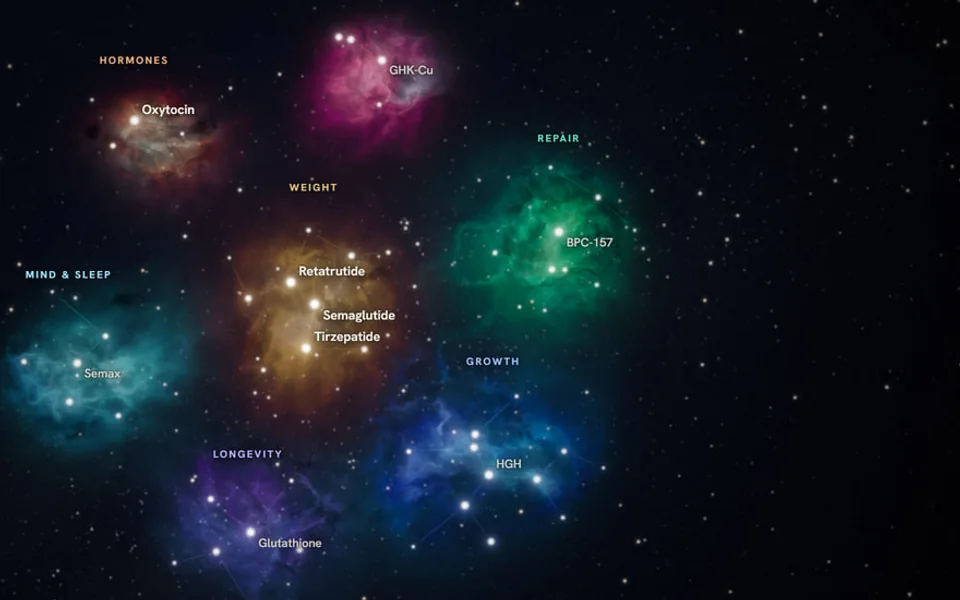 Peptide SkySee GHK-Cu as a molecule53 peptides as a night sky in 3D. Each star opens into its molecule, one bead per amino acid, with the measured shape where one exists.Open the Peptide Sky
What did the skin trials in people find?
Four controlled human trials stand out: two on cosmetic skin and two on chronic wounds. All four put a copper peptide on the skin. Three name it as GHK-Cu; the venous ulcer paper calls its cream a tripeptide copper complex.
| Trial | Who | What was compared | What they found |
|---|---|---|---|
| Badenhorst 20167 | 40 women aged 40 to 65, 8 weeks | GHK-Cu serum twice daily vs the same serum without it and a Matrixyl 3000 product | Wrinkle volume fell significantly more than with either comparison; wrinkle depth too, against the plain serum |
| Miller 20068 | 13 patients after CO2 laser resurfacing, 12 weeks | Skin care with vs without GHK-Cu | No difference in redness or wrinkles on blinded scoring; patients rated their skin better with GHK-Cu |
| Mulder 19949 | Diabetic foot ulcers | GHK-Cu gel vs the same gel without it, plus standard care | Median ulcer closure 98.5% vs 60.8%; fewer infections |
| Bishop 199210 | 86 patients with venous leg ulcers | 0.4% copper tripeptide cream vs silver sulfadiazine vs placebo | The copper cream did no better than placebo |
The wrinkle trial is the one most people mean when they say GHK-Cu works. It was randomized and double-blind, and the GHK-Cu was packed in lipid nano-carriers to help it into the skin. After 8 weeks it had reduced wrinkle volume significantly more than the plain serum (p < 0.001) and more than the Matrixyl product, which carries a fat-tailed GHK relative (p = 0.004). The paper gives those gaps as 55.8% and 31.6%, and a 32.8% gap in wrinkle depth against the plain serum7.
The laser trial is the honest counterweight. Everyone's skin improved after resurfacing, with or without GHK-Cu, and blinded evaluators and software could not tell the groups apart. The difference showed up only in how patients rated their own skin quality (p = 0.04)8.
The wound trials split the same way: a clear win on diabetic foot ulcers, and nothing on venous ulcers, where plain silver sulfadiazine cream beat it910.
How strong is the evidence for skin?
Thin, by the reviewers' own count. A 2026 systematic review in Aesthetic Surgery Journal searched three databases through March 2026 and found 20 studies of GHK-Cu on its own for aesthetic uses: 18 preclinical and 2 randomized trials, the wrinkle and laser trials above. It called the findings constrained by "a limited number of well-designed clinical trials"11.
A 2025 review of GHK as an anti-wrinkle ingredient reached the same place from the cosmetic side. GHK-Cu is in many products, yet the authors found "a surprising absence of clinical studies"12. They also flagged the practical problem: GHK is water-loving and unstable, which makes it hard to formulate and to get through the outer skin. Binding copper and adding a fatty tail both help it cross, and pretreating the skin with microneedles is worth studying12.
There is also a question of who did the work. Another 2026 review counted about 35% of the primary GHK-Cu papers in its window carrying the name of Loren Pickart, who first isolated the peptide and held commercial interests in the field, or Anna Margolina of Skin Biology Inc. The reviewers called that work substantive but said the concentration of authorship limits the independence of the evidence13.
Does GHK-Cu grow hair?
In people, GHK-Cu on its own has been tested on hair once, and on eyebrows rather than the scalp. The scalp evidence people quote is real, but each of those studies used either a close relative of GHK-Cu or a mixture.
| Study | What was tested | Who or what | What they found |
|---|---|---|---|
| Uno and Kurata 199314 | PC1031, a synthetic copper-binding peptide | Fuzzy rats | Larger hair follicles on the back skin, similar to topical minoxidil |
| Pyo 200715 | AHK-Cu, a different copper tripeptide | Human scalp follicles and papilla cells in a dish | Follicles grew longer, papilla cells multiplied |
| Lee 201616 | GHK bonded to 5-aminolevulinic acid, no copper, as a scalp spray | 45 men with pattern hair loss, 6 months, vs placebo | Hair count rose more than on placebo; no difference in thickness or length |
| Kapoor 201817 | Scalp injections of six growth factors and peptides, copper tripeptide-1 among them | 1,000 patients, open label, no control group | Less shedding and more hair; GHK-Cu's share can't be separated |
| Bo 202621 | 2% GHK-Cu serum on one eyebrow, a placebo serum on the other, twice daily | 18 healthy adults aged 18 to 40, 12 weeks | More eyebrow hairs and thicker hairs on the GHK-Cu side; no serious side effects |
Read together, these say copper peptides act on the hair follicle's growth machinery, in rats and in human tissue in a dish. The one controlled test of GHK-Cu itself is the eyebrow trial. It was randomized, double-blind and split-face, so each person was their own control, and by week 12 the treated brow had more hairs and thicker ones. It is small, from a single centre, in a journal PubMed does not index, and a sparse eyebrow is not a balding scalp2021.
The one randomized scalp trial used GHK without its copper, joined to another active, and it raised hair counts but not hair thickness16. For the scalp, the common claim that GHK-Cu thickens hair still rests on a rat study of a different peptide14.
Species note: the follicle-size result is from rats, and the follicle-growth result is from human tissue outside the body. Neither is a hair-loss treatment result in people.
What about injecting GHK-Cu?
Injecting GHK-Cu under the skin is a community practice, often in blends with BPC-157 and TB-500. It is not a route any trial has tested on its own. The only published human injection data we found is the scalp mixture above, which can't isolate GHK-Cu17. A search of ClinicalTrials.gov on November 2, 2026 found no registered trial of injected GHK-Cu.
We found no study that has measured its half-life in people. Given by IV to rats, it broke down quickly to a two-amino-acid fragment, which was cleared quickly too18.
FDA's page on compounding substances that may present significant safety risks (current as of April 22, 2026) lists injectable GHK-Cu among those nominated and then withdrawn. It says compounded injectable GHK-Cu may pose a risk of immune reactions from aggregation and peptide-related impurities, and that "there are limited data in humans to inform safety-related considerations"19. That is a statement about missing data, not a reported harm.
What do people who use it report?
Commonly reported: on serums, smoother texture and a more even tone after one to two months, with lines changing later if at all; occasional mild redness or tingling when starting a strong product. With injections, a short sting and some redness or swelling at the site that passes on its own. The solution is blue, the colour of the copper complex.
These are user reports, not trial results. The trials read their results at 8 weeks for wrinkles and 12 weeks for brows721, so a photo in the same light on day one makes a two- or three-month comparison honest.
What would settle the question?
Three studies would. A larger wrinkle trial run by a group with no stake in the product. A placebo-controlled scalp trial of GHK-Cu on its own, measuring thickness as well as count. And any controlled trial of injected GHK-Cu, starting with how long it lasts in the blood.
Until then, a 2026 evidence review put it plainly: the clinical evidence "remains sparse", and GHK-Cu is "promising but unproven"20. It has a clear mechanism, good lab data, one positive serum trial and one small positive eyebrow trial. For scalp hair and for injection, the measuring is still to come.
Sources
- Pickart L, Thaler MM. Tripeptide in human serum which prolongs survival of normal liver cells and stimulates growth in neoplastic liver. Nat New Biol. 1973. PubMed 4349963
- Schlesinger DH, Pickart L, Thaler MM. Growth-modulating serum tripeptide is glycyl-histidyl-lysine. Experientia. 1977. PubMed 858356
- Hureau C et al. X-ray and solution structures of Cu(II) GHK and Cu(II) DAHK complexes: influence on their redox properties. Chemistry. 2011. PubMed 21780203
- Maquart FX et al. Stimulation of collagen synthesis in fibroblast cultures by the tripeptide-copper complex glycyl-L-histidyl-L-lysine-Cu2+. FEBS Lett. 1988. PubMed 3169264
- Maquart FX et al. In vivo stimulation of connective tissue accumulation by the tripeptide-copper complex glycyl-L-histidyl-L-lysine-Cu2+ in rat experimental wounds. J Clin Invest. 1993. PubMed 8227353
- Siméon A et al. Expression of glycosaminoglycans and small proteoglycans in wounds: modulation by the tripeptide-copper complex glycyl-L-histidyl-L-lysine-Cu(2+). J Invest Dermatol. 2000. PubMed 11121126
- Badenhorst T, Svirskis D, Merrilees M et al. Effects of GHK-Cu on MMP and TIMP expression, collagen and elastin production, and facial wrinkle parameters. J Aging Sci. 2016;4:166. doi.org
- Miller TR et al. Effects of topical copper tripeptide complex on CO2 laser-resurfaced skin. Arch Facial Plast Surg. 2006. PubMed 16847171
- Mulder GD et al. Enhanced healing of ulcers in patients with diabetes by topical treatment with glycyl-l-histidyl-l-lysine copper. Wound Repair Regen. 1994. PubMed 17147644
- Bishop JB et al. A prospective randomized evaluator-blinded trial of two potential wound healing agents for the treatment of venous stasis ulcers. J Vasc Surg. 1992. PubMed 1495150
- Mokhtar J et al. The regenerative potential of GHK-Cu in aesthetic medicine. Aesthet Surg J. 2026. PubMed 42619529
- Mortazavi SM, Mohammadi Vadoud SA, Moghimi HR. Topically applied GHK as an anti-wrinkle peptide: advantages, problems and prospective. Bioimpacts. 2025. PubMed 39963574
- Najafi N et al. A systematic review of the mechanisms and therapeutic applications of GHK-Cu in topical microneedle delivery: a case for expanded clinical trials. Arch Intern Med Res. 2026. PubMed 42787770
- Uno H, Kurata S. Chemical agents and peptides affect hair growth. J Invest Dermatol. 1993. PubMed 8326148
- Pyo HK et al. The effect of tripeptide-copper complex on human hair growth in vitro. Arch Pharm Res. 2007. PubMed 17703734
- Lee WJ et al. Efficacy of a complex of 5-aminolevulinic acid and glycyl-histidyl-lysine peptide on hair growth. Ann Dermatol. 2016. PubMed 27489425
- Kapoor R, Shome D. Intradermal injections of a hair growth factor formulation for enhancement of human hair regrowth: safety and efficacy evaluation in a first-in-man pilot clinical study. J Cosmet Laser Ther. 2018. PubMed 29482481
- Endo T, Miyagi M, Ujiie A. Simultaneous determination of glycyl-L-histidyl-L-lysine and its metabolite, L-histidyl-L-lysine, in rat plasma by HPLC with post-column derivatization. J Chromatogr B. 1997. PubMed 9187381
- U.S. Food and Drug Administration. Certain bulk drug substances for use in compounding that may present significant safety risks (updated April 2026). fda.gov
- Mateescu DM et al. GHK-Cu as a bioactive metallopeptide and drug-delivery cargo: coordination chemistry, formulation science, therapeutic evidence, and a translational roadmap. Pharmaceutics. 2026. PubMed 42797253
- Bo SL, Nararatwanchai T, Supornpun N, Poomarapan K, Thaploka S. The efficacy of 2% copper peptide (GHK-Cu) serum for eyebrow hypotrichosis: a randomized, double-blind, vehicle-controlled, split-face comparative study. Procedia of Multidisciplinary Research. 2026;4(5):16. so09.tci-thaijo.org
Newsletter · Weekly
The weekly peptide briefing.
New guides, the week’s peptide news, one tool. Free, one email a week, unsubscribe anytime.
PepVault for iPhone
Keep your protocol in PepVault
Log every dose, track every vial, and see your protocol come together.
7 days free on the yearly plan for new subscribers.