Is Ozempic insulin? GLP-1, GIP and insulin explained
Reviewed 15 sourcesPublished by PepVault
No. Ozempic and Mounjaro copy gut hormones, GLP-1 and GIP, that make your own pancreas release insulin only when blood sugar is high. Here is how that differs.

- Last reviewed
- Sources
- 15
- Questions
- 7
- Compounds
- 3
The short answer
No. Ozempic is semaglutide, a long-lasting copy of the gut hormone GLP-1, and Mounjaro is tirzepatide, which acts on GLP-1 and a second gut hormone, GIP. Neither contains insulin. Both make your own pancreas release more insulin, but only while blood sugar is high, so on their own they rarely push sugar too low. Taken with insulin or a sulfonylurea, lows become more likely.
Evidence: FDA prescribing information for every brand named (DailyMed, versions current in November 2026) with their placebo-controlled trial tables, one small human study of a GLP-1 drip (1993) and two reviews of incretin physiology; semaglutide and tirzepatide are FDA-approved, retatrutide is investigational (phase 2 trial, phase 3 under way).
What is Ozempic, if it isn't insulin?
Ozempic's label calls it a GLP-1 receptor agonist: a drug that switches on the same receptor the body's own GLP-1 uses (the glossary's entries on GLP-1 and receptor agonists have the short versions)1. Its active ingredient, semaglutide, matches human GLP-1 in 94% of its sequence and is built to be taken once a week, where the body's own GLP-1 is broken down almost as soon as it is released112. Mounjaro's label calls tirzepatide a GIP receptor and GLP-1 receptor agonist, a dual agonist that works two of these hormone switches at once2. Each drug is sold under more than one name, as of November 2026:
| Brand | Ingredient | Acts on | Approved for |
|---|---|---|---|
| Ozempic (weekly pen, and since January 2026 a daily tablet) | Semaglutide | GLP-1 | Type 2 diabetes; heart and kidney risk in type 2 diabetes15 |
| Rybelsus (daily tablet) | Semaglutide | GLP-1 | Type 2 diabetes; heart risk in type 2 diabetes5 |
| Wegovy (weekly pen and daily tablet) | Semaglutide | GLP-1 | Weight; heart risk; MASH liver disease3 |
| Mounjaro (weekly pen, KwikPen or vial) | Tirzepatide | GIP and GLP-1 | Type 2 diabetes from age 10; heart risk in type 2 diabetes2 |
| Zepbound (weekly pen, KwikPen or vial) | Tirzepatide | GIP and GLP-1 | Weight; sleep apnea with obesity4 |
Type Ozempic, Wegovy, Mounjaro or Zepbound when you set up a protocol in PepVault: the app files it under its ingredient, semaglutide or tirzepatide, with the pen as the device. Log it in PepVault

PepVault for iPhone
Keep your protocol in PepVault
Type Ozempic, Wegovy, Mounjaro or Zepbound when you set up a protocol in PepVault: the app files it under its ingredient, semaglutide or tirzepatide, with the pen as the device.

7 days free on the yearly plan for new subscribers.
What are GLP-1, GIP and insulin?
All three are hormones, but they come from different places and do different jobs. GIP (glucose-dependent insulinotropic polypeptide) comes from K cells in the upper gut and GLP-1 (glucagon-like peptide-1) from L cells lower down; both are released after you eat11. They are incretins, gut hormones that tell the pancreas to release insulin, and together they explain why sugar taken by mouth triggers two to three times more insulin than the same sugar given into a vein11. GLP-1 also lowers glucagon, the hormone that raises blood sugar, slows the stomach and curbs appetite12.
Insulin is the hormone at the end of that chain. The pancreas makes it, and it lowers blood sugar directly: it moves sugar into muscle and fat and stops the liver releasing more6. An insulin injection supplies the hormone itself. Ozempic and Mounjaro supply the messages that ask the pancreas for it. Retatrutide, an investigational drug in phase 3 trials with no FDA approval as of November 2026, adds a third message, glucagon's own receptor, to the GIP and GLP-1 pair (the glossary's entry on dual and triple agonists)1415.
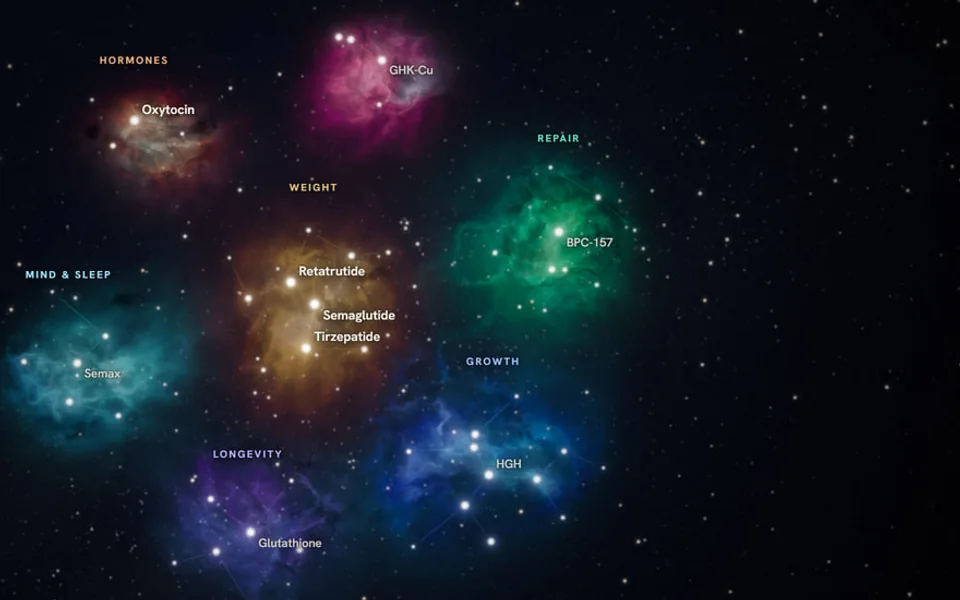 Peptide SkySee Semaglutide as a molecule53 peptides as a night sky in 3D. Each star opens into its molecule, one bead per amino acid, with the measured shape where one exists.Open the Peptide Sky
What does glucose-dependent mean?
It means the drug's push on insulin switches on only when blood sugar is high. Ozempic's label puts it plainly: semaglutide stimulates insulin and lowers glucagon "both in a glucose-dependent manner. Thus, when blood glucose is high, insulin secretion is stimulated, and glucagon secretion is inhibited"1. Mounjaro's label says the same of tirzepatide2.
A 1993 study in 10 people with poorly controlled type 2 diabetes showed it happening. A GLP-1 drip brought fasting blood sugar from 13.1 mmol/L (about 236 mg/dL) to a normal 4.9 mmol/L (about 88 mg/dL) within 4 hours. Once sugar was normal, insulin fell back toward its starting level and sugar held steady, though the drip kept running13. Injected insulin keeps lowering sugar whatever the level, which is why its label names low blood sugar as the most common side effect of every insulin6; these drugs, alone, seldom overshoot.
How is insulin different from Ozempic and Mounjaro?
| Compared | Insulin | Ozempic | Mounjaro |
|---|---|---|---|
| What it is | The hormone itself (for example Humulin R, Humalog, Tresiba)678 | A copy of GLP-11 | A molecule built on GIP's sequence that acts on GIP and GLP-1 receptors2 |
| How it lowers sugar | Moves sugar into muscle and fat; stops the liver making more6 | Raises your own insulin and lowers glucagon, only when sugar is high1 | The same, through two receptors2 |
| Measured in | Units: 100 units in each mL of U-100 insulin6 | Milligrams: 0.25 to 2 mg a week1 | Milligrams: 2.5 to 15 mg a week2 |
| How often | Mealtime insulin within 15 minutes before a meal or right after it7; long-acting once a day8 | Once a week1 | Once a week2 |
Because the drugs work through the insulin your pancreas still makes, they are a different tool from insulin, not a stronger or weaker version of it. Neither label covers type 1 diabetes, and the Wegovy label says its use in type 1 diabetes has not been evaluated3.
Why do Ozempic pens look like insulin pens?
Because they are the same kind of device. A pen injector holds a ready-mixed liquid and gives a set dose through a short needle (the glossary's entry on pen injectors), and the two companies behind these brands make insulin pens too. Eli Lilly sells Mounjaro in a KwikPen, the same pen name it uses for Humalog insulin27. Novo Nordisk makes Ozempic, and its multi-dose pen takes NovoFine Plus needles and has a dial and dose counter like an insulin pen1.
The numbers on the dial are what differ. A Humalog KwikPen dials 1 to 60 units in a single injection7; the Ozempic pen's counter stops at a dose in milligrams, 0.25 mg or 0.5 mg on the starter pen1. The Ozempic instructions open by asking you to check the pen "to make sure that it contains OZEMPIC" before anything else1. And the units printed on an insulin syringe are a measure of volume, not of any drug: the glossary's entries on syringe units and IU, and our guide to reading an insulin syringe, explain why that matters.
Can Ozempic or Mounjaro cause low blood sugar?
On their own, rarely. Alongside insulin or a sulfonylurea (an older kind of diabetes pill that also makes the pancreas release insulin), more often: both labels warn of a higher risk of lows, severe ones included, with that pairing12. The labels' own trial numbers show the pattern. Note that in the insulin trials the placebo groups were on insulin too, so much of the risk comes from the insulin itself:
| Who was studied | Measure | Placebo | On the drug |
|---|---|---|---|
| Ozempic alone, 30 weeks | Severe, or sugar 56 mg/dL or under with symptoms | 1.6% | 0% at 0.5 mg and 1 mg1 |
| Ozempic added to basal insulin, 30 weeks | The same | 5.3% | 8.3% at 0.5 mg, 10.7% at 1 mg1 |
| Ozempic with a sulfonylurea | The same | Not given | 6.5% at 0.5 mg, 10.4% at 1 mg1 |
| Mounjaro alone, 40 weeks | Sugar under 54 mg/dL | 1% | 0% at 5, 10 and 15 mg2 |
| Mounjaro added to basal insulin, 40 weeks | The same | 13% | 16%, 19% and 14% at 5, 10 and 15 mg2 |
| Mounjaro with a sulfonylurea, up to 104 weeks | The same | Not given | 13.8%, 9.9% and 12.8% at 5, 10 and 15 mg2 |
| Zepbound, adults without type 2 diabetes (SURMOUNT-1) | The same (not tracked systematically) | 0% | 0.3%4 |
| Zepbound, adults with type 2 diabetes (SURMOUNT-2) | The same | 1.3% | 4.2%; 10.3% with a sulfonylurea, 2.1% without4 |
Severe lows, the kind where another person has to help, stayed at 0% to 2% in every Ozempic and Mounjaro arm above12. The labels list the signs to know: dizziness, sweating, shakiness, hunger, a fast heartbeat, headache, blurred vision, irritability, confusion or drowsiness12.
Can you take Ozempic or Mounjaro with insulin?
Yes, both labels were tested with basal insulin and give instructions for the pairing; the plan itself is your prescriber's. What the labels say, as of November 202612:
- When the GLP-1 starts, the prescriber may lower the insulin or sulfonylurea dose to cut the risk of lows12.
- The two never go in the same injection: insulin and Ozempic or Mounjaro are given as separate shots12.
- They can go in the same body area, such as the belly, but not right next to each other12.
- In people with diabetes, Wegovy's and Zepbound's labels ask for blood sugar checks before starting and during treatment; Wegovy's adds that its use with insulin has not been studied34.
One kind of pen does hold both. Soliqua (insulin glargine with lixisenatide) and Xultophy (insulin degludec with liraglutide) put a long-acting insulin and a GLP-1 drug in one daily pen for type 2 diabetes, and both labels advise against adding a second GLP-1 drug on top910.
Commonly reported: people already on insulin say their sugar readings ran lower within the first weeks of a GLP-1 and that their insulin dose came down with their prescriber; a sensor or meter made the change easy to follow.
PepVault reminds you of the weekly shot on your day and time, logs each dose you take, and keeps your fasting glucose and HbA1c in Bloodwork beside it. Set reminders in PepVault
When to get help If lows or their signs show up after a GLP-1 joins insulin or a sulfonylurea, contact the prescriber who manages your diabetes; the labels expect the other dose to be adjusted12.
Sources
- OZEMPIC (semaglutide) injection prescribing information, DailyMed (SPL version 20), June 10, 2026 dailymed.nlm.nih.gov
- MOUNJARO (tirzepatide) injection prescribing information, DailyMed (SPL version 40), September 2, 2026 dailymed.nlm.nih.gov
- WEGOVY (semaglutide) injection and tablets prescribing information, DailyMed (SPL version 19), June 30, 2026 dailymed.nlm.nih.gov
- ZEPBOUND (tirzepatide) injection prescribing information, DailyMed (SPL version 40), September 2, 2026 dailymed.nlm.nih.gov
- RYBELSUS and OZEMPIC (semaglutide) tablets prescribing information, DailyMed (SPL version 14), August 19, 2026 dailymed.nlm.nih.gov
- HUMULIN R (insulin human) injection prescribing information, Eli Lilly, DailyMed (SPL version 35), September 7, 2026 dailymed.nlm.nih.gov
- HUMALOG (insulin lispro) injection and HUMALOG KwikPen prescribing information, Eli Lilly, DailyMed (SPL version 87), 2026 dailymed.nlm.nih.gov
- TRESIBA (insulin degludec) injection prescribing information, Novo Nordisk, DailyMed (SPL version 14), 2022 dailymed.nlm.nih.gov
- SOLIQUA 100/33 (insulin glargine and lixisenatide) injection prescribing information, DailyMed (SPL version 25), March 2026 dailymed.nlm.nih.gov
- XULTOPHY 100/3.6 (insulin degludec and liraglutide) injection prescribing information, DailyMed (SPL version 14), November 2025 dailymed.nlm.nih.gov
- Nauck MA, Meier JJ. Incretin hormones: their role in health and disease. Diabetes Obes Metab. 2018;20 Suppl 1:5-21. PubMed 29364588
- Holst JJ. The physiology of glucagon-like peptide 1. Physiol Rev. 2007;87(4):1409-39. PubMed 17928588
- Nauck MA et al. Normalization of fasting hyperglycaemia by exogenous glucagon-like peptide 1 (7-36 amide) in type 2 (non-insulin-dependent) diabetic patients. Diabetologia. 1993;36(8):741-4. PubMed 8405741
- Jastreboff AM et al. Triple-hormone-receptor agonist retatrutide for obesity: a phase 2 trial. N Engl J Med. 2023;389(6):514-526. PubMed 37366315
- TRIUMPH-1: retatrutide once weekly in adults with obesity or overweight, phase 3 (Eli Lilly), ClinicalTrials.gov NCT05929066 clinicaltrials.gov
Newsletter · Weekly
The weekly peptide briefing.
New guides, the week’s peptide news, one tool. Free, one email a week, unsubscribe anytime.
PepVault for iPhone
Keep your protocol in PepVault
Log every dose, track every vial, and see your protocol come together.
7 days free on the yearly plan for new subscribers.