Semaglutide Dosage, half-life & reference guide
Also known as Ozempic · Wegovy
A GLP-1 receptor agonist that mimics a gut hormone your body releases after eating: it reduces appetite and slows stomach emptying.

- FDA label
- 0.25–2.4 mgstarting dose 0.25 mg
- How often
- Weekly
- Half-life
- ~1 week
- Evidence
- ●●●
Established - Route
- SubQ injection
How it works.
GLP-1 receptor agonist that reduces appetite, slows gastric emptying, and improves glucose metabolism. FDA-approved for T2DM and obesity. Titrate dose slowly to minimize GI side effects.
Commonly reported: The constant background thoughts about food ("food noise") go quiet and portions shrink without effort, with nausea worst in the first days after each dose step. FDA-approved for type 2 diabetes, weight management, heart-risk reduction and MASH, with about 15% average weight loss at 68 weeks in its main trial.
Half-life & active level
The half-life of Semaglutide is ~1 week (FDA label).
Here's how a typical Semaglutide schedule accumulates over four weeks (one-compartment estimate).
An estimate from the half-life above, not a measurement. See your own curve build live in the half-life calculator.
Where Semaglutide works.
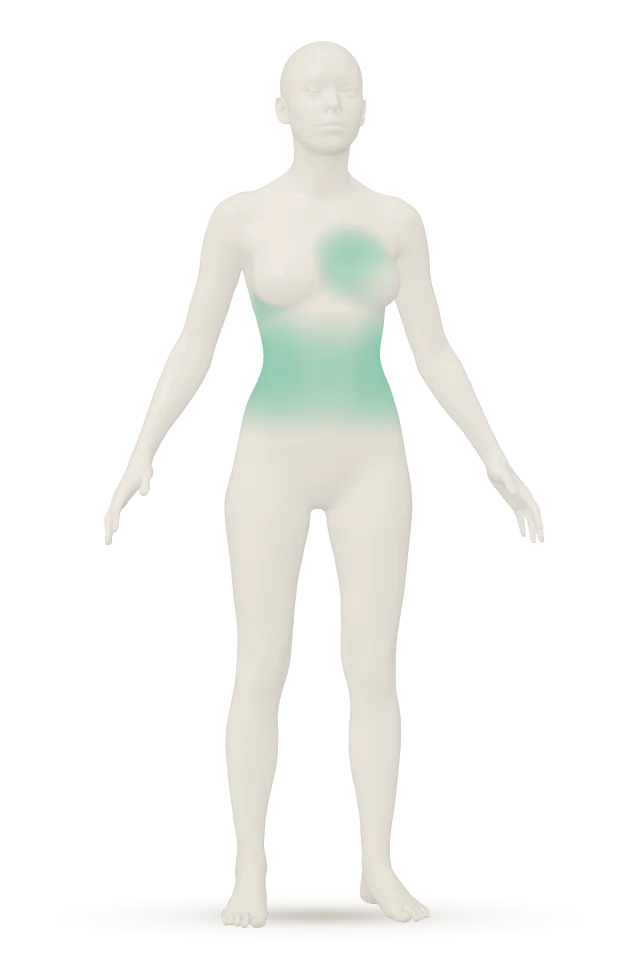
Heart & blood vessels
In people. The 2023 SELECT trial showed semaglutide reduced cardiovascular events by 20% independent of weight loss.
Appetite & metabolism
In people. About 15% average weight loss at 68 weeks in its main trial.
An area lights for what a peptide is used for and what people report, with the evidence beside it. It isn’t a promise that it works there.
Week by week.
What to expect in the first 8 weeks
- Onset
- Days–2 weeks
- Peak effect
- 60–68 weeks
- Duration
- Ongoing
Day 1–28 · 0.25 mgRCT
Gut is adapting
The 0.25mg run-in is sub-therapeutic — it's letting your gut tolerate GLP-1 signaling. Nausea is often worst in week 1 then settles. Don't expect weight loss yet; eat small, stay hydrated.
The science
FDA Wegovy label 2025 specifies the 0.25mg step as GI adaptation, not weight loss. The first dose is usually the hardest — not because of dose magnitude but because it's a new signal the body hasn't seen before.
Sources- FDA Wegovy label (2025)
Updated Apr 2026
Day 29–56 · 0.5 mgRCT
Appetite shifts are real now
You're at 0.5mg, where the first clear appetite signal tends to show up. Commonly reported: portions shrinking on their own and the first quieting of 'food noise' — you're not chasing food between meals the way you used to.
The science
In a 20-week appetite trial in 72 adults, semaglutide cut the energy eaten at an all-you-can-eat lunch by 35% versus placebo, with less hunger and fewer cravings (Friedrichsen 2021). STEP 1 didn't measure appetite by dose step or "food noise"; that timing comes from user reports.
Sources- Friedrichsen et al. (2021)
Updated Sep 2026
Any dayRCT
What Semaglutide is built on
Sema is the most-studied weight loss drug in history. Over 17,000 patients across STEP and SELECT, FDA approvals for diabetes and obesity, plus 20% cardiovascular risk reduction independent of weight loss.
The science
SELECT (Lincoff 2023 NEJM) was the first CV outcomes trial for an obesity drug in non-diabetic patients — 17,604 participants, 20% relative reduction in major adverse cardiovascular events at 2.4mg over ~40 months. Expanded the framing from "weight drug" to "metabolic disease modifier."
Sources- Wilding et al. (2021)
- Lincoff et al. (2023)
Updated Apr 2026
With BPC-157Community
Why people add BPC-157 to Sema
Sema titration comes with GI symptoms, and BPC-157, first studied as a stomach-protecting peptide, is added to ease them. Commonly reported: fewer GI side effects in the first weeks after each step-up.
The science
BPC-157's origin as a gastroprotective compound fits the GLP-1 side-effect profile: in animal studies it supports gut mucosal integrity, reduces NSAID damage and modulates the gut-brain axis. No trial has tested the combination; the pattern comes from community reports.
Sources- Sikiric et al. (2018)
Updated Sep 2026
Any dayRCT
There is now an oral semaglutide for weight loss
Since December 2025 there's an FDA-approved oral semaglutide for obesity — a 25mg daily Wegovy pill, the first oral GLP-1 cleared for weight loss. When taken as directed, the trial showed about −16.6% at 64 weeks, with roughly a third of people losing ≥20%. The needle-free option is real now, not investigational.
The science
OASIS-4 supported the December 2025 FDA approval of oral semaglutide 25mg (Wegovy) for obesity, launched in January 2026 — the first oral GLP-1 for weight management. On-treatment (adherent) analysis showed −16.6% at 64wk, with ~1/3 of participants reaching ≥20% loss. Oral absorption is sensitive to dosing conditions (empty stomach, limited water, wait before eating), which is why adherence framing matters for the effect size. This is distinct from Rybelsus, the lower-dose oral semaglutide approved for type 2 diabetes.
Sources- OASIS-4 (2026)
Updated Sep 2026
Any dayRCT
Semaglutide is now approved for fatty-liver disease
Beyond weight: in August 2025 semaglutide gained an FDA approval for MASH (the inflammatory form of fatty liver). In the phase 3 trial it resolved steatohepatitis in about 63% of people at 72 weeks and improved liver fibrosis — a benefit that goes past the number on the scale.
The science
The ESSENCE phase 3 trial supported the August 2025 FDA approval of semaglutide for MASH (metabolic dysfunction-associated steatohepatitis): 62.9% achieved resolution of steatohepatitis without worsening fibrosis at 72wk, alongside fibrosis improvement. Tirzepatide is close behind in MASH but not yet approved for it. This positions the GLP-1 class as a liver-disease modifier, not only a weight drug.
Sources- ESSENCE (2025)
Updated Jun 2026
Any dayClinical
Protein + lifting protect the muscle underneath
A real share of weight lost on semaglutide is lean mass — across the GLP-1 class, roughly a quarter to 40% of the loss. The fix is in your hands: keep protein near 1.6–2.2g/kg and keep resistance training through the cut. Sema quiets appetite; protein and lifting decide whether the loss is fat or muscle.
The science
STEP and SURMOUNT body-composition data put lean mass at ~25–40% of total weight lost on incretin therapy. Muscle-sparing combinations are emerging in trials (bimagrumab + semaglutide: ~22% loss with ~92% from fat) but are not standard care. Protein intake and resistance training are the evidence-backed levers a user controls today.
Sources- STEP program (2021)
Updated Jun 2026
After week 8
Day 57–112 · 1 mgRCT
Clinically useful weight loss kicks in
At 1mg the scale usually starts moving visibly, and many people pass 5% loss around this step. Commonly reported: eating less without effort feels very real now.
The science
STEP 1 data: 86% of 2.4mg-group participants hit ≥5% loss at the study endpoint (Wilding 2021); the per-step timing isn't reported. Users commonly describe food-noise reduction as the single biggest subjective change; STEP 1 didn't measure it, and the term came from patients.
Sources- Wilding et al. (2021)
Updated Sep 2026
Day 113–140 · 1.7 mgRCT
Max submaximal step
1.7mg is the option for people who don't tolerate the full 2.4mg, or want meaningful loss without chasing the highest dose. If you're doing well here, this is a legitimate maintenance point.
The science
Wegovy label recognizes 1.7mg as a valid maintenance step for users who can't tolerate the 2.4mg. Many Sema users plateau at 1.7mg or even 1mg without needing to escalate — clinical trial mean effect sizes come from the full 2.4mg arm, but individual responses vary widely.
Sources- FDA Wegovy label (2025)
Updated Apr 2026
Day 141–364 · 2.4 mgRCT
Full dose — the working dose
Full dose (2.4mg) — the working dose. Weight keeps coming off, more slowly over time, until about week 60, with STEP 1 showing −14.9% at 68 weeks. This is the payoff for the whole titration ladder.
The science
Wilding 2021 NEJM STEP 1: −14.9% body weight at 68wk on 2.4mg vs −2.4% placebo. 86% of participants hit ≥5% loss. Weight fell from week 4 and reached its lowest point around week 60.
Sources- Wilding et al. (2021)
Updated Sep 2026
Day 365+RCT
Plateau territory — new baseline
Plateau territory. In STEP 1 weight reached its lowest point around week 60 — most of the loss has landed. This is a maintenance medication, not a course: stopping usually means regaining most of the loss (around 10kg back in the first year in pooled data, trending toward baseline by ~18 months). Hold, taper slowly, or stop is a call for you and your clinician.
The science
STEP 1 extension (Wilding 2022) showed roughly 2/3 weight regain within a year of stopping semaglutide; a 2026 BMJ meta-analysis put regain for semaglutide and tirzepatide at about 9.9kg in the first year, back to baseline by about 1.5 years (West 2026). This reflects chronic-therapy pharmacology, not failure. SELECT (Lincoff 2023) separately showed 20% MACE reduction in non-diabetic patients at 2.4mg — a benefit independent of ongoing weight loss. The continue/taper/stop decision is yours, made with your clinician.
Sources- Wilding et al. (2022)
- West et al. (2026)
- Lincoff et al. (2023)
Updated Sep 2026
Day 1 is the day you start it.
Multiple Phase III RCTs (STEP 1–5). FDA-approved. Timelines are for weight management dose (2.4mg) on the label's titration.
Clinical trial data
Mixing and a typical run.
Example numbers
Reconstitution example
Reconstitute a 10 mg vial of Semaglutide with 2 mL of bacteriostatic water and a 0.25 mg dose is 5 units on a U-100 syringe, about 40 doses per vial.
- Vial
- 10 mg
- Water
- 2 mL
- Amount
- 0.25 mg
Draw to5 units
0.3 mL insulin syringe · 30 units
Run notes
- Cycle
- FDA-approved for ongoing use. Community uses indefinitely or until goal weight reached, then tapers.Community practice — opinions vary. Not a clinical recommendation.
- Timing
- Once weekly SubQ, same day each week. Can inject any time of day — consistency matters.
- Route
- SubQ injection
- Stacks
- BPC-157 (GI support), Tirzepatide (not combined)
Safety.
Common side effects
- Nausea
- Vomiting
- Diarrhea
- Constipation
- Decreased appetite
- Fatigue
- Pancreatitis risk
Interactions
Like the GLP-1 class, semaglutide delays gastric emptying and can affect absorption of oral medications — a label-level consideration; discuss oral-drug timing with your clinician. Combined with insulin or sulfonylureas, additive glucose-lowering increases hypoglycemia risk per the label, warranting clinician-guided monitoring. No specific documented interaction with SSRIs or anticoagulants beyond general caution; raise all medications and supplements with your clinician.
Safety notes
Across the STEP and SELECT programs, semaglutide's adverse events are predominantly mild-to-moderate transient gastrointestinal effects; in SELECT, discontinuation for adverse events was higher than placebo (16.6% vs 8.2%), driven by GI events, while overall serious adverse events were actually lower than placebo. Gallbladder-related events were more frequent than placebo (2.8% vs 2.3% in SELECT, mostly gallstones), and acute pancreatitis was rare with no notable signal vs placebo across STEP 1-5. It shares the GLP-1-class rodent thyroid C-cell warning. These are trial/label findings — discuss with your clinician.
Goes with.
Questions people ask.
What is Semaglutide?
A GLP-1 receptor agonist that mimics a gut hormone your body releases after eating: it reduces appetite and slows stomach emptying.
How is Semaglutide dosed in research?
The FDA label range for Semaglutide is 0.25–2.4 mg, weekly SubQ, with a 0.25 mg starting dose.
How long does Semaglutide last?
The half-life of Semaglutide is ~1 week (FDA label).
What do people report on Semaglutide?
Commonly reported on Semaglutide: the constant background thoughts about food ("food noise") go quiet and portions shrink without effort, with nausea worst in the first days after each dose step. FDA-approved for type 2 diabetes, weight management, heart-risk reduction and MASH, with about 15% average weight loss at 68 weeks in its main trial.
Is Semaglutide safe?
The research basis for Semaglutide is established: clinical trials or FDA-approved use exists. Common side effects in the library: nausea, vomiting, diarrhea, constipation, decreased appetite, fatigue and pancreatitis risk.
What does Semaglutide stack with?
Common stacks for Semaglutide: BPC-157 (GI support) and Tirzepatide (not combined).
Reference.
- Cadence
Weekly
Weekly SubQ
- Half-life
~1 week
~1 week (FDA label)
- Research basis
●●●
EstablishedClinical trials or FDA-approved use exists
Track your progress
Watch it work.
Weight, waist and photos in one arc.
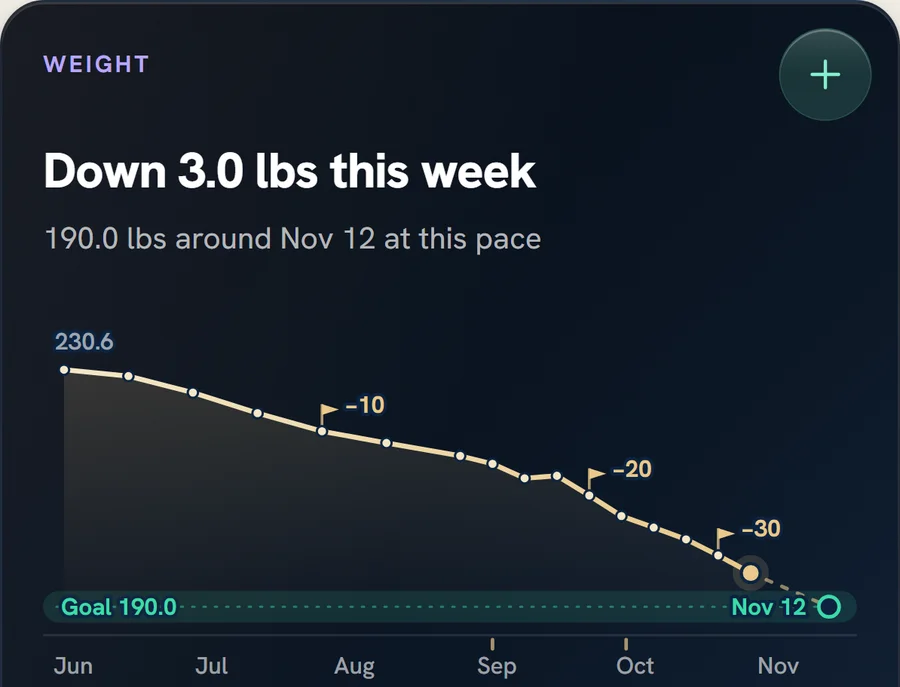


34.8 lbsdown since June
PepVault for iPhone
Track Semaglutide in PepVault
Log every dose, keep your vial and the doses left in it and watch its estimated active level. 7 days free on the yearly plan for new subscribers.
Open the calculatorHow the vial count worksExplore the live demo
Reviewed How we check the library