SS-31 Dosage, half-life & reference guide
Also known as Elamipretide · Szeto-Schiller 31 · MTP-131
A mitochondria-targeting peptide that binds directly to cardiolipin — a key lipid in the inner mitochondrial membrane where your cells generate energy. It stabilizes this membrane and cuts oxidative stress at its source, as shown in cell and animal studies. FDA-approved in 2025 as elamipretide (Forzinity) for the rare disease Barth syndrome; trials in mitochondrial myopathy and heart failure missed their main goals.

- Studied range
- 2–4 mg
- How often
- Daily
- Half-life
- Short
- Evidence
- ●
●●Emerging - Route
- SubQ injection
Studied in research — not a recommendation. FDA-approved as Forzinity (elamipretide): 40 mg SubQ once daily, to improve muscle strength in adults and children with Barth syndrome who weigh at least 30 kg (accelerated approval).
How it works.
Mitochondria-targeting peptide that binds cardiolipin in the inner mitochondrial membrane. Improves mitochondrial function and reduces oxidative stress (cell and animal studies). FDA-approved in 2025 (accelerated) for Barth syndrome, and in trials for dry AMD.
Commonly reported: Injection-site redness, itching or welts (very common), and for some, steadier stamina with less post-exertion crash over weeks.
Where SS-31 works.
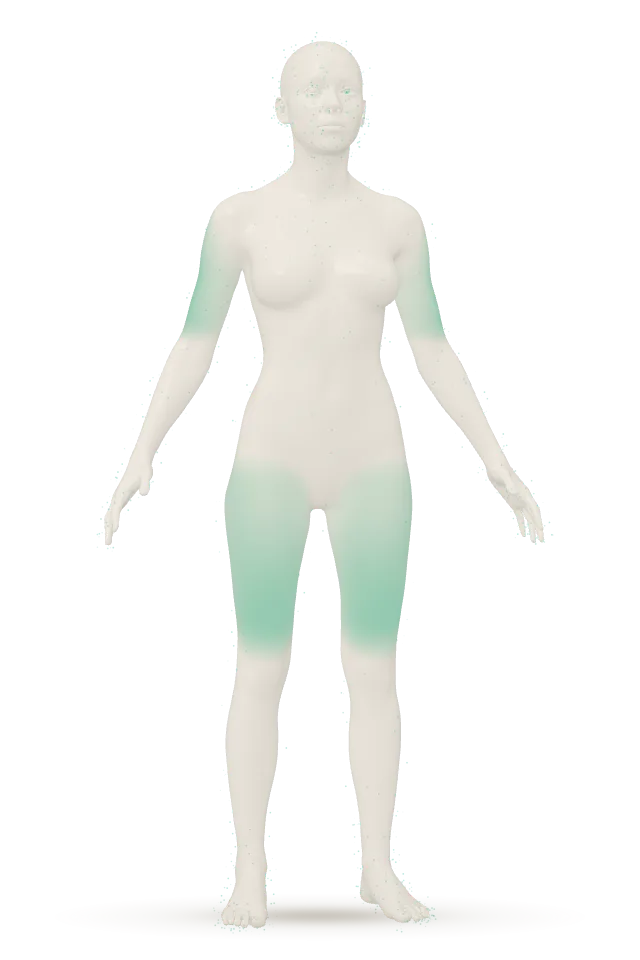
Muscle
Reported by users. Commonly reported by those who respond: sharper recovery from workouts and more exercise capacity.
Energy & longevity
In people. Mitochondria-targeting peptide that binds cardiolipin in the inner mitochondrial membrane. Improves mitochondrial function and reduces oxidative stress (cell and animal studies). FDA-approved in 2025 (accelerated) for Barth syndrome.
An area lights for what a peptide is used for and what people report, with the evidence beside it. It isn’t a promise that it works there.
Week by week.
What to expect in the first 8 weeks
Day 1–14Community
A slow, cumulative start
Commonly reported: steadier energy through the day and less post-exertion crash, building over weeks rather than hitting at once. Injection-site redness or itching is very common.
The science
SS-31 (Elamipretide) accumulates in the inner mitochondrial membrane 1000x over extracellular concentration by binding cardiolipin. It stabilizes the electron transport chain complexes and reduces reactive oxygen species leakage. In a 5-day IV trial in primary mitochondrial myopathy, the top dose trended toward a longer 6-minute walk (Karaa et al. 2018); the 24-week phase 3 found no benefit (Karaa et al. 2023). The record is mixed, though — at least one study in older adults reported improved acute ATP output without a corresponding reduction in fatiguability, a reminder that the energy signal doesn't always translate to felt endurance.
Sources- Karaa et al. (2018)
- Karaa et al. (2023)
Updated Sep 2026
Day 14–56Community
Where stamina changes show up
Commonly reported by those who respond: sharper recovery from workouts and more exercise capacity. If your baseline was good, effects are subtler.
The science
In Barth syndrome, walking distance and muscle strength improved during long-term open-label treatment (TAZPOWER; Thompson 2021), the basis for its 2025 approval; the phase 3 in primary mitochondrial myopathy found no benefit (Karaa 2023). In dry AMD, the phase 2 ReCLAIM-2 missed its main goals but slowed loss of the photoreceptor layer; a phase 3 (ReNEW) is under way.
Sources- Thompson et al. (2021)
- Karaa et al. (2023)
Updated Sep 2026
Day 56–112Clinical
Maintenance or cycle-off
Cycle decision point. In the long Barth syndrome extension, gains held past 3 years of daily use, so some users run it continuously; others cycle 8 weeks on / 4 off, which is community convention.
The science
In Barth syndrome, an open-label extension ran past 3 years (168 weeks) with sustained gains in walking distance, in 8 patients (Thompson 2024). Receptor downregulation isn't expected — cardiolipin binding isn't a classical GPCR mechanism.
Sources- Thompson et al. (2024)
Updated Sep 2026
Any dayClinical
What SS-31 is built on
SS-31 (Elamipretide) has the most clinical data of any mitochondrial peptide — phase 2 and phase 3 trials in primary mitochondrial myopathy, Barth syndrome, dry AMD and heart failure, several of which missed their main goals. In 2025 the FDA granted it accelerated approval for Barth syndrome, its first approval.
The science
Developed by Hazel Szeto (Weill Cornell) and Peter Schiller (Montreal); commercialized by Stealth BioTherapeutics. Multiple completed phase 2/3 trials with published data. The cardiolipin-targeting mechanism is unique in clinical pharmacology. The approval (Forzinity, 2025) rests on muscle strength in 12 Barth patients after the randomized part missed its primary endpoints; on the label, injection-site reactions occurred in every treated patient. The overall evidence is still stronger than for most peptides in this category.
Sources- FDA Forzinity label (2025)
- Thompson et al. (2021)
- Szeto (2014)
Updated Sep 2026
With MOTS-c and HumaninCommunity
Full-spectrum mitochondrial stack
SS-31 protects the mitochondrial membrane itself, MOTS-c tunes metabolic signaling and humanin damps cell-death signaling. Three angles, one organelle. Rationale-based rather than trial-based — no combination data exists.
The science
The three peptides converge on mitochondrial health via non-overlapping mechanisms: membrane integrity (SS-31), AMPK signaling (MOTS-c), Bax-mediated cell death (Humanin). Combined dosing has not been studied in any human trial.
Sources- Szeto (2014)
Updated Sep 2026
Day 1 is the day you start it.
Mixing and a typical run.
Example numbers
Reconstitution example
Reconstitute a 10 mg vial of SS-31 with 2 mL of bacteriostatic water and a 3 mg dose is 60 units on a U-100 syringe, about 3 doses per vial.
- Vial
- 10 mg
- Water
- 2 mL
- Amount
- 3 mg
Draw to60 units
1 mL insulin syringe · 100 units
Run notes
- Cycle
- Daily or EOD use. Cycles of 4–8 weeks common; some run continuously. The Forzinity label doses it once daily with no break.Community practice — opinions vary. Not a clinical recommendation.
- Timing
- Morning injection. SubQ only.
- Route
- SubQ injection
- Stacks
- MOTS-c, Humanin
Safety.
Common side effects
- Injection site reaction
- Nausea
- Mild headache
Compared with.
Questions people ask.
What is SS-31?
A mitochondria-targeting peptide that binds directly to cardiolipin — a key lipid in the inner mitochondrial membrane where your cells generate energy. It stabilizes this membrane and cuts oxidative stress at its source, as shown in cell and animal studies. FDA-approved in 2025 as elamipretide (Forzinity) for the rare disease Barth syndrome; trials in mitochondrial myopathy and heart failure missed their main goals.
How is SS-31 dosed in research?
The research range for SS-31 is 2–4 mg, daily. Studied in research — not a recommendation. FDA-approved as Forzinity (elamipretide): 40 mg SubQ once daily, to improve muscle strength in adults and children with Barth syndrome who weigh at least 30 kg (accelerated approval).
How long does SS-31 last?
The half-life of SS-31 is short (hours).
What do people report on SS-31?
Commonly reported on SS-31: injection-site redness, itching or welts (very common), and for some, steadier stamina with less post-exertion crash over weeks.
Is SS-31 safe?
The research basis for SS-31 is emerging: primarily preclinical / limited human data. Common side effects in the library: injection site reaction, nausea and mild headache.
What does SS-31 stack with?
Common stacks for SS-31: MOTS-c and Humanin. Curated stacks with SS-31: Longevity Core.
Research.
Reference.
- Cadence
Daily
- Half-life
Short
Short (hours)
- Research basis
●
●●EmergingPrimarily preclinical / limited human data
PepVault for iPhone
Track SS-31 in PepVault
Log every dose and keep your vial and the doses left in it. 7 days free on the yearly plan for new subscribers.

Open the calculatorHow the vial count worksExplore the live demo
Reviewed How we check the library