Pentosan Polysulfate Dosage, half-life & reference guide
Also known as Pentosan polysulfate sodium · PPS · iPPS · NaPPS · Elmiron · Pentosan · Zycosan
Reviewed Evidence: ModeratePublished by PepVault
A heparin-like sugar molecule, not a peptide, that is an FDA-approved pill for bladder pain and a veterinary joint injection. In people with knee osteoarthritis, short courses of injections have eased stiffness and pain at rest for months after the last dose in a placebo-controlled pilot, and a phase 3 trial is running.

- Studied range
- 100–180 mg
- How often
- 1–2× weekly
- Half-life
- ~20–27 hours
- Evidence
- ●●
●Moderate - Routes
- SubQ, IM +1
Studied in research — not a recommendation. FDA-approved only as an oral capsule (Elmiron) for interstitial cystitis bladder pain; the joint injection is investigational in people.
How it works.
Not a peptide: a semi-synthetic, heparin-like sulfated sugar made from beech-wood hemicellulose, built to resemble the glycosaminoglycans that cartilage and the bladder lining are made of. It is a weak blood thinner (about 1/15 of heparin's activity). In joints it is thought to slow cartilage breakdown and calm inflammation: in a 2026 placebo-controlled trial, injections lowered a marker of cartilage breakdown in the knee's joint fluid. FDA-approved only as an oral capsule (Elmiron) for bladder pain in interstitial cystitis; the injectable is approved in the US for osteoarthritis in horses (Zycosan) and is in phase 3 trials for knee osteoarthritis in people.
Commonly reported: A less stiff, less swollen knee over a few weeks. It thins the blood a little, and long-term use of the pill is linked to retinal changes.
Your report
Taken Pentosan Polysulfate? What did you notice?
One tap to start. About 30 seconds, no account.

PepVault for iPhone
Track Pentosan Polysulfate in PepVault
Log each dose, see how many doses are left in the vial, and keep your step-ups in one place.

7 days free on the yearly plan for new subscribers.
Where Pentosan Polysulfate works.
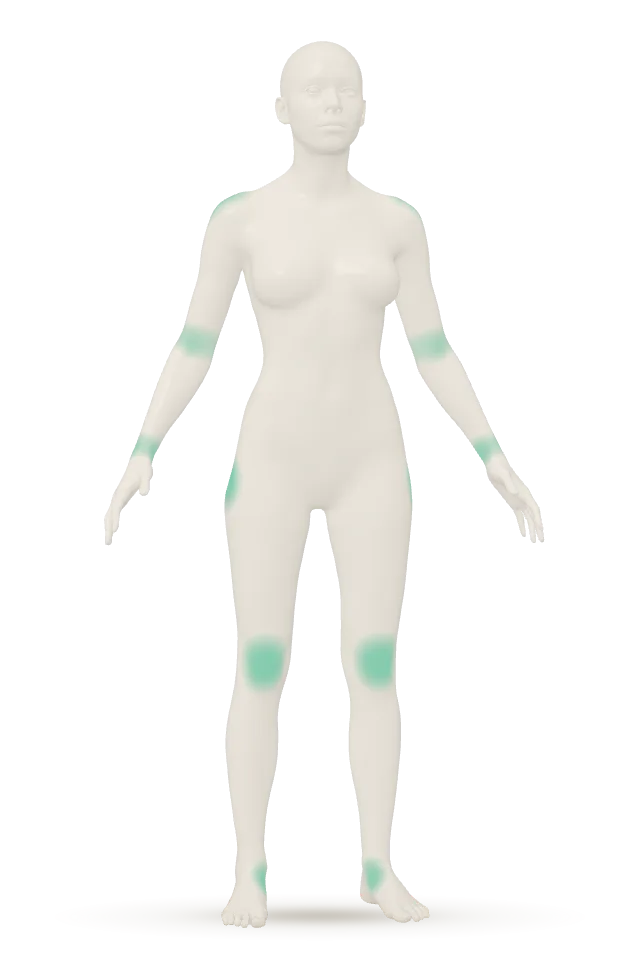
Joints & tendons
In people. In people with knee osteoarthritis, short courses of injections have eased stiffness and pain at rest for months after the last dose in a placebo-controlled pilot.
An area lights for what a peptide is used for and what people report, with the evidence beside it. It isn’t a promise that it works there.
Week by week.
What to expect in the first 8 weeks
- Onset
- 1–4 weeks (swelling and stiffness ease)
- Peak effect
- 4–12 weeks (pain and function scores best in the trials)
- Duration
- A 4–6-week course; effects followed for months after
Day 1–14Clinical
Swelling is the first thing to move
Pentosan is thought to work on the joint's lining and cartilage rather than on pain directly. In an open trial, knee swelling went down within the first weeks. A note of how the joint feels on stairs today gives you a fair baseline.
The science
Kumagai 2010: 20 patients with mild knee osteoarthritis (Kellgren-Lawrence 1–3), 2 mg/kg under the skin weekly for 6 weeks, open-label. Joint effusions were reduced quickly in all cases; flexion and pain on walking and on stairs improved. The dose moved coagulation tests, within safe levels, and triglycerides were slightly abnormal.
Sources- Kumagai et al. (2010)
Updated Nov 2026
Day 7–42Clinical
The labs that move with it
Pentosan thins the blood a little and can nudge liver enzymes and platelets. If you are having blood work during a course, those are the numbers it touches.
The science
Sié 1986: 30 healthy volunteers given 100 mg a day by injection for 10 days; clinical tolerance was good, ALT rose above normal in 18 of 24 on the drug and platelets fell 24–34% on average, with a prolonged APTT and weak anti-Xa activity. Elmiron label: mildly raised liver enzymes in 1.2%, low platelets in 0.2%, a weak anticoagulant at 1/15 of heparin.
Sources- Sié et al. (1986)
- Elmiron prescribing information (FDA) (2024)
Updated Nov 2026
Day 14–42RCT
Stiffness eases first
Through the course, the first change people in trials noticed was stiffness that lasted less long. Commonly reported: a knee that loosens up faster and aches less at rest. Easy bruising, at the shot or elsewhere, is the side effect to expect from a mild blood thinner.
The science
Ghosh 2005: 114 people (mean age 63) with knee osteoarthritis, randomized and double-blind, 3 mg/kg into the muscle weekly for 4 weeks against Ringer's solution. Duration of stiffness was better at weeks 4, 8, 12 and 16, and the patient's overall rating at weeks 4 to 24; injection-site bruising was under 1% in both groups. A pilot study.
Sources- Ghosh et al. (2005)
Updated Nov 2026
Day 42–180RCT
Relief that outlasts the course
In the trials the benefit held well after the last shot: pain at rest stayed lower for months, which is why courses are short. The knee in a few months, not the week after the course, is the fairer read.
The science
Ghosh 2005: pain at rest was better than placebo at weeks 8, 12, 16 and 24 (20 weeks after the last dose), and pain on walking and overall function for 8 weeks after stopping. Kumagai 2010: improvements continued for almost a year after a 6-week course (open-label, 20 patients). Skerrett 2026 (61 people, 39 days of injections): the cartilage-breakdown marker ARGS was still 74% lower than placebo at day 168.
Sources- Ghosh et al. (2005)
- Kumagai et al. (2010)
- Skerrett et al. (2026)
Updated Nov 2026
Any dayRCT
What pentosan is built on
Pentosan has been an FDA-approved pill for bladder pain for decades, and vets inject it for joints. In people, the joint injection rests on small placebo-controlled trials, with a large phase 3 trial now running. Long use of the pill is linked to retinal changes, so eye checks are part of the label.
The science
Elmiron label (2024): approved for interstitial cystitis bladder pain, 100 mg three times a day; warnings for pigmentary maculopathy with long-term use (most cases after 3 years or more, cumulative dose a likely risk factor) and for bleeding. Hall 2025 reviews the case that the maculopathy is caused by the drug and notes the injection for osteoarthritis is being tested. Knee osteoarthritis: Ghosh 2005 (114 people, placebo-controlled pilot), Skerrett 2026 (61 people, phase 2 biomarker trial; most authors work for the developer, Paradigm), and the 466-person phase 3 (NCT06917404, 2 mg/kg twice weekly for 6 weeks, results expected after July 2027).
Sources- Elmiron prescribing information (FDA) (2024)
- Hall et al. (2025)
- Ghosh et al. (2005)
- Skerrett et al. (2026)
Updated Nov 2026
With BPC-157Community
Joint lining and tendon, side by side
People run pentosan for the joint itself and BPC-157 for the tendons and ligaments around it. Each has its own evidence; no study has tested the pair, so each one's effects are read on their own.
The science
Pentosan's human joint evidence is knee osteoarthritis trials (Ghosh 2005; Skerrett 2026). BPC-157's evidence is rat tendon and ligament studies and three small uncontrolled human pilots (its library entry). Both act on healing by different routes; neither has been studied with the other.
Sources- Ghosh et al. (2005)
- Skerrett et al. (2026)
Updated Nov 2026
Day 1 is the day you start it.
Elmiron FDA label (2024) for the drug facts and safety; one randomized placebo-controlled pilot, one placebo-controlled biomarker trial and open-label studies in knee osteoarthritis. The injection is investigational in people.
Moderate evidence
A typical run.
Run notes
- Cycle
- The knee trials ran short courses: 2 mg/kg twice weekly for 6 weeks (Paradigm's phase 3), 2 mg/kg weekly for 6 weeks (Kumagai 2010) or 3 mg/kg into the muscle weekly for 4 weeks (Ghosh 2005), then follow-up of months with no dosing. The effect in those studies outlasted the course. Long continuous use is the pattern the label ties to eye changes.Community practice — opinions vary. Not a clinical recommendation.
- Timing
- Injected once or twice a week through a course; no time of day was set in the trials. The oral capsule is taken with water 1 hour before or 2 hours after meals (Elmiron label).
- Routes
- SubQ injection, IM injection, Oral capsule
- Stacks
- BPC-157, TB-500
Safety.
Common side effects
- Injection-site bruising
- Easier bruising or bleeding (gums, nose)
- Nausea or diarrhea
- Headache
- Patchy hair loss (uncommon)
- Raised liver enzymes on labs
Interactions
It adds to the effect of other blood thinners: the Elmiron label lists coumarins such as warfarin, heparin, clot-dissolving drugs, high-dose aspirin and NSAIDs as reasons to check bleeding risk first. In a label study it did not change warfarin's levels or INR. Liver enzymes and platelets are the labs read with it. Discuss any prescription medications with your clinician.
Safety notes
Approved in the US only as Elmiron, an oral capsule for interstitial cystitis; injecting it for joints is investigational in people (phase 3 under way) and approved only for animals. The Elmiron label's main warning is the eyes: long-term use is linked to pigmentary maculopathy, a change in the retina that shows up as trouble reading, slow adjustment to dim light or blurred vision; most cases came after 3 or more years, cumulative dose appears to raise the risk, and the changes may not reverse and can progress after stopping. The label suggests a retinal exam within six months of starting and periodically after. It is a weak blood thinner: the label reports rectal bleeding in 6.3% at 300 mg a day, bruising, nose and gum bleeding, and says anyone with a bleeding risk, a coming procedure or other blood thinners should be evaluated first. The label also warns that a similar product given by injection has been linked to delayed immune-driven low platelets (heparin-induced thrombocytopenia history is a caution). In a 10-day injection study in healthy volunteers, liver enzymes rose above normal in most and platelets fell by about a quarter to a third; the knee-injection trials reported it as well tolerated, with no serious related events. Not named on the WADA 2026 Prohibited List. Discuss with your clinician.
One question at a time.
Questions people ask.
What is Pentosan Polysulfate?
A heparin-like sugar molecule, not a peptide, that is an FDA-approved pill for bladder pain and a veterinary joint injection. In people with knee osteoarthritis, short courses of injections have eased stiffness and pain at rest for months after the last dose in a placebo-controlled pilot, and a phase 3 trial is running.
How is Pentosan Polysulfate dosed in research?
The research range for Pentosan Polysulfate is 100–180 mg, 1–2x weekly (6-week course). Studied in research — not a recommendation. FDA-approved only as an oral capsule (Elmiron) for interstitial cystitis bladder pain; the joint injection is investigational in people.
How long does Pentosan Polysulfate last?
The half-life of Pentosan Polysulfate is ~20–27 hours (measured as total radioactivity after an oral dose, Elmiron label; no figure has been published for the injection).
What do people report on Pentosan Polysulfate?
Commonly reported on Pentosan Polysulfate: A less stiff, less swollen knee over a few weeks. It thins the blood a little, and long-term use of the pill is linked to retinal changes.
Is Pentosan Polysulfate safe?
The research basis for Pentosan Polysulfate is moderate: animal studies + some human data. Common side effects in the library: injection-site bruising, easier bruising or bleeding (gums, nose), nausea or diarrhea, headache, patchy hair loss (uncommon) and raised liver enzymes on labs.
What does Pentosan Polysulfate stack with?
Common stacks for Pentosan Polysulfate: BPC-157 and TB-500.
Research.
Reference.
- Cadence
1–2× weekly
1–2x weekly (6-week course)
- Half-life
~20–27 hours
~20–27 hours (measured as total radioactivity after an oral dose, Elmiron label; no figure has been published for the injection)
- Research basis
●●
●ModerateAnimal studies + some human data
PepVault for iPhone
Track Pentosan Polysulfate in PepVault
Log each dose, see how many doses are left in the vial, and keep your step-ups in one place.
7 days free on the yearly plan for new subscribers.
Reviewed How we check the library