Collagen Peptides Dosage, half-life & reference guide
Also known as Hydrolyzed collagen · Collagen hydrolysate · Collagen peptide · Bioactive collagen peptides · Gelatin hydrolysate · Collagen powder
Reviewed Evidence: ModeratePublished by PepVault
Collagen broken into small peptides that dissolve in a drink. Some of these peptides reach the blood intact and are thought to signal and feed the cells that build skin, tendon, cartilage and bone. Trials report better skin hydration and elasticity after about three months, less knee pain during sport, faster tendon rehab and denser bones in older women, though a 2026 re-analysis questioned the skin results.

- Studied range
- 5–15 g
- How often
- Daily
- Half-life
- ~4 hours
- Evidence
- ●●
●Moderate - Route
- Oral powder
Studied in research — not a recommendation.
How it works.
Collagen from animal skin, bone or fish broken down into short peptides that dissolve in a drink. Most of it is digested to amino acids, but some small collagen peptides, chiefly the dipeptide Pro-Hyp, reach the blood intact within an hour or two. The idea is that these act as building blocks and as signals to the cells that make collagen in skin, tendon, cartilage and bone; in a small crossover study, gelatin with vitamin C taken an hour before exercise doubled a blood marker of collagen production. Trials report modest gains in skin hydration and elasticity, activity-related knee pain, Achilles tendon function and bone density, though a 2026 re-analysis of the skin meta-analyses found no reliable benefit. It does not build muscle the way whey protein does.
Commonly reported: Smoother skin and less achy joints over a couple of months.
Your report
Taken Collagen Peptides? What did you notice?
One tap to start. About 30 seconds, no account.

PepVault for iPhone
Track Collagen Peptides in PepVault
Log each dose and keep your schedule and step-ups in one place.

7 days free on the yearly plan for new subscribers.
Where Collagen Peptides works.
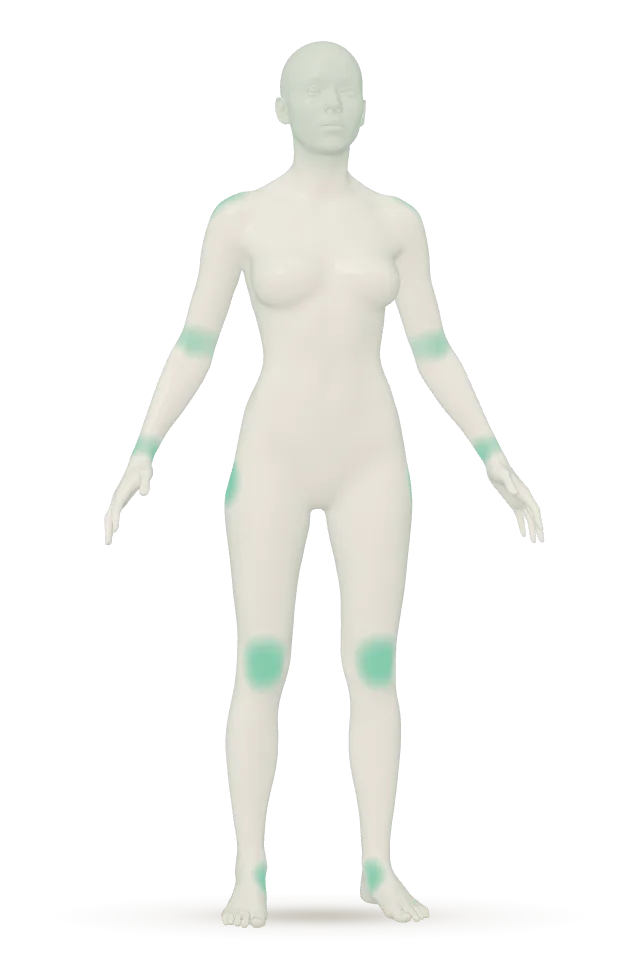
Skin & hair
In people. Pooled trials found better hydration and elasticity after about three months, but not fewer wrinkles, and one re-analysis found no reliable benefit at all.
Joints & tendons
In people. Less knee pain during sport, faster tendon rehab and denser bones in older women.
An area lights for what a peptide is used for and what people report, with the evidence beside it. It isn’t a promise that it works there.
Week by week.
What to expect in the first 8 weeks
- Onset
- 4–8 weeks (joint comfort, skin hydration)
- Peak effect
- 12 weeks or more (skin elasticity, knee pain); 12 months (bone)
- Duration
- Ongoing; trials ran 3–12 months
Day 1–28Clinical
Building blocks in the blood
Some of the collagen you drink reaches your blood as small peptides, peaking an hour or two after each dose. The changes trials measured took weeks to show, so the first month is about consistency.
The science
Iwai 2005: in fasting volunteers given 9.4–23 g of gelatin hydrolysate, the peptide form of hydroxyproline in plasma rose to 20–60 nmol/mL at 1–2 hours and fell to half by 4 hours; the main peptide was Pro-Hyp, with smaller amounts of Ala-Hyp, Pro-Hyp-Gly, Leu-Hyp and others. These collagen dipeptides are thought to be the signalling part.
Sources- Iwai et al. (2005)
Updated Nov 2026
Day 7–90Clinical
An hour before loading the tendon
For tendons and ligaments, the idea is to have collagen building blocks in the blood when the tissue is loaded. In a small study, gelatin with vitamin C an hour before a few minutes of jump rope doubled a marker of new collagen.
The science
Shaw 2017: 8 healthy men, crossover, 5 or 15 g vitamin C-enriched gelatin or placebo, then 6 minutes of rope-skipping, three times a day for 3 days. Blood glycine, proline, hydroxyproline and hydroxylysine peaked an hour after; engineered ligaments grown in post-gelatin serum had more collagen and better mechanics; 15 g doubled PINP, a blood marker of collagen synthesis.
Sources- Shaw et al. (2017)
Updated Nov 2026
Day 28–84RCT
Knees that ache less in training
In a placebo-controlled trial, athletes with sore knees had less pain during activity after 12 weeks of 5 g a day, and leaned less on other treatments. Pain at rest changed less. Commonly reported: joints that complain less on runs and stairs.
The science
Zdzieblik 2017: 139 athletes with functional knee pain, 5 g bioactive collagen peptides or placebo daily for 12 weeks. Activity-related pain fell by 19.5 points (VAS) against 13.9 on placebo (p = 0.046); the physicians' rating agreed (16.7 against 12.2, p = 0.021). Pain at rest improved without a significant difference (p = 0.209). Use of other treatments fell with collagen.
Sources- Zdzieblik et al. (2017)
Updated Nov 2026
Any dayRCT
What collagen peptides are built on
Collagen peptides rest on many small randomized trials, many testing a branded product: modest gains for knee pain in sport, tendon rehab and bone density, and a disputed effect on skin. For building muscle, whey protein does more.
The science
Bone: König 2018, 131 postmenopausal women, 5 g a day for 12 months; spine T-score +0.10 against −0.03 (p = 0.030), femoral neck +0.09 against −0.01 (p = 0.003). Tendon: Praet 2019, 20 people with Achilles tendinopathy, crossover with calf-strengthening; function (VISA-A) rose 12.6 points on collagen first against 5.3 on placebo first, with no adverse events. Muscle: Oikawa 2020, 22 older women, 30 g twice a day for 6 days; whey raised muscle protein synthesis, collagen did not over the longer measure. Skin: Batool 2026 against Grimes 2026.
Sources- König et al. (2018)
- Praet et al. (2019)
- Oikawa et al. (2020)
- Grimes and Mahto (2026)
Updated Nov 2026
With BPC-157Community
Raw material beside a repair signal
People pair collagen peptides with BPC-157 on the idea that one supplies collagen building blocks while the other drives repair. No study has tested the pair, and BPC-157's own evidence is mostly in animals.
The science
Collagen peptides supply collagen amino acids and dipeptides (Iwai 2005; Shaw 2017). BPC-157's tendon evidence is in rats (its library entry). The combination is community practice; neither has been studied with the other.
Sources- Iwai et al. (2005)
- Shaw et al. (2017)
Updated Nov 2026
After week 8
Day 84–180RCT
Skin hydration and elasticity
Skin is the slowest and most argued-over result. Pooled trials found better hydration and elasticity after about three months, but not fewer wrinkles, and one re-analysis found no reliable benefit at all. A photo in the same light at the start is the fair comparison.
The science
Batool 2026: 35 randomized trials, 2,534 healthy adults; hydration SMD 0.44, elasticity 0.62, lower water loss through the skin (−0.39), with elasticity and barrier gains needing 12 weeks or more; wrinkle, roughness and dermal-density effects were driven by outliers. Pu 2023 (26 trials, 1,721 people) found hydration and elasticity gains but biases in the trials. Grimes 2026 re-analysed the major meta-analyses, found data reported inaccurately and measures combined that should not be, and in a dose meta-regression found no evidence of benefit.
Sources- Batool et al. (2026)
- Pu et al. (2023)
- Grimes and Mahto (2026)
Updated Nov 2026
Day 1 is the day you start it.
Randomized placebo-controlled trials (skin, knee, tendon, bone) and meta-analyses that disagree on the skin evidence; most trials are small and several test a branded product.
Moderate evidence
A typical run.
Run notes
- Cycle
- Taken daily without breaks in the trials: 12 weeks for knee pain, 3–6 months for the Achilles tendon, 12 months for bone, and 8–12 weeks or more for skin, where elasticity needed at least 12 weeks.Community practice — opinions vary. Not a clinical recommendation.
- Timing
- Any time of day in most trials. For tendons and ligaments, the one mechanistic study took it with vitamin C about an hour before a short bout of exercise, when the collagen building blocks in blood peaked (Shaw 2017).
- Route
- Oral powder
- Stacks
- BPC-157, GHK-Cu, TB-500
Safety.
Common side effects
- Usually none: the trials report no side effects of note
Interactions
No drug interactions are reported. It is protein, so it counts toward a protein target, though as an incomplete one. Discuss any prescription medications with your clinician.
Safety notes
A food supplement made from animal or fish collagen, with no drug label; the trials tested it as a daily dietary supplement. Side effects were not a feature of the trials: the Achilles pilot reported none. It is made from pig, chicken, fish and other animal tissues, worth knowing with a fish or other food allergy or for dietary rules. It is not a complete protein for muscle: in older women it did not raise muscle protein synthesis over days, where whey did. Not named on the WADA 2026 Prohibited List. Discuss with your clinician.
One question at a time.
Questions people ask.
What is Collagen Peptides?
Collagen broken into small peptides that dissolve in a drink. Some of these peptides reach the blood intact and are thought to signal and feed the cells that build skin, tendon, cartilage and bone. Trials report better skin hydration and elasticity after about three months, less knee pain during sport, faster tendon rehab and denser bones in older women, though a 2026 re-analysis questioned the skin results.
How is Collagen Peptides dosed in research?
The research range for Collagen Peptides is 5–15 g, daily. Studied in research — not a recommendation.
How long does Collagen Peptides last?
The half-life of Collagen Peptides is ~4 hours (the collagen peptides in blood peak 1–2 hours after a dose and fall to half by about 4 hours, Iwai 2005); not a drug half-life.
What do people report on Collagen Peptides?
Commonly reported on Collagen Peptides: smoother skin and less achy joints over a couple of months.
Is Collagen Peptides safe?
The research basis for Collagen Peptides is moderate: animal studies + some human data. Common side effects in the library: usually none: the trials report no side effects of note.
What does Collagen Peptides stack with?
Common stacks for Collagen Peptides: BPC-157, GHK-Cu and TB-500.
Research.
Reference.
- Cadence
Daily
- Half-life
~4 hours
~4 hours (the collagen peptides in blood peak 1–2 hours after a dose and fall to half by about 4 hours, Iwai 2005); not a drug half-life
- Research basis
●●
●ModerateAnimal studies + some human data
PepVault for iPhone
Track Collagen Peptides in PepVault
Log each dose and keep your schedule and step-ups in one place.
7 days free on the yearly plan for new subscribers.
Reviewed How we check the library