Efinopegdutide Dosage, half-life & reference guide
Also known as MK-6024 · JNJ-64565111 · Efino
Reviewed 3 studiesEvidence: ModeratePublished by PepVault
A once-weekly GLP-1 and glucagon dual agonist that Merck is developing for MASH, the inflamed form of fatty liver disease. In its 52-week phase 2b trial, about 6 in 10 people on it had their liver inflammation resolve on biopsy, against about 1 in 8 on placebo, and at 7 mg about half saw their liver scarring improve. In a 24-week trial it cut liver fat by about 73%, against 42% on semaglutide 1 mg.

- Studied range
- 4–10 mgstarting dose 2 mg
- How often
- Weekly
- Evidence
- ●●
●Moderate - Route
- SubQ injection
Studied in research — not a recommendation.
How it works.
Once-weekly GLP-1 and glucagon receptor co-agonist, the same pair as mazdutide and survodutide, tuned about 2 to 1 toward GLP-1. GLP-1 lowers appetite and weight; glucagon acts on the liver directly and is thought to make it burn more of its stored fat. That is why Merck is developing it for MASH, the inflamed form of fatty liver disease, rather than for weight alone. Investigational; first made by Hanmi Pharmaceutical, then tested by Janssen in obesity, and now with Merck.
Commonly reported: GI side effects during step-ups, and weight loss too. Not approved anywhere.

Model. Individual results vary.
PepVault for iPhone
Track efinopegdutide in PepVault
Log each dose, see how many doses are left in the vial, and keep your step-ups in one place.

7 days free on the yearly plan for new subscribers.
Where Efinopegdutide works.
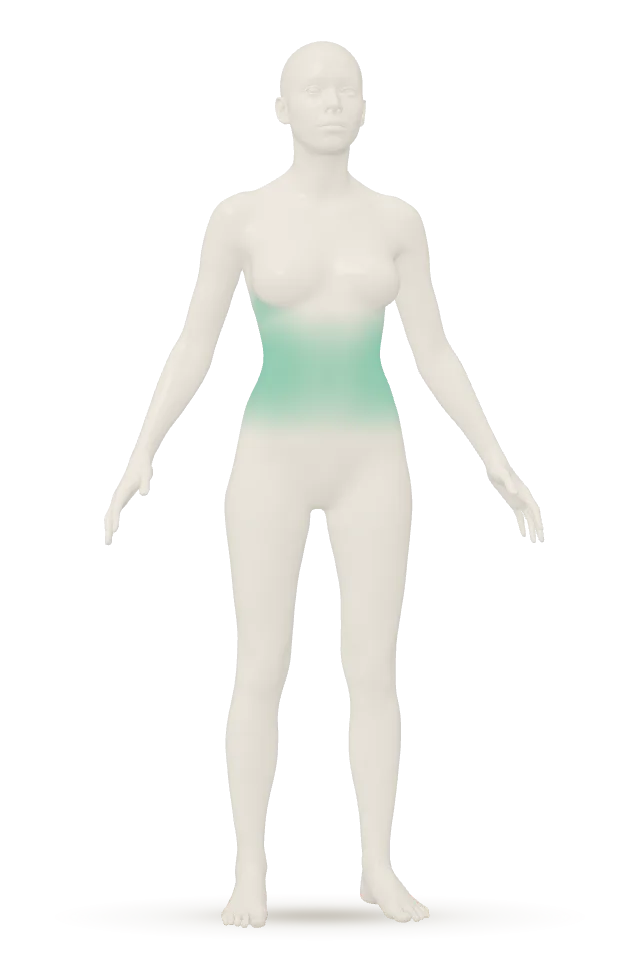
Appetite & metabolism
In people. In its 52-week phase 2b trial, about 6 in 10 people on it had their liver inflammation resolve on biopsy, against about 1 in 8 on placebo.
An area lights for what a peptide is used for and what people report, with the evidence beside it. It isn’t a promise that it works there.
Week by week.
What to expect in the first 8 weeks
- Onset
- Weeks
- Peak effect
- 24–52 weeks (trial endpoints)
- Duration
- Ongoing
Day 1–28 · 2 mgRCT
A gentle first month
You're on 2 mg, the first step of the MASH trial. An earlier trial that started at full dose had a lot of nausea and vomiting, which is why the newer trials step up slowly. Commonly reported: appetite dropping within days.
The science
Phase 2b (Lawitz 2026; NCT05877547): every efinopegdutide arm began at 2 mg for 4 weeks. In Janssen's obesity trial, 5.0, 7.4 and 10.0 mg were given with no dose escalation and nausea and vomiting were higher than on placebo and liraglutide (Alba 2021); a review linked the high GI rate to the missing titration (Hope 2021).
Sources- Lawitz et al. (2026)
- Alba et al. (2021)
- Hope et al. (2021)
Updated Nov 2026
Day 29–364 · 4 mgRCT
Four milligrams
You're at 4 mg. In the MASH trial, 4 mg as a final dose resolved liver inflammation in 56% at one year, against 13% on placebo, and improved scarring in 43% vs 21%.
The science
Phase 2b, week 52 (biopsy): MASH resolution without worsening of fibrosis 31/55 (56%) on 4 mg vs 7/53 (13%) on placebo (difference 43.0 points, p < 0.0001); fibrosis improvement of at least one stage 32/75 (43%) vs 16/77 (21%) (21.7 points, p = 0.0038) (Lawitz 2026).
Sources- Lawitz et al. (2026)
Updated Nov 2026
Any dayRCT
What Efinopegdutide is built on
Two phase 2 trials in obesity, a phase 2a in fatty liver against semaglutide, and a 52-week phase 2b in MASH with liver biopsies, published in the Lancet in November 2026. There is no phase 3 yet, and it is not approved anywhere.
The science
Janssen ran phase 2 in obesity as JNJ-64565111 (Alba 2021; Di Prospero 2021, with type 2 diabetes), then returned the licence to Hanmi, and Merck took it up for MASH (Hope 2021, Front Endocrinol). Phase 2a: 145 people with fatty liver, 10 mg vs semaglutide 1 mg (Romero-Gómez 2023, J Hepatol; NCT04944992). Phase 2b: 386 randomised at 176 centres in 26 countries, biopsy-confirmed MASH with F2-F3 fibrosis, 4/7/10 mg vs placebo and open-label semaglutide 2.4 mg (Lawitz 2026, Lancet; sponsor Merck Sharp & Dohme). A compensated-cirrhosis phase 2 (NCT06465186) has completed.
Sources- Alba et al. (2021)
- Di Prospero et al. (2021)
- Hope et al. (2021)
- Romero-Gómez et al. (2023)
- Lawitz et al. (2026)
Updated Nov 2026
With BPC-157Community
Why people add BPC-157 to a GLP-1
GI side effects come mostly with the step-ups, and BPC-157, first studied as a stomach-protecting peptide, is added to ease them. Commonly reported: smoother step-ups. No trial has tested the pair.
The science
BPC-157's early research was on gastric protection in animal studies (Sikiric 2018 review). No trial has tested it alongside efinopegdutide or any GLP-1 drug; the pairing comes from community reports.
Sources- Sikiric et al. (2018)
Updated Nov 2026
After week 8
Day 57–364 · 7 mgRCT
The dose the trial favoured
You're at 7 mg, the dose the trial's authors judged the best balance. About 6 in 10 had their liver inflammation resolve and about half saw their liver scarring improve at one year.
The science
Phase 2b, week 52: MASH resolution 31/49 (63%) on 7 mg vs 13% on placebo (49.5 points); fibrosis improvement 39/75 (52%) vs 21% (30.4 points, p < 0.0001). Authors: "The 7 mg dose showed the most favourable benefit-risk profile" (Lawitz 2026). Stopping for side effects was 3% to 4% at 4 and 7 mg.
Sources- Lawitz et al. (2026)
Updated Nov 2026
Day 57–364RCT
Weight comes down too
It is a liver drug first, but it also lowers weight. In Janssen's 26-week obesity trial, people lost about 7% to 10% more than on placebo, at the cost of more nausea and vomiting without a step-up.
The science
Phase 2 in obesity without diabetes (Alba 2021, Clin Obes; 474 participants, BMI 35-50; 5.0, 7.4 or 10.0 mg weekly without escalation): placebo-subtracted −6.8%, −8.1% and −10.0% at week 26 vs −5.8% on liraglutide 3.0 mg; nausea and vomiting higher in every efinopegdutide group.
Sources- Alba et al. (2021)
Updated Nov 2026
Day 85–364 · 10 mgRCT
Ten milligrams: more side effects, not more benefit
You're at 10 mg, the top dose tested. In the MASH trial it resolved liver inflammation about as often as 7 mg, but improved scarring less often, and more people stopped for side effects.
The science
Phase 2b, week 52: MASH resolution 35/57 (61%) on 10 mg; fibrosis improvement 26/77 (34%) vs 21% on placebo (13.0 points, p = 0.072, not significant); GI events highest at 10 mg; stopping for adverse events 9/79 (11%) vs 3-4% on lower doses and 1% on placebo (Lawitz 2026). In the 24-week phase 2a, 10 mg cut liver fat 72.7% vs 42.3% on semaglutide 1 mg, with weight −8.5% vs −7.1% (Romero-Gómez 2023).
Sources- Lawitz et al. (2026)
- Romero-Gómez et al. (2023)
Updated Nov 2026
Day 1 is the day you start it.
Phase 2b MASH (Lawitz 2026, Lancet; NCT05877547), phase 2a vs semaglutide (Romero-Gómez 2023, J Hepatol), phase 2 obesity (Alba 2021, Clin Obes), development history (Hope 2021, Front Endocrinol). Investigational.
Moderate evidence
Mixing and a typical run.
Example numbers
Reconstitution example
Reconstitute a 10 mg vial of Efinopegdutide with 2 mL of bacteriostatic water and a 2 mg dose is 40 units on a U-100 syringe, about 5 doses per vial.
- Vial
- 10 mg
- Water
- 2 mL
- Amount
- 2 mg
Draw to40 units
0.5 mL insulin syringe · 50 units
Run notes
- Cycle
- Used continuously, once weekly, in its trials: 24 to 52 weeks, stepping up every 4 weeks from 2 mg in the MASH trial. No trial has tested stopping it.Community practice — opinions vary. Not a clinical recommendation.
- Timing
- Once weekly SubQ, same day each week, in its trials. The MASH phase 2b stepped up every 4 weeks: 2 mg, then 4 mg, then 7 mg, then 10 mg, stopping at the assigned dose. These are trial schedules, not an approved regimen.
- Route
- SubQ injection
- Stacks
- BPC-157 (GI support)
Safety.
Common side effects
- Nausea
- Vomiting
- Diarrhea
Interactions
No study of efinopegdutide with other medicines has been published. Like other GLP-1 drugs it slows stomach emptying, which can change how oral medicines are absorbed, and it is not stacked with another GLP-1. With insulin or a sulfonylurea, discuss glucose monitoring with your clinician.
Safety notes
Efinopegdutide has no label: it is still in trials. In the 52-week phase 2b MASH trial, the most common side effects were GI, most often at 10 mg; 11% on 10 mg stopped for side effects vs 3% to 4% on 4 and 7 mg and 1% on placebo. In an earlier obesity trial that started at full dose with no step-up, nausea and vomiting were much more common than on placebo, which is why later trials step up from 2 mg. It is a GLP-1 drug, so the class warnings in GLP-1 labels (including pancreatitis, gallbladder disease and the rodent thyroid C-cell finding) are the ones to read. These are trial findings to review with your clinician.
Goes with.
One question at a time.
Mixing charts by vial size.
Questions people ask.
What is Efinopegdutide?
A once-weekly GLP-1 and glucagon dual agonist that Merck is developing for MASH, the inflamed form of fatty liver disease. In its 52-week phase 2b trial, about 6 in 10 people on it had their liver inflammation resolve on biopsy, against about 1 in 8 on placebo, and at 7 mg about half saw their liver scarring improve. In a 24-week trial it cut liver fat by about 73%, against 42% on semaglutide 1 mg.
How is Efinopegdutide dosed in research?
The research range for Efinopegdutide is 4–10 mg, weekly, with a 2 mg starting dose. Studied in research — not a recommendation.
How long does Efinopegdutide last?
The half-life of Efinopegdutide is not reported in an open human PK source; dosed once weekly in all its trials.
What do people report on Efinopegdutide?
Commonly reported on Efinopegdutide: GI side effects during step-ups, and weight loss too. Not approved anywhere.
Is Efinopegdutide safe?
The research basis for Efinopegdutide is moderate: animal studies + some human data. Common side effects in the library: nausea, vomiting and diarrhea.
What does Efinopegdutide stack with?
Common stacks for Efinopegdutide: BPC-157 (GI support).
Research.
Reference.
- Cadence
Weekly
- Half-life
Not reported in an open human PK source; dosed once weekly in all its trials
- Research basis
●●
●ModerateAnimal studies + some human data
PepVault for iPhone
Track efinopegdutide in PepVault
Log each dose, see how many doses are left in the vial, and keep your step-ups in one place.
7 days free on the yearly plan for new subscribers.
Reviewed How we check the library