Tesofensine Dosage, half-life & reference guide
Also known as NS2330 · NS 2330 · Teso · Tesomet (with metoprolol)
Reviewed Evidence: ModeratePublished by PepVault
An oral appetite drug, not a peptide, that keeps three brain messengers (noradrenaline, dopamine and serotonin) active for longer. In a 24-week trial with a diet, 0.5 mg a day took off about 9% more body weight than the diet with placebo did (about 2%), mainly by making people feel full sooner. It is not approved anywhere, and its heart rate rise is the side effect to watch.

- Studied range
- 0.25–0.5 mgstarting dose 0.25 mg
- How often
- Daily
- Evidence
- ●●
●Moderate - Route
- Oral tablet
Studied in research — not a recommendation.
How it works.
Not a peptide: an oral drug that blocks the reuptake of three brain messengers at once, noradrenaline, dopamine and serotonin, so more of each stays active. In rats it curbs appetite through noradrenaline and dopamine signalling; in people it raises fullness and lowers hunger, with a small rise in fat burning. First developed for Parkinson's and Alzheimer's disease, where trials noticed weight loss, it was then tested for obesity: in a 24-week phase 2 trial, 0.5 mg a day with a diet took off 9.2% more body weight than diet and placebo, which lost 2.0%. It is not approved anywhere; a marketing application in Mexico is still pending.
Commonly reported: A strong drop in appetite within the first week or two, dry mouth and poor sleep.
Your report
Taken Tesofensine? What did you notice?
One tap to start. About 30 seconds, no account.

Model. Individual results vary.
PepVault for iPhone
Track tesofensine in PepVault
Log each dose and keep your schedule and step-ups in one place.

7 days free on the yearly plan for new subscribers.
Where Tesofensine works.
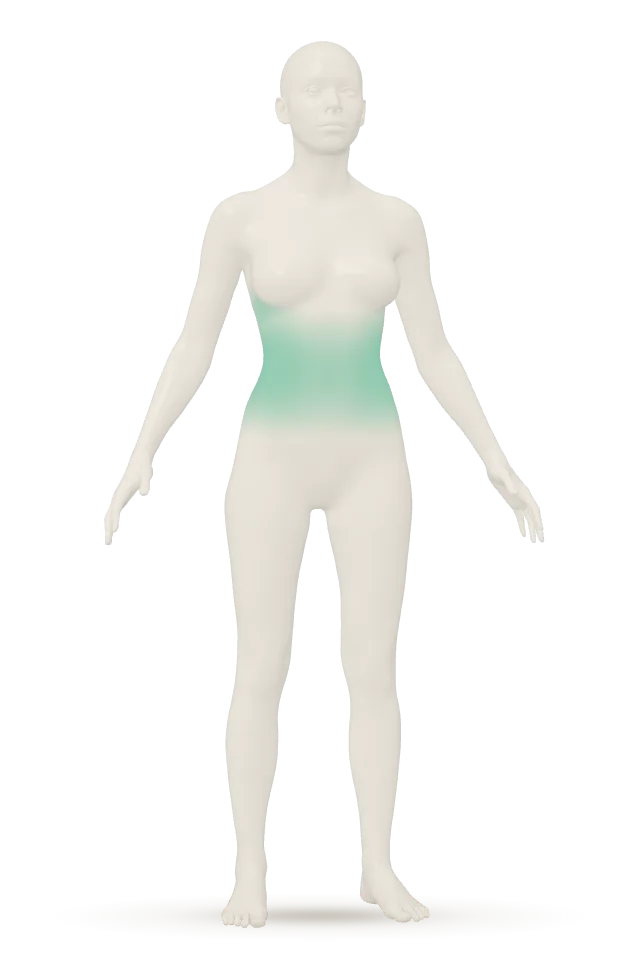
Appetite & metabolism
In people. In people it raises fullness and lowers hunger, with a small rise in fat burning.
An area lights for what a peptide is used for and what people report, with the evidence beside it. It isn’t a promise that it works there.
Week by week.
What to expect in the first 8 weeks
- Onset
- 1–2 weeks (appetite falls)
- Peak effect
- 12–24 weeks (weight loss in the trial)
- Duration
- 24 weeks in the trials; extension to about a year
Day 1–14RCT
Hunger turns down early
Tesofensine keeps noradrenaline, dopamine and serotonin active longer, and the first thing people notice is that food matters less. In a two-week trial, men felt fuller and lost weight even while trying to eat as usual. Commonly reported: dry mouth and lighter sleep in the first days.
The science
Sjödin 2010: 32 overweight or moderately obese men, 2.0 mg a day for 7 days then 1.0 mg for 7 days, against placebo, told to keep habitual intake and activity. Weight fell 1.8 kg more than on placebo (P<0.0001), with higher satiety and fullness ratings. Total 24-hour energy expenditure did not change; night-time expenditure was 4.6% higher and 24-hour fat oxidation 18 g higher (P<0.001). The doses were above the 0.25–0.5 mg later carried forward.
Sources- Sjödin et al. (2010)
Updated Nov 2026
Day 14–84RCT
Fullness peaks in the first months
Through the first three months, appetite stays down and weight comes off steadily. The heart rate rise is the side effect worth watching: in the main trial it averaged about 7 beats a minute at 0.5 mg.
The science
Gilbert 2012 (the phase 2 programme, 158 people in the randomized part): the composite satiety score rose with dose and was highest at week 12 (1.0 mg: 52 mm at baseline, 64 at week 12), and the week-12 rise tracked weight loss over 24 weeks (r = 0.36). Astrup 2008: heart rate +7.4 bpm at 0.5 mg (p = 0.0001); in the pooled Parkinson's and Alzheimer's trials heart rate rose 2.1 to 6.8 bpm across 0.125–1.0 mg with no blood pressure change (Astrup 2008, Obesity).
Sources- Gilbert et al. (2012)
- Astrup et al. (2008)
Updated Nov 2026
Any dayRCT
What tesofensine is built on
Tesofensine has strong phase 2 weight results and a clean abuse-potential study, but it is not approved anywhere, and the key trial's paper drew an expression of concern over how its side effects were reported. A phase 3 trial in Mexico is described by the developer but not published.
The science
Astrup 2008 (Lancet; 203 people, 24 weeks): at 0.5 mg, weight loss 9.2% greater than on diet and placebo, which lost 2.0%; The Lancet published an expression of concern in 2013 and the authors a letter, "Under-reporting of adverse effects of tesofensine". Schoedel 2010: in 52 recreational stimulant users, its effects on drug liking did not differ from placebo and were below amphetamine's. Saniona, Nov 2024: Mexico's regulator has not approved it; its pipeline page says Medix's phase 3 tested 0.25 and 0.5 mg. Lehr 2007: half-life about 234 hours.
Sources- Astrup et al. (2008)
- Schoedel et al. (2010)
- Lehr et al. (2007)
Updated Nov 2026
With Semaglutide and TirzepatideCommunity
Two appetite brakes at once
People add tesofensine to a GLP-1 for a second, brain-side brake on appetite. No study has tested the pair. Both slow hunger, and the GLP-1's nausea and tesofensine's dry mouth and heart-rate rise can add up, so the heart rate is the number to keep an eye on.
The science
No published trial combines tesofensine with a GLP-1 receptor agonist. Tesofensine acts on brain monoamines (noradrenaline, dopamine, serotonin); GLP-1 drugs act on gut-brain incretin signalling, a different route. Tesofensine raised heart rate in a dose-related way (Astrup 2008, both papers). The pairing is community practice.
Sources- Astrup et al. (2008)
Updated Nov 2026
After week 8
Day 84–180RCT
The appetite effect fades as weight falls
By six months the weight loss in the trial was large, but the fullness signal had faded back toward where it started. After stopping, appetite returned to baseline while the lower weight remained for a while; restarting brought the fullness back.
The science
Astrup 2008 (Lancet): after 24 weeks on a diet, weight fell 4.5%, 9.2% and 10.6% further at 0.25, 0.5 and 1.0 mg than on diet and placebo, which lost 2.0% (203 randomized, 79% completed). Gilbert 2012: at 1.0 mg the satiety score went from 64 mm at week 12 to 55 at week 24; after a 12-week drug-free period it was back at 50 mm despite a reduced weight (−7.2 kg), and rose to 56 mm on restarting (week 60).
Sources- Astrup et al. (2008)
- Gilbert et al. (2012)
Updated Nov 2026
Day 1 is the day you start it.
Phase 2 randomized trials and human pharmacology studies (2007–2012), and the developer's regulatory updates. The phase 3 run in Mexico is unpublished.
Moderate evidence
A typical run.
Run notes
- Cycle
- The trials dosed it daily without breaks for 14 to 24 weeks, with an open extension to about a year. Because of the ten-day half-life, levels take several weeks to build to steady state and several weeks to clear. In the phase 2 programme, the fullness effect faded by week 24 as weight fell, returned to baseline after stopping, and came back when the drug was restarted.Community practice — opinions vary. Not a clinical recommendation.
- Timing
- Once a day; taken in the morning in community practice, since insomnia is one of its most common side effects. The trials set no time of day.
- Route
- Oral tablet
- Stacks
- Semaglutide, Tirzepatide
Safety.
Common side effects
- Dry mouth
- Insomnia
- Nausea
- Constipation or hard stools
- Diarrhea
- Faster heart rate
Interactions
Interaction data in people are limited. It raises noradrenaline, dopamine and serotonin, so other drugs acting on those messengers (antidepressants, stimulants, MAO inhibitors) are the class worth raising with a clinician; the developer paired it with metoprolol, a beta-blocker, to blunt the heart-rate rise. Exposure was 62% higher in women with reduced kidney function. Discuss any prescription medications with your clinician.
Safety notes
Not approved by the FDA or any other regulator; in Mexico the developer's partner has applied for approval, a technical committee gave a favorable opinion in February 2023, and as of November 2024 no approval had been granted. Its human safety record is phase 2 trials of up to about a year. In the main obesity trial the most common side effects were dry mouth, nausea, constipation, hard stools, diarrhea and insomnia; at 0.25 and 0.5 mg blood pressure did not rise against placebo, but heart rate rose by 7.4 beats a minute at 0.5 mg, and heart rate climbed with dose in the Parkinson's and Alzheimer's trials too. In 2013 The Lancet published an expression of concern about that trial's paper, and its authors published a letter on under-reporting of its adverse effects. In a study in recreational stimulant users its abuse potential was no greater than bupropion's. It lingers: its half-life is about ten days, so side effects take weeks to clear after stopping. Banned in competition in sport (WADA 2026, S6.B stimulants). Discuss with your clinician.
Goes with.
One question at a time.
Questions people ask.
What is Tesofensine?
An oral appetite drug, not a peptide, that keeps three brain messengers (noradrenaline, dopamine and serotonin) active for longer. In a 24-week trial with a diet, 0.5 mg a day took off about 9% more body weight than the diet with placebo did (about 2%), mainly by making people feel full sooner. It is not approved anywhere, and its heart rate rise is the side effect to watch.
How is Tesofensine dosed in research?
The research range for Tesofensine is 0.25–0.5 mg, daily, with a 0.25 mg starting dose. Studied in research — not a recommendation.
How long does Tesofensine last?
The half-life of Tesofensine is ~234 hours, about 10 days (population PK in 320 patients; its active metabolite ~374 hours, Lehr 2007).
What do people report on Tesofensine?
Commonly reported on Tesofensine: A strong drop in appetite within the first week or two, dry mouth and poor sleep.
Is Tesofensine safe?
The research basis for Tesofensine is moderate: animal studies + some human data. Common side effects in the library: dry mouth, insomnia, nausea, constipation or hard stools, diarrhea and faster heart rate.
What does Tesofensine stack with?
Common stacks for Tesofensine: Semaglutide and Tirzepatide.
Research.
Reference.
- Cadence
Daily
- Half-life
~234 hours, about 10 days (population PK in 320 patients; its active metabolite ~374 hours, Lehr 2007)
- Research basis
●●
●ModerateAnimal studies + some human data
PepVault for iPhone
Track tesofensine in PepVault
Log each dose and keep your schedule and step-ups in one place.
7 days free on the yearly plan for new subscribers.
Reviewed How we check the library