Eloralintide Dosage, half-life & reference guide
Also known as LY3841136 · Elora
Reviewed 2 studiesEvidence: ModeratePublished by PepVault
A once-weekly amylin drug from Eli Lilly, built to copy the fullness hormone the pancreas releases with insulin, and to act on its receptor more selectively than cagrilintide does. In its 48-week phase 2 trial, average weight loss ran from about 9.5% on 1 mg to about 20% on 9 mg, against 0.4% on placebo.

- Studied range
- 1–9 mgstarting dose 3 mg
- How often
- Weekly
- Half-life
- ~14 days
- Evidence
- ●●
●Moderate - Route
- SubQ injection
Studied in research — not a recommendation.
How it works.
Once-weekly, long-acting agonist of the amylin receptor, the receptor for amylin, the fullness hormone the pancreas releases with insulin. Unlike cagrilintide, it is selective: it acts far more on amylin receptors than on the calcitonin receptor, a difference Lilly thinks may make it easier on the stomach. The idea is fewer calories through earlier fullness after meals rather than through the GLP-1 pathway. Its half-life of about 14 days keeps blood levels nearly flat across the week. Investigational, from Eli Lilly, in phase 3 since late 2025.
Commonly reported: In trials, fewer cravings, especially for sugar, and less food noise, with nausea and tiredness more likely on the higher doses. It is in phase 3 and not approved anywhere.
Half-life & active level
The half-life of Eloralintide is ~14 days (measured in people: phase 1 trials, Bhattachar 2026).
Here's how a typical Eloralintide schedule accumulates over four weeks (one-compartment estimate).
An estimate from the half-life above, not a measurement. See your own curve build live in the half-life calculator.

Model. Individual results vary.
PepVault for iPhone
Track eloralintide in PepVault
Log each dose, see how many doses are left in the vial, and keep your step-ups in one place.

7 days free on the yearly plan for new subscribers.
Where Eloralintide works.
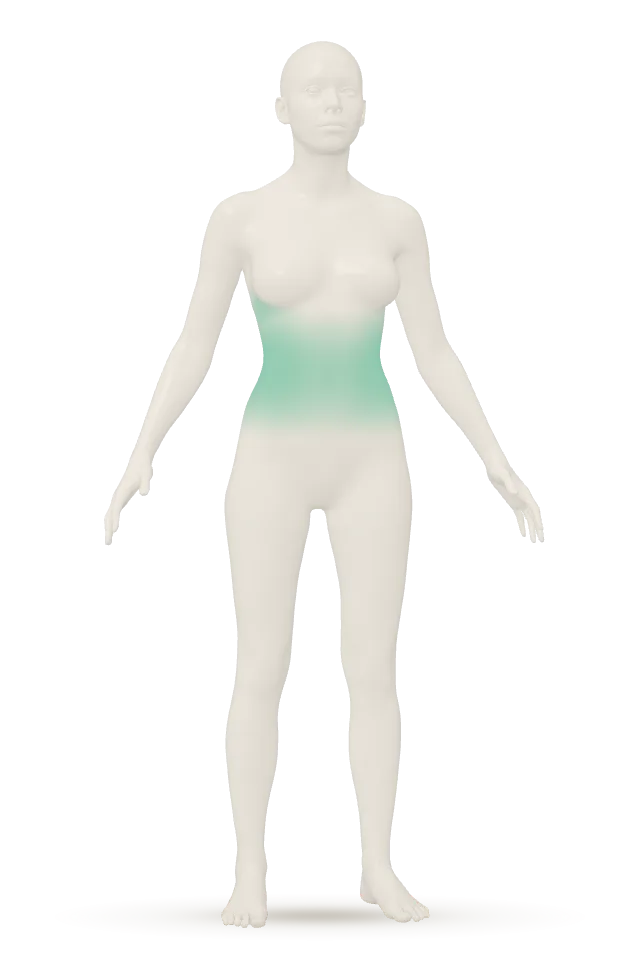
Appetite & metabolism
In people. In interviews at the end of the phase 2 trial, about 3 in 4 people said they had fewer cravings and half said food noise was quieter.
An area lights for what a peptide is used for and what people report, with the evidence beside it. It isn’t a promise that it works there.
Week by week.
What to expect in the first 8 weeks
- Onset
- Days–2 weeks
- Peak effect
- 48 weeks (phase 2 endpoint)
- Duration
- Ongoing
Day 1–28 · 3 mgRCT
Fullness first, gently
You're on 3 mg, where the slowest step-up in the phase 2 trial began. Commonly reported: feeling full sooner at meals and smaller portions. In that trial, side effects at 3 mg were close to placebo.
The science
Phase 2 (Billings 2025, Lancet; 263 adults without type 2 diabetes): the 3/6/9 mg arm took 3 mg for 4 weeks, 6 mg for 4 weeks, then 9 mg (NCT06230523). In the fixed 3 mg arm, nausea affected 13% vs 14% on placebo, and Lilly reported side-effect rates at 1 and 3 mg similar to placebo (Lilly, Nov-6-2025). The idea is amylin's fullness signal, acting through the brain after meals.
Sources- Billings et al. (2025)
- Lilly (phase 2 release) (2025)
Updated Nov 2026
Day 29–56 · 6 mgRCT
The step where nausea shows up
You're at 6 mg. In the phase 2 trial, nausea and tiredness became more common from 6 mg up, and a slower step-up kept them lower. Commonly reported: a few queasy days after the step, then steadier appetite control.
The science
Phase 2 nausea rates: 64% on fixed 6 mg (started at full dose) vs 25% in the 3/6/9 mg step-up arm and 14% on placebo; fatigue 29% on 6 mg vs 12% on placebo (Billings 2025). Lilly: the incidence of these events "were lower with slower dose escalation" (Nov-6-2025). The fixed 6 mg arm averaged −17.6% at 48 weeks.
Sources- Billings et al. (2025)
- Lilly (phase 2 release) (2025)
Updated Nov 2026
Any dayRCT
What Eloralintide is built on
A 12-week phase 1 trial, a 48-week phase 2 trial in the Lancet, and a phase 2b with tirzepatide. Phase 3 (the ENLIGHTEN trials) started in late 2025. It is not approved anywhere.
The science
Discovery and rat work: more amylin-receptor than calcitonin-receptor activity, and in rats less lean-mass loss than cagrilintide (Briere 2025, Mol Metab). Phase 1 (Bhattachar 2026; 100 adults, no step-up): dose-proportional exposure, a half-life of about 14 days, and up to 11.3% placebo-adjusted loss at 12 weeks on 12 mg. Phase 2 (Billings 2025; NCT06230523, sponsor Eli Lilly): −9.5% to −20.1% at 48 weeks vs −0.4%. Phase 3: ENLIGHTEN-1 (NCT07321886) and others, recruiting.
Sources- Briere et al. (2025)
- Bhattachar et al. (2026)
- Billings et al. (2025)
Updated Nov 2026
With TirzepatideRCT
Eloralintide with tirzepatide
Lilly is testing the two together as EloraTZP, amylin plus GIP and GLP-1. In a 48-week trial in type 2 diabetes, the top pair averaged about 23% weight loss vs about 15% on tirzepatide alone. Side effects were more common in the pairs, mostly while doses were stepping up.
The science
Phase 2b (NCT06603571; 367 adults with obesity and type 2 diabetes; separate injections): eloralintide 9 mg + tirzepatide 15 mg −23.3%, tirzepatide 15 mg −14.8%, eloralintide alone up to −12.3%, placebo −3.0%; A1C fell up to 2.9 points on the pair. Stopping for side effects: 10.8% to 27.0% on the pairs vs 2.9% on tirzepatide alone; Lilly plans a slower step-up in phase 3 (Lilly, Sep-30-2026; presented at EASD, not yet a paper).
Sources- Lilly (EloraTZP release) (2026)
Updated Nov 2026
After week 8
Day 57–336 · 6 mgRCT
Holding at 6 mg
Staying at 6 mg is a dose the trial tested on its own for the full 48 weeks. That group averaged about 17.6% weight loss, close to the 9 mg groups.
The science
Phase 2, efficacy estimand at 48 weeks: 6 mg −17.6% (−18.7 kg) vs −0.4% on placebo; 9 mg −20.1%; 6/9 mg −19.9%; 3/6/9 mg −16.4% (Lilly, Nov-6-2025; Billings 2025). Not adjusted for multiplicity, and the arms were small (24 to 54 people each).
Sources- Billings et al. (2025)
- Lilly (phase 2 release) (2025)
Updated Nov 2026
Day 57–336 · 9 mgRCT
The top dose tested
You're at 9 mg, the highest dose in the phase 2 trial. People on 9 mg averaged about 20% weight loss at 48 weeks. Tiredness was the side effect that rose most at this dose.
The science
Phase 2: 9 mg −20.1% (−21.3 kg) at 48 weeks vs −0.4% on placebo (efficacy estimand). Fatigue: 43% on 9 mg and 46% on 6/9 mg vs 12% on placebo; nausea 33% on 9 mg (Billings 2025). Posted results (NCT06230523) also list hair thinning in 6 of 54 on 9 mg and none on placebo.
Sources- Billings et al. (2025)
Updated Nov 2026
Day 85–336Clinical
Fewer cravings, quieter food noise
Commonly reported: sugar cravings and constant thoughts about food easing off. In interviews at the end of the phase 2 trial, about 3 in 4 people said they had fewer cravings and half said food noise was quieter.
The science
Participant exit interviews at 48 weeks (Lilly, ObesityWeek 2026 poster, release Nov-14-2026): 74% reported fewer cravings, especially for sugary foods; 52% less food noise; among those who drank alcohol at baseline, 41% reported drinking less. Self-reported interview data, not a measured endpoint.
Sources- Lilly (ObesityWeek release) (2026)
Updated Nov 2026
Day 337+Clinical
A long-term medicine, not a course
Worth knowing before you stop: with GLP-1 drugs, coming off usually means regaining most of the loss within about a year and a half. Eloralintide hasn't been tested in a stopping trial, so this is the pattern of other weight drugs. Continue, taper or stop is a call for you and your clinician.
The science
A BMJ meta-analysis found that after stopping semaglutide or tirzepatide, about 9.9 kg came back within the first year, with weight projected back to baseline about 1.5 years after stopping (West 2026). No withdrawal trial of eloralintide has been published.
Sources- West et al. (2026)
Updated Nov 2026
Day 1 is the day you start it.
Phase 1 (Bhattachar 2026), phase 2 RCT (Billings 2025, Lancet; NCT06230523 posted results), Lilly releases Nov-6-2025, Sep-30-2026 and Nov-14-2026. Investigational.
Moderate evidence
Mixing and a typical run.
Example numbers
Reconstitution example
Reconstitute a 10 mg vial of Eloralintide with 2 mL of bacteriostatic water and a 3 mg dose is 60 units on a U-100 syringe, about 3 doses per vial.
- Vial
- 10 mg
- Water
- 2 mL
- Amount
- 3 mg
Draw to60 units
1 mL insulin syringe · 100 units
Run notes
- Cycle
- Used continuously, once weekly, in its trials: 12 weeks in phase 1 and 48 weeks in phase 2; phase 3 runs about 75 weeks. No trial has tested stopping it.Community practice — opinions vary. Not a clinical recommendation.
- Timing
- Once weekly SubQ, same day each week, in its trials. The phase 2 trial tested fixed doses of 1, 3, 6 and 9 mg from the first shot, and two step-ups: 6 mg for 20 weeks then 9 mg, and 3 mg for 4 weeks, 6 mg for 4 weeks, then 9 mg. These are trial schedules, not an approved regimen.
- Route
- SubQ injection
- Stacks
- Tirzepatide, Semaglutide, Retatrutide
Safety.
Common side effects
- Nausea
- Fatigue
- Constipation
- Diarrhea
- Vomiting
- Decreased appetite
- Hair thinning
- Injection site reaction
Interactions
No interaction studies have been published. In the phase 1 trial, eloralintide slowed stomach emptying only a little after the first dose, and the effect faded with weekly dosing, so the authors expect less delay to oral medicines than with older amylin drugs; this still needs confirming. It is not a GLP-1, and Lilly is testing it on top of tirzepatide (EloraTZP), but the GI side effects add up in the pair. With insulin or a sulfonylurea, discuss glucose monitoring with your clinician.
Safety notes
Eloralintide has no label: it is still in trials. In the 48-week phase 2 trial, nausea affected 11% on 1 mg and 13% on 3 mg (about the same as 14% on placebo), and 25% to 64% on the higher doses; fatigue rose with dose to 43% to 46% at 9 mg vs 12% on placebo. Most of these were mild to moderate, and Lilly reported fewer of them with a slower step-up. The trial's posted results also list a slower heart rate (bradycardia) in a few people on 6 and 9 mg and none on placebo, and hair thinning in about 1 in 9 on 9 mg (6 of 54) and none on placebo. In Lilly's later trial in type 2 diabetes, 0% to 10.8% on eloralintide alone stopped for side effects. Long-term safety is not yet known. These are trial findings to review with your clinician.
Goes with.
One question at a time.
Mixing charts by vial size.
Questions people ask.
What is Eloralintide?
A once-weekly amylin drug from Eli Lilly, built to copy the fullness hormone the pancreas releases with insulin, and to act on its receptor more selectively than cagrilintide does. In its 48-week phase 2 trial, average weight loss ran from about 9.5% on 1 mg to about 20% on 9 mg, against 0.4% on placebo.
How is Eloralintide dosed in research?
The research range for Eloralintide is 1–9 mg, weekly, with a 3 mg starting dose. Studied in research — not a recommendation.
How long does Eloralintide last?
The half-life of Eloralintide is ~14 days (measured in people: phase 1 trials, Bhattachar 2026).
What do people report on Eloralintide?
Commonly reported on Eloralintide: in trials, fewer cravings, especially for sugar, and less food noise, with nausea and tiredness more likely on the higher doses. It is in phase 3 and not approved anywhere.
Is Eloralintide safe?
The research basis for Eloralintide is moderate: animal studies + some human data. Common side effects in the library: nausea, fatigue, constipation, diarrhea, vomiting, decreased appetite, hair thinning and injection site reaction.
What does Eloralintide stack with?
Common stacks for Eloralintide: Tirzepatide, Semaglutide and Retatrutide.
Research.
Reference.
- Cadence
Weekly
- Half-life
~14 days
~14 days (measured in people: phase 1 trials, Bhattachar 2026)
- Research basis
●●
●ModerateAnimal studies + some human data
PepVault for iPhone
Track eloralintide in PepVault
Log each dose, see how many doses are left in the vial, and keep your step-ups in one place.
7 days free on the yearly plan for new subscribers.
Reviewed How we check the library