Petrelintide Dosage, half-life & reference guide
Also known as ZP8396 · Petre
Reviewed 1 studyEvidence: ModeratePublished by PepVault
A once-weekly amylin drug from Zealand Pharma and Roche, a long-acting copy of the fullness hormone the pancreas releases with insulin. In its 42-week phase 2 trial, people lost about 8% to 10% of their weight at 28 weeks and up to about 10.7% by week 42, less than GLP-1 drugs but with GI side effects close to placebo apart from mild nausea.

- Studied range
- 1–9 mgstarting dose 0.6 mg
- How often
- Weekly
- Half-life
- ~10 days
- Evidence
- ●●
●Moderate - Route
- SubQ injection
Studied in research — not a recommendation.
How it works.
Long-acting analogue of human amylin, the fullness hormone the pancreas releases with insulin. Amylin receptor activation is thought to make the body more responsive to leptin, its satiety signal, so people feel full sooner. A fatty-acid chain binds it to albumin in the blood, giving a half-life of about 10 days. Zealand designed it to stay stable at neutral pH so it can be mixed with other peptides, and Roche is testing it with its own GLP-1 drug. Investigational, in phase 3 since September 2026.
Commonly reported: Feeling full sooner and smaller portions. It is in phase 3 and not approved anywhere.
Half-life & active level
The half-life of Petrelintide is ~10 days (measured in people: mean 213–257 h after SubQ doses, 239 h IV; Brændholt Olsen 2026).
Here's how a typical Petrelintide schedule accumulates over four weeks (one-compartment estimate).
An estimate from the half-life above, not a measurement. See your own curve build live in the half-life calculator.

Model. Individual results vary.
PepVault for iPhone
Track petrelintide in PepVault
Log each dose, see how many doses are left in the vial, and keep your step-ups in one place.

7 days free on the yearly plan for new subscribers.
Where Petrelintide works.
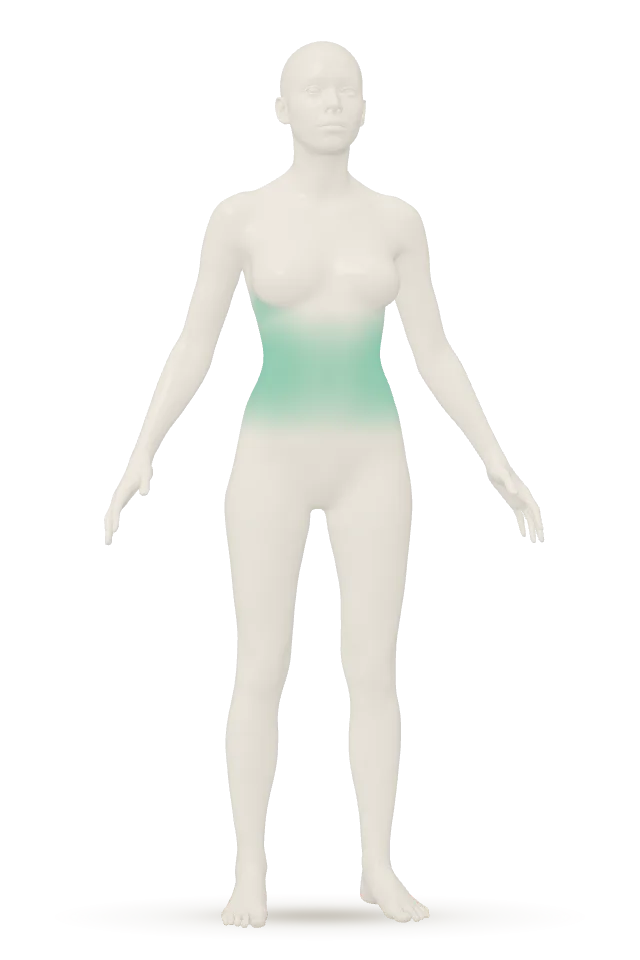
Appetite & metabolism
In people. In its 42-week phase 2 trial, people lost about 8% to 10% of their weight at 28 weeks and up to about 10.7% by week 42.
An area lights for what a peptide is used for and what people report, with the evidence beside it. It isn’t a promise that it works there.
Week by week.
What to expect in the first 8 weeks
- Onset
- Days–2 weeks
- Peak effect
- 42 weeks (phase 2, still falling)
- Duration
- Ongoing
Day 1–28RCT
Fullness, gently
Petrelintide's trials start low and step up every 4 weeks. Commonly reported: feeling full sooner at meals. In its phase 2 trial, mild nausea during the step-ups was the main side effect, and vomiting was no more common than on placebo.
The science
ZUPREME-1 (Garvey 2026, Lancet Diabetes Endocrinol; 485 dosed, 32 sites in Poland, Romania and the USA): nausea 20% vs 6% on placebo, vomiting 3% vs 6%, diarrhoea 7% vs 7%, constipation 7% vs 4%. Zealand: dose escalation every fourth week (Oct-7-2026). Amylin receptor activation is thought to restore sensitivity to leptin (Zealand, Oct-7-2026).
Sources- Garvey et al. (ZUPREME-1) (2026)
- Zealand Pharma (ZUPREME-2 release) (2026)
Updated Nov 2026
Day 29–294 · 2.5 mgRCT
Low doses already work
You're at 2.5 mg. In ZUPREME-1, the 1.0 and 2.5 mg groups both lost about 7.9% of their weight at 28 weeks, against 1.7% on placebo.
The science
ZUPREME-1, week 28 (efficacy estimand): −7.9% with 1.0 mg and −7.9% with 2.5 mg vs −1.7% on placebo (treatment differences −6.2% each).
Sources- Garvey et al. (ZUPREME-1) (2026)
Updated Nov 2026
Any dayRCT
What Petrelintide is built on
Two phase 1 trials, a 42-week phase 2 trial in the Lancet Diabetes & Endocrinology, and a phase 2 in type 2 diabetes. Roche and Zealand started phase 3 in 2026. It is not approved anywhere.
The science
Design: a human amylin analogue built for stability without fibrillation at neutral pH (Fischer Munch 2025, J Med Chem). Phase 1 SAD/MAD (Brændholt Olsen 2026): half-life 213 to 257 h SubQ, 77.4% bioavailability, up to −8.6% at 16 weeks. ZUPREME-1 (NCT06662539, sponsor Zealand Pharma, 32 sites). Phase 3: ZUPREME-3 (NCT07843498, ~3,900, without diabetes), ZUPREME-4 (NCT07843485, with diabetes), ZUPREME-5 (NCT07843472, with heart disease), sponsor Hoffmann-La Roche with Zealand.
Sources- Fischer Munch et al. (2025)
- Brændholt Olsen et al. (2026)
- Garvey et al. (ZUPREME-1) (2026)
Updated Nov 2026
With Semaglutide and TirzepatideCommunity
Petrelintide beside a GLP-1
Amylin and GLP-1 drugs work on appetite in different ways, which is why CagriSema pairs them. Roche plans a trial of petrelintide with its own GLP-1/GIP drug. Commonly reported: the pair adds fullness, and GI side effects add up too. No published trial has tested petrelintide with a GLP-1 yet.
The science
Zealand built petrelintide to be stable at neutral pH for co-formulation with other peptides (Zealand, Oct-7-2026). A phase 2 dose-finding trial with enicepatide (CT-388), ZYNERGY (NCT07589686, sponsor Hoffmann-La Roche), was not yet recruiting on Nov-18-2026. The pairing with semaglutide or tirzepatide comes from community practice.
Sources- Zealand Pharma (ZUPREME-2 release) (2026)
Updated Nov 2026
After week 8
Day 57–294 · 5 mgRCT
Five milligrams
You're at 5 mg. In ZUPREME-1, 5 mg gave the largest loss at 28 weeks, about 9.8%. The higher doses (7 and 9 mg) did about the same, so more was not better in this trial.
The science
ZUPREME-1, week 28: 5.0 mg −9.8%, 7.0 mg −9.3%, 9.0 mg −9.4% vs −1.7% on placebo (treatment differences −8.1%, −7.7%, −7.7%).
Sources- Garvey et al. (ZUPREME-1) (2026)
Updated Nov 2026
Day 85–294 · 9 mgRCT
The top dose tested
You're at 9 mg, the highest phase 2 dose. It averaged about 9.4% loss at 28 weeks, close to 5 and 7 mg. Commonly reported: steady fullness, with nausea most likely in the weeks after a step-up.
The science
ZUPREME-1, week 28: 9.0 mg −9.4% vs −1.7% on placebo; weight kept falling to week 42, with up to −10.7% across doses. In phase 1, escalating to 9.0 mg needed a dose hold in one person, and no serious or severe adverse events occurred (Brændholt Olsen 2026).
Sources- Garvey et al. (ZUPREME-1) (2026)
- Brændholt Olsen et al. (2026)
Updated Nov 2026
Day 85–294Clinical
With type 2 diabetes
In ZUPREME-2, people with type 2 diabetes lost about 7.4% to 9.2% of their weight at 28 weeks against 2% on placebo, and HbA1c fell by up to 0.65 points. Few stopped for GI side effects, about as many as on placebo.
The science
ZUPREME-2 (NCT06926842; 220 US adults on metformin ± an SGLT2 inhibitor; three doses, steps every 4 weeks for up to 16 weeks): −7.4% to −9.2% vs −2.0% (efficacy estimand); HbA1c −0.65% vs +0.23% (placebo-adjusted −0.61 to −0.88); GI discontinuation 1.9% vs 1.7% (Zealand topline, Oct-7-2026; not yet a paper).
Sources- Zealand Pharma (ZUPREME-2 release) (2026)
Updated Nov 2026
Day 197–294RCT
Weeks 28 to 42: still moving
In ZUPREME-1, weight kept coming down after the 28-week readout, reaching up to about 10.7% by week 42.
The science
ZUPREME-1: "Bodyweight continued to decline to week 42, with reductions of up to −10.7% with petrelintide" (placebo −1.7% at week 28).
Sources- Garvey et al. (ZUPREME-1) (2026)
Updated Nov 2026
Day 1 is the day you start it.
Phase 1 (Brændholt Olsen 2026, Diabetes Obes Metab), ZUPREME-1 (Garvey 2026, Lancet Diabetes Endocrinol; NCT06662539), Zealand release Oct-7-2026 (ZUPREME-2), ZUPREME-3/4/5 records on ClinicalTrials.gov. Investigational.
Moderate evidence
Mixing and a typical run.
Example numbers
Reconstitution example
Reconstitute a 10 mg vial of Petrelintide with 2 mL of bacteriostatic water and a 0.6 mg dose is 12 units on a U-100 syringe, about 16 doses per vial.
- Vial
- 10 mg
- Water
- 2 mL
- Amount
- 0.6 mg
Draw to12 units
0.3 mL insulin syringe · 30 units
Run notes
- Cycle
- Used continuously, once weekly, in its trials: 42 weeks in ZUPREME-1 and 28 weeks in ZUPREME-2, with steps every 4 weeks. No trial has tested stopping it.Community practice — opinions vary. Not a clinical recommendation.
- Timing
- Once weekly SubQ, same day each week, in its trials. Phase 2 stepped up every 4 weeks for up to 16 weeks to one of five maintenance doses (1.0, 2.5, 5.0, 7.0 or 9.0 mg); phase 1 started at 0.6 or 1.0 mg and stepped up every 2 weeks. These are trial schedules, not an approved regimen.
- Route
- SubQ injection
- Stacks
- Semaglutide, Tirzepatide
Safety.
Common side effects
- Nausea
- Decreased appetite
- Constipation
- Diarrhea
Interactions
No interaction studies have been published. Amylin can slow stomach emptying, which could change how quickly oral medicines are absorbed. It is not a GLP-1; beside one, the GI side effects can add up, and the pair has not yet been tested in a published trial. With insulin or a sulfonylurea, discuss glucose monitoring with your clinician.
Safety notes
Petrelintide has no label: it is still in trials. In the 42-week ZUPREME-1 trial, the most common side effect was nausea (20% vs 6% on placebo), mostly mild and during the step-ups; vomiting (3% vs 6%), diarrhea (7% vs 7%) and constipation (7% vs 4%) were about as common as on placebo, and there were no deaths. In the diabetes trial, 1.9% stopped for GI side effects vs 1.7% on placebo. Long-term safety is not yet known. These are trial findings to review with your clinician.
Goes with.
One question at a time.
Mixing charts by vial size.
Studies, in plain English.
Questions people ask.
What is Petrelintide?
A once-weekly amylin drug from Zealand Pharma and Roche, a long-acting copy of the fullness hormone the pancreas releases with insulin. In its 42-week phase 2 trial, people lost about 8% to 10% of their weight at 28 weeks and up to about 10.7% by week 42, less than GLP-1 drugs but with GI side effects close to placebo apart from mild nausea.
How is Petrelintide dosed in research?
The research range for Petrelintide is 1–9 mg, weekly, with a 0.6 mg starting dose. Studied in research — not a recommendation.
How long does Petrelintide last?
The half-life of Petrelintide is ~10 days (measured in people: mean 213–257 h after SubQ doses, 239 h IV; Brændholt Olsen 2026).
What do people report on Petrelintide?
Commonly reported on Petrelintide: feeling full sooner and smaller portions. It is in phase 3 and not approved anywhere.
Is Petrelintide safe?
The research basis for Petrelintide is moderate: animal studies + some human data. Common side effects in the library: nausea, decreased appetite, constipation and diarrhea.
What does Petrelintide stack with?
Common stacks for Petrelintide: Semaglutide and Tirzepatide.
Research.
Reference.
- Cadence
Weekly
- Half-life
~10 days
~10 days (measured in people: mean 213–257 h after SubQ doses, 239 h IV; Brændholt Olsen 2026)
- Research basis
●●
●ModerateAnimal studies + some human data
PepVault for iPhone
Track petrelintide in PepVault
Log each dose, see how many doses are left in the vial, and keep your step-ups in one place.
7 days free on the yearly plan for new subscribers.
Reviewed How we check the library