VK2735 Dosage, half-life & reference guide
Also known as VK-2735 · VK 2735
Reviewed 1 studyEvidence: ModeratePublished by PepVault
A weekly GLP-1 and GIP dual agonist from Viking Therapeutics, the same two-receptor approach as tirzepatide, also being tested as a daily tablet. In its 13-week phase 2 trial, people lost about 9% to 15% of their body weight depending on the dose, with no sign of levelling off.

- Studied range
- 2.5–17.5 mgstarting dose 2.5 mg
- How often
- Weekly
- Half-life
- ~9 days
- Evidence
- ●●
●Moderate - Route
- SubQ injection
Studied in research — not a recommendation.
How it works.
Once-weekly peptide that switches on both the GLP-1 and the GIP receptors, the same pair tirzepatide works through. A side chain stretches its half-life to about 7 to 10 days in people, long enough for weekly shots. The idea is the one tirzepatide proved: two incretin signals that curb appetite and food intake together. Viking also makes it as a daily tablet, the same molecule by mouth. Investigational, in phase 3 since June 2025.
Commonly reported: In trials, nausea and other GI effects early on, fading as the dose holds. It is in phase 3 and not approved anywhere.
Half-life & active level
The half-life of VK2735 is ~9 days (measured in people: 170–250 hours after single doses, Viking phase 1, 2023).
Here's how a typical VK2735 schedule accumulates over four weeks (one-compartment estimate).
An estimate from the half-life above, not a measurement. See your own curve build live in the half-life calculator.

Model. Individual results vary.
PepVault for iPhone
Track VK2735 in PepVault
Log each dose, see how many doses are left in the vial, and keep your step-ups in one place.

7 days free on the yearly plan for new subscribers.
Where VK2735 works.
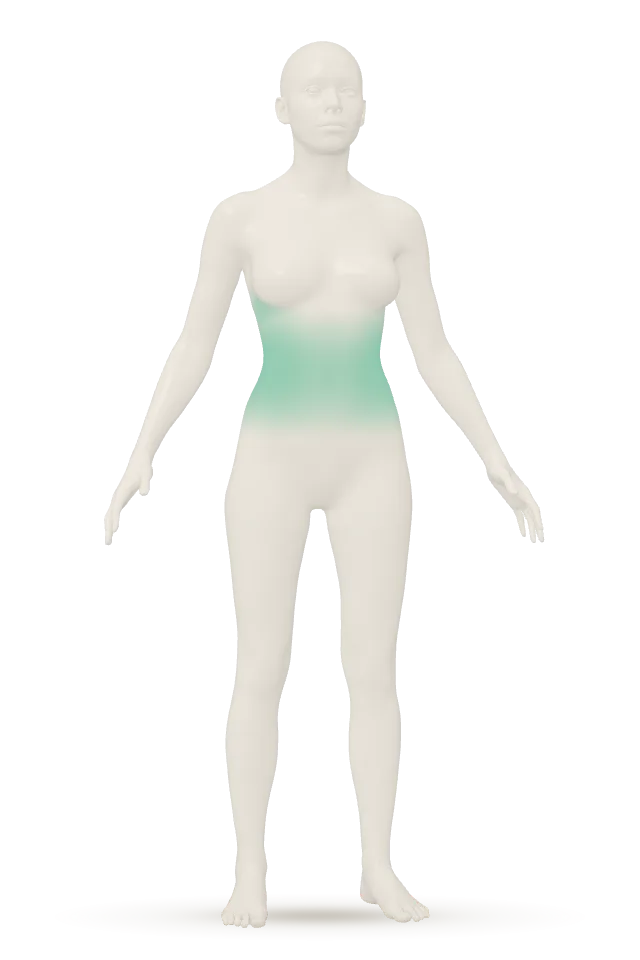
Appetite & metabolism
In people. In its 13-week phase 2 trial, people lost about 9% to 15% of their body weight depending on the dose, with no sign of levelling off.
An area lights for what a peptide is used for and what people report, with the evidence beside it. It isn’t a promise that it works there.
Week by week.
What to expect in the first 8 weeks
- Onset
- Days–2 weeks
- Peak effect
- 78 weeks (phase 3 endpoint, not yet read out)
- Duration
- Ongoing
Day 1–21 · 2.5 mgRCT
Low start, first weeks
You're on 2.5 mg, where most of the phase 2 trial began. Commonly reported: appetite dropping within days. In that trial, GI side effects came early and faded, and the group that skipped this start had the worst first-week nausea.
The science
VENTURE (Bays 2026, Obesity; 176 adults without diabetes): all groups started at 2.5 mg except the 15 mg group, which started at 5.0 mg; nausea was highest in that group's first week, and GI AEs "were generally observed early in the study and subsided over time". The authors: "The clear benefit of starting below 5.0 mg and titrating up has informed the phase 3 trial design".
Sources- Bays et al. (VENTURE) (2026)
Updated Nov 2026
Day 22–91RCT
The first 13 weeks
In the phase 2 trial, every dose took off weight quickly: about 9% on the lowest and 15% on the highest by week 13, against about 2% on placebo. Nearly everyone on the drug lost at least 5%.
The science
VENTURE week 13 (mITT, MMRM): 2.5 mg −9.1%, 5 mg −10.9%, 10 mg −12.9%, 15 mg −14.7% vs −1.7% on placebo (all p < 0.0001); 9.2 to 14.6 kg; 93% (130/140) reached at least 5% loss vs 12% (4/34) on placebo (Bays 2026). Viking reported no sign of a plateau at week 13.
Sources- Bays et al. (VENTURE) (2026)
Updated Nov 2026
Day 22–546 · 7.5 mgRCT
The lowest phase 3 dose
You're at 7.5 mg, the lowest of the three doses in the phase 3 trials. In phase 2, doses around here took off about 11% to 13% in 13 weeks. Commonly reported: appetite control holding, with GI effects quieter once the dose stays put.
The science
VANQUISH-1 and -2 randomize to 7.5, 12.5 or 17.5 mg weekly or placebo for 78 weeks (Viking, Oct-28-2026; NCT07104500, NCT07104383). VENTURE's neighbouring doses: 5 mg −10.9% and 10 mg −12.9% at week 13 (Bays 2026). Phase 3 results are expected after its primary completion (estimated Jul-2027).
Sources- Bays et al. (VENTURE) (2026)
- Viking (Q3 2026 update) (2026)
Updated Nov 2026
Day 43–546 · 12.5 mgRCT
The middle phase 3 dose
You're at 12.5 mg, the middle phase 3 dose. In phase 2, 10 mg and 15 mg took off about 13% and 15% in 13 weeks. GI side effects were more common at the higher doses, mostly early.
The science
VENTURE TEAEs, 10 mg vs 15 mg vs placebo: any GI 71% / 83% / 37%; nausea 37% / 63% / 20%; vomiting 17% / 29% / 0; stopped for an AE 11% / 20% / 0 (Bays 2026).
Sources- Bays et al. (VENTURE) (2026)
Updated Nov 2026
Day 43–546 · 17.5 mgClinical
The top phase 3 dose
You're at 17.5 mg, the highest phase 3 dose. In Viking's maintenance study, a group kept on 17.5 mg weekly reached about 22% average loss by week 33 and was still losing.
The science
Maintenance study Part 1 (180 adults with a BMI of 30 or more, no comorbidities; 21-week induction at 15 to 22.5 mg weekly, titrated every 2 weeks): week-21 loss about 16% to 19% vs about 0% on placebo; 98% reached 5%, 90% 10%, 65% 15% and 32% 20%. An exploratory group on 17.5 mg weekly through week 33 reached about 22% with no plateau (Viking, Oct-28-2026; topline, not yet a paper).
Sources- Viking (Q3 2026 update) (2026)
Updated Nov 2026
Any dayRCT
What VK2735 is built on
A phase 1 trial, a 13-week phase 2 trial of the shot, a 13-week phase 2 trial of the tablet, and a maintenance study. Two phase 3 programs are running: VANQUISH for the shot since 2025 and SUNRISE for the tablet since late 2026. It is not approved anywhere.
The science
Phase 1 SAD/MAD in Australia (NCT05203237): half-life 170 to 250 hours after single shots, up to 7.8% loss from baseline after 28 days (Viking, Mar-28-2023). VENTURE (Bays 2026; NCT06068946, sponsor Viking, 20 US sites). VENTURE-Oral (NCT06828055): up to 12.2% at 13 weeks on daily tablets, GI events similar to placebo (Viking, Oct-28-2026). Phase 3: VANQUISH-1 (NCT07104500, ~4,500, 78 weeks), VANQUISH-2 (NCT07104383, with type 2 diabetes); SUNRISE-1 and -2 (tablet: 27.5, 35 or 55 mg daily, 68 weeks).
Sources- Viking (phase 1 release) (2023)
- Bays et al. (VENTURE) (2026)
- Viking (Q3 2026 update) (2026)
Updated Nov 2026
With BPC-157Community
Why people add BPC-157 to a GLP-1
GI side effects come mostly early, and BPC-157, first studied as a stomach-protecting peptide, is added to ease them. Commonly reported: smoother first weeks. No trial has tested the pair.
The science
BPC-157's early research was on gastric protection in animal studies (Sikiric 2018 review). No trial has tested it alongside VK2735 or any GLP-1 drug; the pairing comes from community reports.
Sources- Sikiric et al. (2018)
Updated Nov 2026
After week 8
Day 150+Clinical
Holding the loss on fewer shots
Viking is testing whether a shot every other week or once a month can hold the loss. In its first maintenance study, people kept 82% to 97% of their loss over 12 weeks on the less frequent shots, against 61% on placebo. Continue, space out or stop is a call for you and your clinician.
The science
After 21 weekly doses, groups moved to every-other-week dosing (83% to 97% of the loss retained at week 33) or monthly dosing (82% to 90%) vs 61% after switching from 17.5 mg weekly to placebo (each p < 0.01); GI events in the maintenance period were low (Viking, Oct-28-2026). Part 2, with daily tablet options, is running. Topline only.
Sources- Viking (Q3 2026 update) (2026)
Updated Nov 2026
Day 1 is the day you start it.
Phase 1 (Viking release, Mar-28-2023), phase 2 VENTURE RCT (Bays 2026, Obesity; NCT06068946), Viking updates Feb-11-2026 and Oct-28-2026, VANQUISH records on ClinicalTrials.gov. Investigational.
Moderate evidence
Mixing and a typical run.
Example numbers
Reconstitution example
Reconstitute a 10 mg vial of VK2735 with 2 mL of bacteriostatic water and a 2.5 mg dose is 50 units on a U-100 syringe, about 4 doses per vial.
- Vial
- 10 mg
- Water
- 2 mL
- Amount
- 2.5 mg
Draw to50 units
0.5 mL insulin syringe · 50 units
Run notes
- Cycle
- Used continuously, once weekly, in its trials: 13 weeks in phase 2 and 78 weeks in phase 3. In Viking's maintenance study, people who switched after 21 weekly doses to a shot every other week or once a month kept most of their loss over the next 12 weeks; on placebo they kept about 61%.Community practice — opinions vary. Not a clinical recommendation.
- Timing
- Once weekly SubQ, same day each week, in its trials. VENTURE started at 2.5 mg (5 mg for its 15 mg group) and stepped up every 3 weeks to 5, 10 or 15 mg; phase 3 tests 7.5, 12.5 and 17.5 mg. The tablet is a daily dose in its own trials (27.5 to 55 mg in phase 3), not interchangeable mg for mg with the shot. These are trial schedules, not an approved regimen.
- Route
- SubQ injection
- Stacks
- BPC-157 (GI support)
Safety.
Common side effects
- Nausea
- Constipation
- Diarrhea
- Vomiting
- Acid reflux
- Fatigue
- Dry mouth
Interactions
No interaction studies have been published. GLP-1 drugs slow stomach emptying, which can change how oral medicines are absorbed. It is a GLP-1 drug itself, so it is not stacked with another one. With insulin or a sulfonylurea, discuss glucose monitoring with your clinician.
Safety notes
VK2735 has no label: it is still in trials. In the 13-week phase 2 VENTURE trial, GI side effects affected 51% to 83% across doses vs 37% on placebo, mostly mild or moderate, early, and fading over time; nausea was highest in the first week of the 15 mg group, the only one started at 5 mg instead of 2.5 mg. 9.1% stopped the drug for side effects (none on placebo), most often for nausea or vomiting. It is a GLP-1 drug, so the class warnings in GLP-1 labels (including pancreatitis, gallbladder disease and the rodent thyroid C-cell finding) are the ones to read. These are trial findings to review with your clinician.
Goes with.
One question at a time.
Compared with.
Mixing charts by vial size.
Studies, in plain English.
Questions people ask.
What is VK2735?
A weekly GLP-1 and GIP dual agonist from Viking Therapeutics, the same two-receptor approach as tirzepatide, also being tested as a daily tablet. In its 13-week phase 2 trial, people lost about 9% to 15% of their body weight depending on the dose, with no sign of levelling off.
How is VK2735 dosed in research?
The research range for VK2735 is 2.5–17.5 mg, weekly, with a 2.5 mg starting dose. Studied in research — not a recommendation.
How long does VK2735 last?
The half-life of VK2735 is ~9 days (measured in people: 170–250 hours after single doses, Viking phase 1, 2023).
What do people report on VK2735?
Commonly reported on VK2735: in trials, nausea and other GI effects early on, fading as the dose holds. It is in phase 3 and not approved anywhere.
Is VK2735 safe?
The research basis for VK2735 is moderate: animal studies + some human data. Common side effects in the library: nausea, constipation, diarrhea, vomiting, acid reflux, fatigue and dry mouth.
What does VK2735 stack with?
Common stacks for VK2735: BPC-157 (GI support).
Research.
Reference.
- Cadence
Weekly
- Half-life
~9 days
~9 days (measured in people: 170–250 hours after single doses, Viking phase 1, 2023)
- Research basis
●●
●ModerateAnimal studies + some human data
PepVault for iPhone
Track VK2735 in PepVault
Log each dose, see how many doses are left in the vial, and keep your step-ups in one place.
7 days free on the yearly plan for new subscribers.
Reviewed How we check the library