Cardiogen Dosage, half-life & reference guide
Also known as Ala-Glu-Asp-Arg · AEDR peptide
Reviewed Evidence: EmergingPublished by PepVault
A four-amino-acid peptide from the Russian bioregulator program, which its developers describe as a bioregulator for the heart. In rat heart tissue in the lab it made cells multiply and calmed a cell-death signal; in old rats it slowed a transplanted tumor through its blood supply. No human study has been published.

- How often
- Daily
- Half-life
- Unknown
- Evidence
- ●
●●Emerging - Routes
- SubQ, Oral capsules
No human study has tested a dose of Cardiogen: the amounts people run are their own protocol, not a reference.
How it works.
A tetrapeptide, Ala-Glu-Asp-Arg (AEDR), from Vladimir Khavinson's St. Petersburg bioregulator program, which its developers describe as the bioregulator of the heart. In heart tissue from young and old rats grown in the lab it made cells multiply and lowered p53, a protein that drives cells toward death, and in old rats with a transplanted sarcoma it slowed the tumor through the tumor's blood vessels rather than by poisoning its cells. Its developers place it with Vesugen among the peptides that act on the aging signals of heart and vessel cells. No human study of Cardiogen is indexed on PubMed.
Commonly reported: Little to feel; user reports are few.

PepVault for iPhone
Track cardiogen in PepVault
Log each dose, see how many doses are left in the vial, and keep your step-ups in one place.

7 days free on the yearly plan for new subscribers.
Where Cardiogen works.
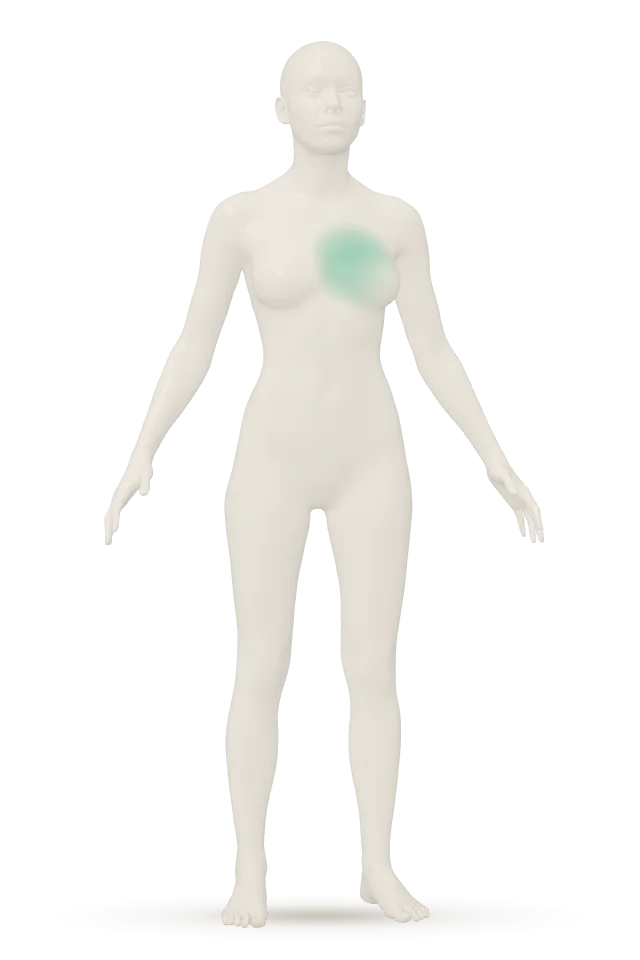
Heart & blood vessels
In the lab. In rat heart tissue in the lab it made cells multiply and calmed a cell-death signal.
An area lights for what a peptide is used for and what people report, with the evidence beside it. It isn’t a promise that it works there.
Week by week.
What to expect in the first 8 weeks
- Onset
- Not established (no human data)
- Peak effect
- Not established
- Duration
- Courses of about 10 days (community practice)
Day 1–10Community
Nothing in people to go on
Cardiogen has never been studied in people, so there is no human timeline to compare against. Commonly reported: little to feel; some redness where it goes in.
Updated Nov 2026
Day 10–60Animal
What the rat heart tissue showed
In heart tissue from young and old rats, grown in the lab, Cardiogen made cells multiply and lowered p53, a protein that pushes cells toward death. That is tissue in a dish; no study has looked at a heart in a person.
The science
Chalisova 2009: of 20 amino acids, 7 stimulated proliferation in young rat myocardial explants and 2 in old ones; the tetrapeptide Cardiogen at 10⁻¹² M stimulated proliferation strongly in both and lowered p53.
Sources- Chalisova et al. (2009)
Updated Nov 2026
Any dayAnimal
What Cardiogen is built on
A four-amino-acid peptide from the Russian bioregulator program, its peptide for the heart. Its evidence is rat heart tissue in the lab and one study of a tumor in old rats; there is no human study.
The science
Khavinson 2021 review (Table 5): AEDR, Cardiogen, regulation of cardiovascular function. Chalisova 2009: in organotypic myocardial explants from 3- and 24-month-old rats, Cardiogen stimulated proliferation in both and lowered p53. Zakutsky 2006: Cardiogen, Bronchogen, Prostamax and Pancragen each stimulated its own tissue in rat explant cultures. Levdik 2009: in old rats with M-1 sarcoma, dose-dependent slowing of tumor growth by hemorrhagic necrosis and apoptosis, through the tumor's vessels. Khavinson 2022 review: KED and AEDR among peptides regulating aging-signal molecules in cardiovascular cells.
Sources- Khavinson et al. (2021)
- Chalisova et al. (2009)
- Zakutsky et al. (2006)
- Levdik & Knyazkin (2009)
- Khavinson et al. (2022)
Updated Nov 2026
With VesugenCommunity
The heart and vessel pair
Cardiogen is often run with Vesugen, the program's vessel peptide, one for the heart and one for the vessel wall. Its developers group the two together in their review of heart and vessel aging; no study has given them together.
The science
Khavinson 2022: KED (Vesugen) and AEDR (Cardiogen) regulate the synthesis of molecules involved in inflammaging and the senescence-associated secretory phenotype of cardiovascular cells (a review). The pairing is community practice.
Sources- Khavinson et al. (2022)
Updated Nov 2026
Day 1 is the day you start it.
No human study of Cardiogen has been published. The effects come from rat studies and rat tissue cultures, almost all by its developers' circle.
Preliminary research
A typical run.
Run notes
- Cycle
- Run in short courses rather than continuously, like the other bioregulators: community courses run about 10 days, a few times a year. No study in people has tested a course length.Community practice — opinions vary. Not a clinical recommendation.
- Timing
- No timing has been studied.
- Routes
- SubQ injection, Oral capsules
- Stacks
- Vesugen
Safety.
Common side effects
- Injection-site redness or itch
Interactions
No interaction studies exist, including with heart and blood-pressure medicines.
Safety notes
No safety study exists: no human study of Cardiogen is indexed, so nothing is known about its side effects beyond user reports, or about long-term use. Discuss with your clinician before use, particularly during pregnancy or breastfeeding, or with any heart condition, which needs its own care.
Goes with.
One question at a time.
Compared with.
Questions people ask.
What is Cardiogen?
A four-amino-acid peptide from the Russian bioregulator program, which its developers describe as a bioregulator for the heart. In rat heart tissue in the lab it made cells multiply and calmed a cell-death signal; in old rats it slowed a transplanted tumor through its blood supply. No human study has been published.
How is Cardiogen dosed in research?
The library carries no reference dose for Cardiogen. No human study has tested a dose of Cardiogen: the amounts people run are their own protocol, not a reference.
How long does Cardiogen last?
The half-life of Cardiogen is unknown (never measured).
What do people report on Cardiogen?
Commonly reported on Cardiogen: little to feel; user reports are few.
Is Cardiogen safe?
The research basis for Cardiogen is emerging: primarily preclinical / limited human data. Common side effects in the library: injection-site redness or itch.
What does Cardiogen stack with?
Common stacks for Cardiogen: Vesugen.
Research.
Reference.
- Cadence
Daily
- Half-life
Unknown
Unknown (never measured)
- Research basis
●
●●EmergingPrimarily preclinical / limited human data
PepVault for iPhone
Track cardiogen in PepVault
Log each dose, see how many doses are left in the vial, and keep your step-ups in one place.
7 days free on the yearly plan for new subscribers.
Reviewed How we check the library