MariTide Dosage, half-life & reference guide
Also known as Maridebart cafraglutide · AMG 133 · AMG133 · Maridebart
Reviewed Evidence: ModeratePublished by PepVault
A once-a-month weight drug in development from Amgen: an antibody that blocks the GIP receptor, carrying two GLP-1 peptides that switch the GLP-1 receptor on. In its 52-week phase 2 trial, people without diabetes lost up to about 20% of their weight on average (about 16% counting everyone who stopped), and the curve had not flattened by the end.

- Studied range
- 21–420 mgstarting dose 21 mg
- How often
- Every 4 weeks
- Half-life
- ~15 days
- Evidence
- ●●
●Moderate - Route
- SubQ injection
Studied in research — not a recommendation.
How it works.
A once-monthly injection built in an unusual way: a full antibody that blocks the GIP receptor, with two GLP-1 peptides linked to it. So it turns the GLP-1 receptor on and the GIP receptor off, the opposite of tirzepatide on GIP; in Amgen's studies, the pair lowered body weight in mice, monkeys and people. The antibody backbone is what makes it last: its half-life in people is about 2 to 3 weeks, long enough for one shot a month or less. Investigational, from Amgen, in phase 3 since 2025.
Commonly reported: In trials, nausea and vomiting around the first doses, easing with a slower start. It is in phase 3 and not approved anywhere.
Half-life & active level
The half-life of MariTide is ~15 days (measured in people: 14–16 days for the active, peptide-carrying form and 21–24 days for the antibody overall; phase 1, Véniant 2024).
Here's how one MariTide dose rises and falls over four weeks (one-compartment estimate).
An estimate from the half-life above, not a measurement. See your own curve build live in the half-life calculator.
Your report
Taken MariTide? What did you notice?
One tap to start. About 30 seconds, no account.

Model. Individual results vary.
PepVault for iPhone
Track MariTide in PepVault
Log each dose, see how many doses are left in the vial, and keep your step-ups in one place.

7 days free on the yearly plan for new subscribers.
Where MariTide works.
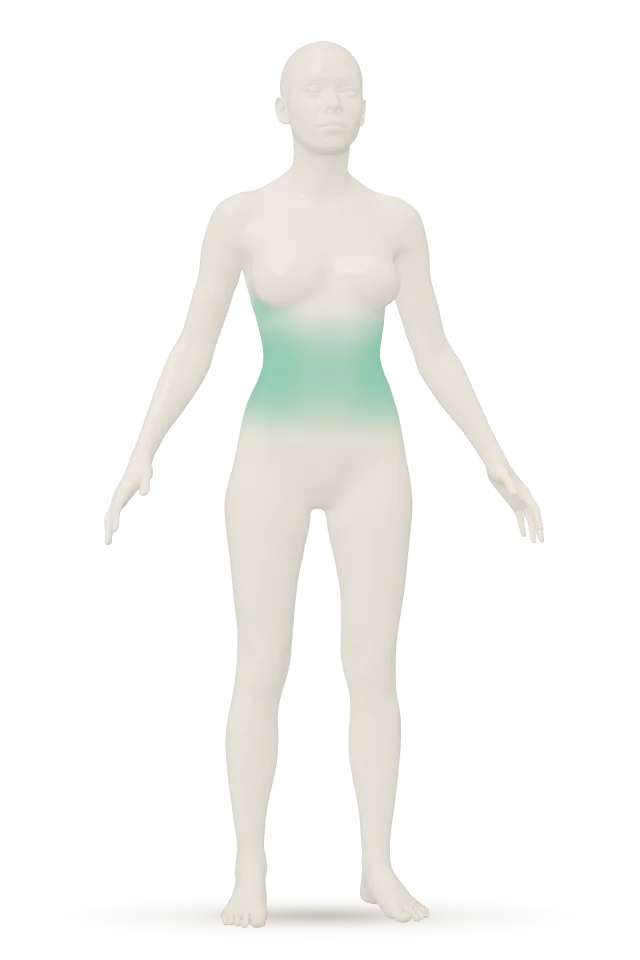
Appetite & metabolism
In people. In its 52-week phase 2 trial, people without diabetes lost up to about 20% of their weight on average.
An area lights for what a peptide is used for and what people report, with the evidence beside it. It isn’t a promise that it works there.
Week by week.
What to expect in the first 8 weeks
- Onset
- Days–2 weeks
- Peak effect
- 52 weeks (phase 2 endpoint, no plateau yet)
- Duration
- Ongoing
Day 1–56 · 21 mgClinical
A low start, on purpose
You're on 21 mg, the first step in Amgen's phase 3 trials. Amgen lowered the start after phase 2, where nausea and vomiting came mostly with the first doses. Commonly reported: a few queasy days after the first shot, then appetite settling lower.
The science
Phase 3 MARITIME weight trials start at 21 mg, then 35 mg, then 70 mg over 8 weeks before one of three target doses (Amgen, Jun-23-2025). In the phase 1 PK-LDI study (121 people), a 21 mg start followed by 70 mg and 350 mg had an overall vomiting rate of 24.4%, and no one stopped for GI side effects. In phase 2, GI events were less frequent with dose escalation and a lower starting dose (Jastreboff 2025).
Sources- Amgen (ADA release) (2025)
- Jastreboff et al. (2025)
Updated Nov 2026
Day 1–56 · 35 mgClinical
Second step
You're at 35 mg, the second step of the phase 3 start. Commonly reported: each step can bring back a few days of nausea, usually milder than the first. In phase 2, when nausea came it usually settled within about 6 days.
The science
In phase 2's step-up arms, nausea and vomiting were episodic and generally resolved within a median of about 6 days for nausea and 1 to 2 days for vomiting (Amgen, Nov-26-2024). A 35 mg start in the PK-LDI study had an overall vomiting rate of 22.5% (Amgen, Jun-23-2025).
Sources- Amgen (phase 2 topline) (2024)
- Amgen (ADA release) (2025)
Updated Nov 2026
Day 29–112 · 70 mgClinical
The last step before the target dose
You're at 70 mg, where the phase 3 step-up ends and phase 2's step-up groups began. From here the trials move to a monthly target dose. One shot now covers about a month, because the drug clears so slowly.
The science
Phase 2 step-up arms started at 70 mg and reached 420 mg over 4 or 12 weeks (Amgen, Jun-23-2025). In phase 1, the active form had a half-life of about 14 to 16 days and the antibody overall 21 to 24 days, with peak levels 4 to 7 days after a dose (Véniant 2024).
Sources- Amgen (ADA release) (2025)
- Véniant et al. (2024)
Updated Nov 2026
Any dayRCT
What MariTide is built on
A phase 1 trial, a 52-week phase 2 trial of 592 people in the New England Journal of Medicine with a second year, and a large phase 3 program that began in 2025. It is not approved anywhere.
The science
Discovery: a fully human anti-GIPR antibody conjugated to two GLP-1 analogue peptides; GIPR antagonism plus GLP-1 agonism lowered weight in mice and monkeys, and single and repeated doses lowered weight in people (Véniant 2024, Nat Metab; NCT04478708). Phase 2 (Jastreboff 2025, NEJM; NCT05669599, sponsor Amgen, 78 sites). Phase 3: MARITIME-1 (NCT06858839, 3,853 people, 72 weeks, primary completion estimated Jan-2027), MARITIME-2 (with diabetes), plus heart, heart failure and sleep apnea trials.
Sources- Véniant et al. (2024)
- Jastreboff et al. (2025)
Updated Nov 2026
With BPC-157Community
Why people add BPC-157 to a GLP-1
GI side effects come mostly with the first doses, and BPC-157, first studied as a stomach-protecting peptide, is added to ease them. Commonly reported: smoother first weeks. No trial has tested the pair.
The science
BPC-157's early research was on gastric protection in animal studies (Sikiric 2018 review). No trial has tested it alongside MariTide or any GLP-1 drug; the pairing comes from community reports.
Sources- Sikiric et al. (2018)
Updated Nov 2026
After week 8
Day 57–364 · 420 mgRCT
The top monthly dose tested
420 mg a month was the highest dose in phase 2. Across its doses, people without diabetes lost about 16% to 20% on average at 52 weeks if they kept taking it, and the weight was still coming down at the end.
The science
Phase 2 obesity cohort (465 people): −16.3% to −19.9% at week 52 vs −2.6% on placebo (efficacy estimand), and −12.3% to −16.2% vs −2.5% counting everyone regardless of stopping (treatment-policy estimand); doses 140, 280 or 420 mg every 4 weeks, 420 mg every 8 weeks, or 420 mg after a 4- or 12-week step-up (Jastreboff 2025; Amgen, Jun-23-2025). Amgen reported no plateau by week 52.
Sources- Jastreboff et al. (2025)
- Amgen (ADA release) (2025)
Updated Nov 2026
Day 85–364RCT
With type 2 diabetes too
People with type 2 diabetes often lose less on GLP-1 drugs. In the phase 2 diabetes group, MariTide took off up to about 17% of body weight at 52 weeks for those who kept taking it, and A1C fell by up to about 2 points.
The science
Phase 2 obesity-diabetes cohort (127 people; 140, 280 or 420 mg monthly, no step-up): −12.1% to −17.0% vs −1.4% on placebo (efficacy estimand), −8.4% to −12.3% vs −1.7% (treatment-policy); A1C −1.2 to −1.6 points (treatment-policy) and up to −2.2 points (efficacy estimand) vs +0.1 on placebo (Jastreboff 2025; Amgen, Jun-23-2025).
Sources- Jastreboff et al. (2025)
- Amgen (ADA release) (2025)
Updated Nov 2026
Day 365+Clinical
Year two: keeping it off on less
In the second year of phase 2, people who had lost at least 15% were moved to lower monthly doses or one shot every 3 months. Amgen reported that most kept their loss, with very little nausea. Continue, step down or stop is a call for you and your clinician.
The science
Phase 2 Part 2 re-randomized those with at least 15% loss at week 52 to placebo, 70, 140 or 420 mg monthly, or 420 mg every 12 weeks, for another 52 weeks. Amgen: "The large majority of participants maintained the weight loss achieved in Part 1 for an additional 52 weeks on a lower monthly dose or quarterly dose", with "a very low incidence of nausea and vomiting" (Feb-3-2026). Topline only: the numbers are not yet published.
Sources- Amgen (Q4 2025 results) (2026)
Updated Nov 2026
Day 1 is the day you start it.
Phase 1 (Véniant 2024, Nat Metab), phase 2 RCT (Jastreboff 2025, NEJM; NCT05669599), Amgen releases Nov-26-2024, Jun-23-2025 and Feb-3-2026, MARITIME records on ClinicalTrials.gov. Investigational.
Moderate evidence
A typical run.
Run notes
- Cycle
- Used continuously, every 4 weeks, in its trials: 52 weeks in phase 2 and 72 weeks in the phase 3 weight trials. In the second year of phase 2, people who had lost at least 15% were moved to lower monthly doses, a 420 mg dose every 12 weeks, or placebo, and Amgen reported that most kept their loss on the lower or quarterly doses.Community practice — opinions vary. Not a clinical recommendation.
- Timing
- One SubQ injection every 4 weeks in its trials; phase 2 also tested 420 mg every 8 weeks. Phase 3 steps up from 21 mg to 35 mg to 70 mg over 8 weeks before the target dose; phase 2 tested fixed 140, 280 and 420 mg monthly doses and two step-ups from 70 mg to 420 mg over 4 or 12 weeks. These are trial schedules, not an approved regimen.
- Route
- SubQ injection
- Stacks
- BPC-157 (GI support)
Safety.
Common side effects
- Nausea
- Vomiting
- Constipation
- Diarrhea
- Indigestion
- Bloating
Interactions
No interaction results have been published; Amgen has run studies of its effect on stomach emptying and on oral contraceptives (NCT07429032, NCT07523711). GLP-1 drugs slow stomach emptying, which can change how oral medicines are absorbed. It is a GLP-1 drug itself, so it is not stacked with another one. With insulin or a sulfonylurea, discuss glucose monitoring with your clinician.
Safety notes
MariTide has no label: it is still in trials. In its 52-week phase 2 trial, the most common side effects were GI (nausea, vomiting, constipation), mostly mild to moderate and mostly around the first doses. They were less frequent when the dose was stepped up and started lower, and in the step-up groups nausea, when it came, usually settled within about 6 days and vomiting within 1 to 2 days. About 11% in the step-up groups stopped for any side effect, and up to 7.8% for GI ones. Amgen reported no link to changes in bone density and no new safety signals, and tolerability in line with the GLP-1 class. It is a GLP-1 drug, so the class warnings in GLP-1 labels (including pancreatitis, gallbladder disease and the rodent thyroid C-cell finding) are the ones to read. These are trial findings to review with your clinician.
Goes with.
One question at a time.
Questions people ask.
What is MariTide?
A once-a-month weight drug in development from Amgen: an antibody that blocks the GIP receptor, carrying two GLP-1 peptides that switch the GLP-1 receptor on. In its 52-week phase 2 trial, people without diabetes lost up to about 20% of their weight on average (about 16% counting everyone who stopped), and the curve had not flattened by the end.
How is MariTide dosed in research?
The research range for MariTide is 21–420 mg, every 4 weeks (monthly), with a 21 mg starting dose. Studied in research — not a recommendation.
How long does MariTide last?
The half-life of MariTide is ~15 days (measured in people: 14–16 days for the active, peptide-carrying form and 21–24 days for the antibody overall; phase 1, Véniant 2024).
What do people report on MariTide?
Commonly reported on MariTide: in trials, nausea and vomiting around the first doses, easing with a slower start. It is in phase 3 and not approved anywhere.
Is MariTide safe?
The research basis for MariTide is moderate: animal studies + some human data. Common side effects in the library: nausea, vomiting, constipation, diarrhea, indigestion and bloating.
What does MariTide stack with?
Common stacks for MariTide: BPC-157 (GI support).
Research.
Reference.
- Cadence
Every 4 weeks
Every 4 weeks (monthly)
- Half-life
~15 days
~15 days (measured in people: 14–16 days for the active, peptide-carrying form and 21–24 days for the antibody overall; phase 1, Véniant 2024)
- Research basis
●●
●ModerateAnimal studies + some human data
PepVault for iPhone
Track MariTide in PepVault
Log each dose, see how many doses are left in the vial, and keep your step-ups in one place.
7 days free on the yearly plan for new subscribers.
Reviewed How we check the library
Track your progress
Watch it work.
Weight, waist and photos in one arc.
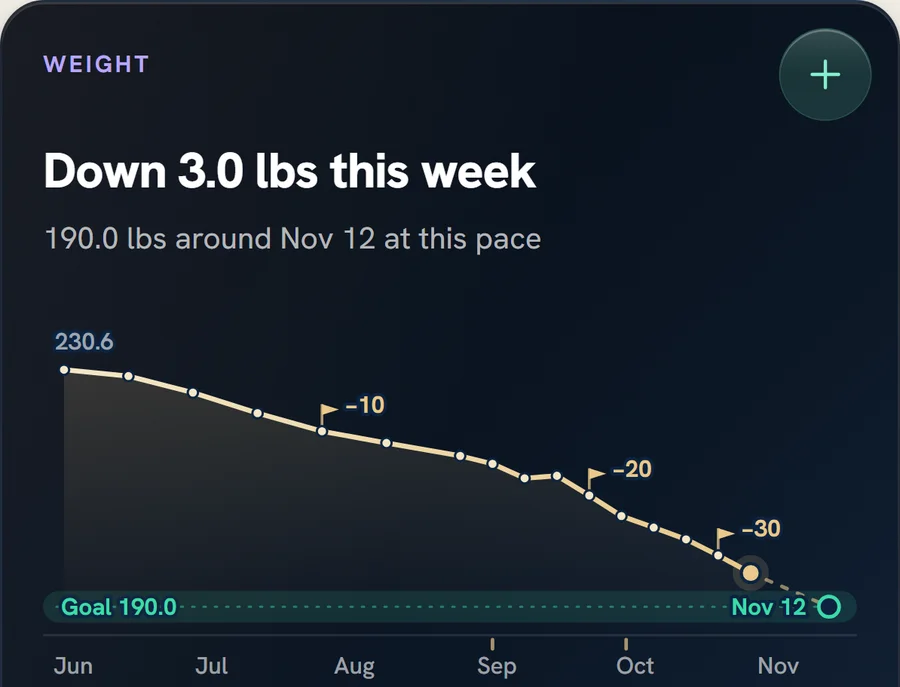

34.8 lbsdown since June